FANNIE MAE OWNS NOTHING–FANNIE MAE PDF

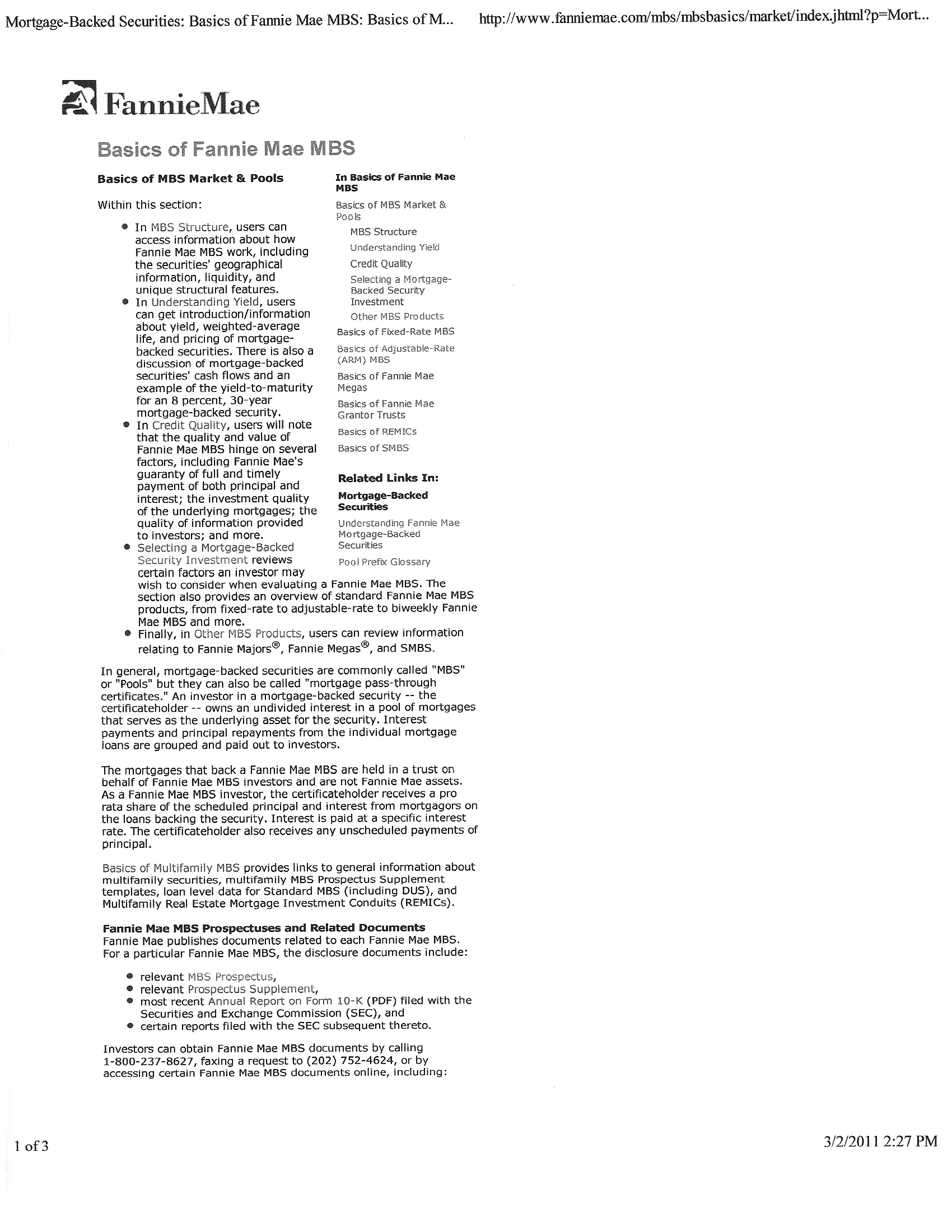
Reader and fellow Fannie fighter P Nach submitted this PDF of a Fannie Mae document which contains-right on page one– the statement that “The mortgages that back a Fannie Mae MBS are held in a trust on behalf of Fannie Mae MBS investors and are not Fannie Mae assets.”  P Nach requested that I post this, so here it is (thanks, P Nach!):

2012 02 06 Fannie Mae-Basics-of-MBS

The post “FANNIE MAE, BY ITS OWN ADMISSION, OWNS NOTHING” has also been updated with this PDF.

Posted in Debt, Fannie Mae, Financial Terrorism, Foreclosure | Tagged , , , , | 3 Comments

THE ADMISSION FANNIE MAE DOESN’T WANT YOU TO SEE

In researching my own lawsuit against Fannie Mae,  I ran across this stunning statement on a publicly-available Fannie Mae website (otherwise I wouldn’t have found it):

“The mortgages that back a Fannie Mae MBS are held in a trust on behalf of Fannie Mae MBS investors and are not Fannie Mae assets.”

I used it in my own lawsuit (to no avail, unfortunately) because Fannie Mae had claimed to be all of the following: the owner, holder, and investor of my note.  Yet here was an admission from Fannie itself, in plain language, that the “mortgages” (i.e., the promissory notes) are NOT Fannie Mae assets, which of course negates Fannie’s claim to be an owner, holder, or investor of ANYTHING.

By the time I wrote the post “FANNIE MAE, BY ITS OWN ADMISSION, OWNS NOTHING,” I was only able to find the admission in a PDF, again on a publicly-available Fannie website.  The link where I had first found the admission was dead, non-existent.  So I cut and pasted the statement from the Fannie PDF back in July 2013 when I wrote the post.

That post generated new interest in the past couple of days, and a reader named P Nach commented that the “not assets” admission was nowhere to be found in the link I used.  I checked it out, and sure enough, she was right!  In fact when I Googled “The mortgages that back a Fannie Mae MBS are held in a trust on behalf of Fannie Mae MBS investors and are not Fannie Mae assets” (in quotes), almost all I got were links to my own blog!   Apparently, this admission has been all but erased from the Internet!

Fortunately, in 2011, I printed out the admission from the Fannie website where I originally found it, then scanned that printout.  So below is the document containing the “not assets” admission that Fannie Mae would apparently not like anyone to see:

Fannie Website states notes not Fannie assets

So download this, print it out, pass it on.  And if we aren’t already, let’s all get in the habit of making screenshots of stuff like this, and/or downloading and printing them.  Shelley Erickson commented that she had also noticed documents being deleted.

Posted in Fannie Mae, Financial Terrorism, Foreclosure | Tagged , , , , , , , | 13 Comments

STRIKE THREE: BANKS SHOULD BE OUT (of the foreclosure business)

On Facebook, the excellent Shelley Erickson from Washington state just posted this bombshell article from MS Fraud:  “State AGs settle with LPS for $113 million; only nobody knew”.  It’s the latest proof that there are no original promissory notes in existence which a bank can use to foreclose or sue for a money judgment, even though those practices continue unabated.  Here’s the bombshell part:

In the 2007 (pre-crisis) certified Texas Supreme Court transcript of the “Meeting on Foreclosure Rules”, Michael Barrett (now deceased), of the Texas foreclosure-mill Barrett-Burke, Castle, Daffin & Frappier, admits that the mandated paperwork required to lawfully execute a foreclosure simply does not exist in 90% of the cases: 

So finding a document that says, “I am the owner and holder, and I thereby grant to the servicer the right to foreclose in my name” is an impossibility in 90 percent of the cases.” (transcript page 27, line 16) 

The remedy for when, as Mr. Barrett confirmed “There really isn’t such a document” (Page 27, line 8), was revealed by Judge Bruce Priddy (See State of Texas v. Judge Priddy D-1-GV-08-002311) when he added: 

They just create one for the most part sometimes, and the servicer signs it themselves saying that it’s been transferred to whatever entity they name as applicant”. (page 28, line 10) 

First American Title added: 

Well, the other problem — Judge, this is Tim Redding. The other problem that I see — and, Tommy, you and I talk about it regularly – that we have a bunch of servicers that are corporations or trusts attempting to foreclose on behalf of other trusts using a power of attorney, and I don’t think that’s really proper. I mean, we all kind of turn a blind eye to it, but I think that’s an issue that’s out there that somebody could use to potentially attack a foreclosure.  (p. 33, line 5)


So that’s strike one…

Strike two
Shelley pointed out that she has the transcript of a Washington state senate hearing at which Stu Halsan of the Washington Land Title Association said the following:

“You’re not gonna be able to change what Wall Street did with those securitizations of all these things.  And if you start requiring the original note that has been gone through I don’t know how many hands–but the collection is being done by a servicing company that we know–if you require that original note, none of you [i.e., the senators] will ever be able to sell your property.  You just won’t.”

Read all about that at Deadly Clear

Strike three

Then of course, there was the letter from the Florida Mortgage Banker’s Association to the Florida Supreme Court which admitted quite openly that the original promissory notes were destroyed as a matter of standard, routine practice:

The reason “many firms file lost note counts as a standard alternative pleading in the complaint” is because the physical document [i.e., the original note] was deliberately eliminated to avoid confusion immediately upon its conversion to an electronic file. See State Street Bank and Trust Company v. Lord, 851 So. 2d 790 (Fla. 4th DCA 2003). Electronic storage is almost universally acknowledged as safer, more efficient and less expensive than maintaining the originals in hard copy, which bears the concomitant costs of physical indexing, archiving and maintaining security. It is a standard in the industry [presumably not just in Florida, then] and becoming the benchmark of modern efficiency across the spectrum of commerce—including the court system.

Given all this, how can any judge anywhere let these banks continue to illegally foreclose? It’s exasperating, it’s crazy-making. We truly live in the Wild West, and one can completely understand Karl Denninger’s outrage that is leading him (and apparently others, according to the comments) to quit the entire illegal scheme altogether:

In 2007 I began writing The Market Ticker due to the outrageous conduct of various branches in the Administration and portions of the Capital Markets.  Endemic fraud in the financial system that had generated unbridled and outrageous credit creation threatened the collapse of our entire economic system.

The consequence of this should have been thousands of indictments, prosecutions and imprisonments — of banking executives, of members of Congress, of various executive branch officers in various agencies and more.  The banking system should have been forced to match assets to liabilities and either put up the margin to back their bets or liquidate them — and if that forced them out of business and collapsed asset prices by 90%, so be it.

Instead our government took the easy way out.  It doubled down on the fraudulent models of the past.

Posted in Asset Bubble, Conspiracy, Financial Terrorism, Foreclosure, MERS | Tagged , , , , , , , , , , | 7 Comments

THE BANK VS. YOU: ASYMMETRICAL WARFARE

Rarely does one hear the financial terrorism of the banks distilled with such clarity into a single paragraph…

Max Keiser (begins at 17:42):  If we look at the recent history of these financial predators going back 5 or 6 years, they were making these no-income, no-asset loans–NINJA loans–to people, really in a way that was completely asymmetric, if you will, in terms of their risk. Because the banks were able to sell that risk on whereas the homeowners accepted all the risk. They got these homeowners into enormous debt. Then all the banks decided, “You know what, we’re going to go into debt, we’re gonna have a banking crisis because we inflated a huge bubble.” Then they went in and they illegally foreclosed on these properties—they stole the property from these people that they fraudulently sold the mortgages to to begin with, trading on inside information against their clients as Goldman Sachs did. Now what you’re saying is, 5 or 6 years later, after basically throwing these people out in the street, they end up buying them for all cash, with money that they get at 0% interest rate. They charge them rent on people that were living there to begin with, and now they’re in a crisis again, which will probably lead to another bailout of the hedge funds like we saw with Long Term Capital Management. Is that about it?”

Michael Hudson (nodding in agreement during the entire breakdown above): That’s EXACTLY what’s happening, Max. You’ve got it.

We’ve been ZIRPed…

Posted in Asset Bubble, Debt, Debt Slavery, Financial Terrorism, Foreclosure, Keiser Report, Rent-seeking, Rentier, Wages, ZIRP | Tagged , , , , , , , , , , , , | Leave a comment

IT ALL COMES DOWN TO ASSETS VS. WAGES

As usual, Max Keiser very succinctly (and almost nonchalantly) pierces through the mumbo jumbo and hopium to the very essence of the crisis facing not only the U.S., but also the world (quote below starts at approximately 12:04 in the video above):

It’s a battle between assets and wages.  And wages are being sacrificed to pump up asset bubbles. Just like a game of musical chairs, when the bubble pops, a few people have a chair, they make money.  They’re the new winners, whether it’s Facebook or the Google guys…and then there are millions of people who are castigated into permanent poverty as a result of that.  They could very simply do the exact same thing, but for wage earners—and they would have a more equitable society.  But they’re rolling the dice, that society won’t rise up and have them all burned at the stake. And so far they’re winning.”

Quite well said. Keiser has also suggested tying the minimum wage to the money supply, since that is the only defense the wage-earner (i.e., the vast majority of people in the world) has against the inflation created by the QE, ZIRP, and bailouts given to the asset-holders (i.e., the very small minority of people in the world).

But wage-earners have been brainwashed that they should not only be happy with their pittance of a wage (when adjusted for inflation: “Median Family Income Is Lower Today Than In 1989“), but they should also be against any hike in the minimum wage because any increase in it only makes things cost more because the cost of it is passed on to the consumer.

Elizabeth Warren debunked that last point very effectively in this exchange from earlier this year:

WARREN: If we started in 1960 and we said that, as productivity goes up — that is, as workers are producing more — then the minium wage was going to go up the same. And if that were the case, the minimum wage today would be about $22 an hour. So my question, Mr. Dube, if the minimum wage is $7.25 an hour, what happened to the other $14.75? It sure didn’t go to the worker…

WARREN: During my Senate campaign, I ate a number 11 at McDonald’s many, many times a week. I know the price on that. $7.19. According to the data on the analysis of what would happen if we raised the minimum wage to $10.10 over three years, the price increase on that item would be about four cents. So instead of being $7.19 it would be $7.23. Are you telling me that’s unsustainable?

BUSINESS OWNER DAVID RUTIGLIANO: Senator Warren, not all restaurants are created equal. I’m in a full service restaurant business. McDonalds has efficiencies and they operate completely differently than I do. I have many jobs, many jobs that pay well above minimum wage. We have a retirement plan. We offer health insurance to our salaried employees. So my business is a little different. I can’t raise a four cent price. I mean I don’t have, I don’t operate like a fast food restaurant. I would hope you appreciate the distinction.

WARREN: I do appreciate the distinction and I’m not going to be in the business of being a McDonald’s representatives but they would talk about having some higher paid jobs and some opportunities for management and advancement as well. But I get your point, maybe it’s only four cents on $7.19. But if your entrees are $14.40 we’ll see how fast I can do the math — are you telling me you can’t raise your prices by eight cents?

RUTIGLIANO: You know, typically, when costs rise we don’t actually raise it just four cents, we might actually go a little higher. It has an inflationary effect on the economy, so, you may actually be taking away the money you just gave that employee, through the minimum wage increase on raised prices throughout the economy…

WARREN: I have to say, you’ve now switched your argument from what it was going to do to your business to what it’s going to do to the economy, and I think Dr. Dube, you’ve looked at the inflationary effects of increasing the minimum wage, can you just give us a quick summary on this data?

DR. DUBE: I think it is uncontroversial amongst economists that a minimum wage increase of this sort would not have a noticeable impact on the overall price level, because just the math doesn’t add up, the number of people aren’t getting the raises, there’s not enough for it to show up in some kind of a wage/price spiral, so the effects on the overall price level? Very small. (emphasis from Crooks and Liars, where it is worth watching the video of this exchange)

Further, what one never hears argued is the natural converse of the “minimum wage causes inflation” trope.  That is, no one ever suggests that if there was no minimum wage, then prices would go down.  And that, of course, is because prices would not go down if there were no minimum wage because minimum wage is not even close to being the biggest driving factor behind inflation.  But that’s a post for another day…

Posted in Asset Bubble, Financial Terrorism, Keiser Report, Wages | Tagged , , , , , , , , , , , | Leave a comment

“BARGAIN” COOKED UP IN THE FAKERY BAKERY

Smell that aroma?

Fraud Pie

It’s kinda foul, but some people–mostly judges and politicians–find it absolutely intoxicating.  It’s another fraud pie from the Fakery Bakery, where all the lies that keep us in servitude are cooked up.  It’s been brought out and set on the window for us all to smell and see it for what it is, and in this case, it’s Bank of New York Mellon (BONY) saying in an email that it doesn’t own a loan it wants to foreclose, even though BONY’s lawyers had previously told the homeowner that BONY did own the loan.

It’s all explained very concisely at the website of one Bill Paatalo, and the redacted email from BONY is there for all to see (hat tip to Living Lies).  Paatalo shows the QWR response in which this homeowner was told, in plain language, that the owner of her loan was “Bank of New York Mellon.”  The homeowner then contacted BONY about this matter, and BONY eventually sent her an email saying the exact opposite of what the QWR response said:

“She said that many people from Bank of America has [sic] informed her that she will have to contact Bank of New York Mellon  because it is showing us [i.e., BONY] as the owner.  We [BONY] are only the trustee for this loan and we cannot authorize any remodifications, foreclosures, or short sales.”

Now, I don’t know whether or not this case is in litigation.  It sure seems like it should be if it isn’t.  But rest assured, this startling and damning admission will not bring any harm to BONY, Bank of America, or any of the lawyers involved if and when this case is brought to trial.  They will simply be allowed to explain their way out of this glaring (and again, damning) contradiction, because judges LOVE fraud pie from the Fakery Bakery.

Question is, why do judges love that damn pie so much when everybody else knows it’s nasty, it’s rotten, and very bad for you?

The “Bargain”

In a very eye-opening, recent article, Janet Tavakoli explains why the banks and the financial system were bailed out but nobody was indicted or sent to jail (hat tip: Zero Hedge). Tavakoli states that on separate occasions, two Democrat sources close to the Obama regime told her the reason why no one has gone to jail:

“The administration made a bargain…it was better to let a lot of people get away scot free…

Oh, that’s why the judges love the smell and taste of fraud pie! They’re in on the “bargain!” You know who isn’t in on the bargain? You. Me. Everyone we know personally. Everyone we hang out with. Everyone that works where we work. In short, no one but the Obama regime is in on this “bargain.”

What is insane is that Tavakoli’s sources tell us only one part of the bargain, i.e., the banks get bailed out and let off the hook for any wrong-doing.  What’s the other part of the bargain?  What do we, the American people, get out of this bargain?  All we’ve gotten out of it so far is wealth confiscation, foreclosures, shit jobs, police state, more wars, more debt.  I’m thinking this ain’t such a good bargain.

The REAL Terms of The Bargain

Oh, but then one realizes–the “bargain” was never made between we, the people and the banks–the “bargain” was between the Obama/Bush regime and the banks.  The “bargain” is this: “Obama/Bush will bail out the banks and look the other way on all wrongdoing, and in exchange for doing so, you will take care of Obama/Bush and all their cronies for the rest of their natural lives.”  That’s the REAL bargain.

Tavakoli’s sources told her that a collapse in or crisis of confidence was the worst possible thing that could have ever happened, so they let the banks get away with defrauding the entire country and stealing people’s houses and putting an end to every aspect of the “American dream.”  Well, guess what?  The crisis of confidence is happening ANYWAY.  Nobody buys the banks’ bullshit anymore.  All the bargain did was put off the collapse for just a little longer, because collapse is mathematically inevitable and it is going to happen.  So the bargain was for nothing, from the perspective of everyone in the country except the banks and the government.

The One Consolation

I do take one consolation from knowing about the bargain, though, and that is this: I’m not crazy.  I always suspected there was a bargain, but still didn’t want to believe it–and that made me feel crazy.  Like when I and hundreds of thousands (millions?) of others sued the banks trying to take their houses and lost, despite the overwhelming evidence that the foreclosures shouldn’t take place–that made me feel crazy.  Now I at least know that yes, I did have an excellent case, it’s just that there’s this bargain, see, and if any one of us was able to win, well, that would kinda tend to undermine the bargain.  The biggest part of the bargain is that the banks don’t get held accountable for anything.  Oh, you and I sure as hell will have our property and livelihoods taken and be held “accountable” for “defaulting”–but there was no bargain struck over that.

In fact, the bank bargain more or less explicitly says that the people must lose and the banks must win.  Just like when Elizabeth Warren found out in questioning over the “Independent Foreclosure Review” that the government possessed concrete knowledge of bank criminality in regards to foreclosures and she asked if that knowledge would be passed on to homeowners so they could sue the banks.  She was of course told that there hadn’t been a decision about that at that time, and yada yada…But of course no one’s going to give the homeowners a weapon to fight the banks, that would violate the bargain!

So we were sold out.  No two ways about it.  What, my friends, do we do now?

Posted in Conspiracy, Foreclosure | Tagged , , , , , , , , , , , , , , , , , , , , , , , , , | Leave a comment

BABCOCK OBLITERATES MERS AND MERRILL SHERMAN

Watch this video and you will understand why they call George Babcock “The Law Dog.”  He tears MERS and Merrill Sherman a new one, with evidence for the world to see.    Check out my take on this here: https://libertyroadmedia.wordpress.com/2013/08/26/babcock-correct-sherman-should-not-be-special-master/


Posted in Foreclosure, MERS | Tagged , , , , , , , , , , , , , | Leave a comment

BABCOCK CORRECT: SHERMAN SHOULD NOT BE SPECIAL MASTER

The Law Dog, George Babcock, is having a tough time of it lately. He’s already been sanctioned once and likely faces more sanctions, according to posts on his Facebook page.

So why is a fierce homeowner advocate like Babcock getting the bum’s rush? Beside the fact that the question answers itself, one must look to a woman named Merrill Sherman, a former bank president who was appointed “Special Master” over several hundred foreclosure cases, many of them Babcock’s.  Babcock has been openly critical of Sherman for a number of reasons, but the latest and perhaps most despicable reasons were discussed by Babcock on his Facebook page recently.

Sherman: No known grounds for disqualification? Are you shitting me?

Sherman was appointed Special Master pursuant to Rule 53 of the Federal Rules of Civil Procedure, which states that:

A master must not have a relationship to the parties, attorneys, action, or court that would require disqualification of a judge under 28 U.S.C. §455, unless the parties, with the court’s approval, consent to the appointment after the master discloses any potential grounds for disqualification.”

But the judge’s order that made Sherman a Special Master required her to file an affidavit disclosing any possible conflicts with the requirements of Rule 53, and Sherman did in fact file such an affidavit, signed and notarized on January 5, 2012. In this affidavit, Sherman stated that “there are no known grounds for disqualification under 28 U.S.C. §455 that would prevent me from serving as the Special Master.”

Maybe that was true on January 5, 2012 (or maybe it wasn’t), but it doesn’t appear to be true now, because according to Forbes.com, Sherman currently owns 17,000 shares of Brookline Bancorp, Inc.  and Brookline Bank, Inc. is a member of MERS!   (Note: MERS search results cannot be linked here, but if one goes to the preceding link and enters the names of the entities herein, one finds that they are in fact MERS members).   That’s obviously very problematic because MERS is a party to any number of the consolidated cases over which Sherman is Special Master (the judge states as much in his order appointing Sherman Special Master). This fact would appear to put Sherman in violation of Rule 53, particularly because the language of the Rule precludes a “relationship” to the parties involved, which is a very broad category.

Indeed, Sherman’s “relationship” to MERS seems to be rather long-standing–she is a  former president of Bank Rhode Island,  which is also a MERS member.   And according to Business WeekSherman has been on the Board of Directors of Brookline Bancorp, Inc. (MERS member) since January 1, 2012, only four days before she signed an affidavit saying that she knew of no grounds for disqualification!  If being on the Board of Directors of an entity that is a member of a party to the litigation in question isn’t a “relationship” pursuant to Rule 53, pray tell what is?

So what are those grounds for disqualification? Here’s the text of 28 USC § 455—see for yourself just how many grounds Sherman does, in fact, appear to meet:

(a) Any justice, judge, or magistrate judge of the United States shall disqualify himself in any proceeding in which his impartiality might reasonably be questioned [Sherman’s impartiality can reasonably be questioned because of her stock ownership in a MERS member]

(b) He shall also disqualify himself in the following circumstances:
(1) Where he has a personal bias or prejudice concerning a party, or personal knowledge of disputed evidentiary facts concerning the proceeding;

(2) Where in private practice he served as lawyer in the matter in controversy, or a lawyer with whom he previously practiced law served during such association as a lawyer concerning the matter, or the judge or such lawyer has been a material witness concerning it;

(3) Where he has served in governmental employment and in such capacity participated as counsel, adviser or material witness concerning the proceeding or expressed an opinion concerning the merits of the particular case in controversy;

(4) He knows that he, individually or as a fiduciary, or his spouse or minor child residing in his household, has a financial interest in the subject matter in controversy or in a party to the proceeding, or any other interest that could be substantially affected by the outcome of the proceeding [again, Sherman has a financial interest because of her stock ownership in a MERS member];

(5) He or his spouse, or a person within the third degree of relationship to either of them, or the spouse of such a person:
(i) Is a party to the proceeding, or an officer, director, or trustee of a party;

(ii) Is acting as a lawyer in the proceeding;

(iii) Is known by the judge to have an interest that could be substantially affected by the outcome of the proceeding;

(iv) Is to the judge’s knowledge likely to be a material witness in the proceeding.

(c) A judge should inform himself about his personal and fiduciary financial interests, and make a reasonable effort to inform himself about the personal financial interests of his spouse and minor children residing in his household.

(d) For the purposes of this section the following words or phrases shall have the meaning indicated:
(1) “proceeding” includes pretrial, trial, appellate review, or other stages of litigation;

(2) the degree of relationship is calculated according to the civil law system;

(3) “fiduciary” includes such relationships as executor, administrator, trustee, and guardian;

(4) “financial interest” means ownership of a legal or equitable interest, however small, or a relationship as director, adviser, or other active participant in the affairs of a party, except that:
(i) Ownership in a mutual or common investment fund that holds securities is not a “financial interest” in such securities unless the judge participates in the management of the fund;

(ii) An office in an educational, religious, charitable, fraternal, or civic organization is not a “financial interest” in securities held by the organization;

(iii) The proprietary interest of a policyholder in a mutual insurance company, of a depositor in a mutual savings association, or a similar proprietary interest, is a “financial interest” in the organization only if the outcome of the proceeding could substantially affect the value of the interest;

(iv) Ownership of government securities is a “financial interest” in the issuer only if the outcome of the proceeding could substantially affect the value of the securities.

(e) No justice, judge, or magistrate judge shall accept from the parties to the proceeding a waiver of any ground for disqualification enumerated in subsection (b). Where the ground for disqualification arises only under subsection (a), waiver may be accepted provided it is preceded by a full disclosure on the record of the basis for disqualification.

(f) Notwithstanding the preceding provisions of this section, if any justice, judge, magistrate judge, or bankruptcy judge to whom a matter has been assigned would be disqualified, after substantial judicial time has been devoted to the matter, because of the appearance or discovery, after the matter was assigned to him or her, that he or she individually or as a fiduciary, or his or her spouse or minor child residing in his or her household, has a financial interest in a party (other than an interest that could be substantially affected by the outcome), disqualification is not required if the justice, judge, magistrate judge, bankruptcy judge, spouse or minor child, as the case may be, divests himself or herself of the interest that provides the grounds for the disqualification.

And therein lies Babcock’s problem—he’s pointing out that Emperor Sherman has no clothes, yet he’s being sanctioned for it. We all need to stand with the Law Dogs and share this info far and wide!

Posted in Foreclosure, MERS | Tagged , , , , , , , , , , , , , | 1 Comment

FANNIE MAE: “WE ARE NOT A CREDITOR” UNDER TILA

Last night I saw an incredible Facebook post by the Property Defense Network.  It was a link to a Fannie Mae “Lender Letter” that I at first didn’t see the date on and therefore assumed it was new.  The “Lender Letter” said this:

Although Fannie Mae is not a creditor under the Truth in Lending Act, after consultation with its regulator, the Federal Housing Finance Agency, Fannie Mae has elected to provide the notice to borrowers when it purchases or securitizes a mortgage loan. Fannie Mae will begin sending the notices on or before June 19, 2009 for loans acquired on or after May 20, 2009.”

I find this admission absolutely astonishing, not because I didn’t already know this, but because Fannie Mae put the admission in writing.  And it turns out that this “Lender Letter” was issued not in 2013, but on June 16, 2009!

Fannie “Mae” not be telling the truth

I would have definitely used this admission against Fannie Mae in my lawsuit against them if I had known about it.  But I didn’t know about it until now, a year and a half after I lost my lawsuit.  I doubt it would’ve made much difference to the judge that ruled against me, but who knows?

At any rate, to lessen the possibility that people will go into court or negotiations ignorant (as I was, at least about this admission) of what Fannie Mae openly admits about itself in publicly available documents, I intend to make Fannie Mae and its fake securitizations and empty pools a special research project of this blog.  Did that make any PRISM ears perk up?  Well, stay perky assholes, I’m just getting started.

Wait, what was that part about Fannie Mae not being a creditor?

Yes, so back to Fannie Mae saying it isn’t a creditor.  Notice that the letter specifies that Fannie is not a creditor “under the Truth in Lending Act.”  Very interesting distinction, that–naturally one wonders what the Truth in Lending Act (TILA)considers a “creditor,” doesn’t one?  Here is the relevant part of the TILA definition of “creditor”:

(l)  Creditor means a person who, in the ordinary course of business, regularly participates in a credit decision, including setting the terms of the credit. The term creditor includes a creditor’s assignee, transferee, or subrogee who so participates.

Now, that definition begs another question, namely, what is the standard, vanilla, legal definition of “creditor?”  Let us turn to Black’s Law Dictionary (2nd Ed.), which defines “creditor” as the following:

“A person to whom a debt is owing by another person, called the ‘debtor.'”

Hmmm…I think that second definition is most people’s understanding of what a “creditor” is.

So what does that all mean?

In short, then, we can see that Fannie Mae admits that it is NOT a creditor pursuant to TILA, leaving unspoken the idea that Fannie Mae IS a creditor in some other sense, presumably under the more standard definition of the word “creditor” cited above.  However, given several other publicly available statements by Fannie Mae, we can see that Fannie Mae is not a creditor in ANY sense of that word.

How can that be, one might understandably ask?  Here’s how, as I previously wrote in the post “Fannie Mae, By Its Own Admission, Owns Nothing”:


A PDF from Fannie Mae’s own website entitled “Basics of Fannie Mae MBS” explains Fannie Mae’s lack of ownership very simply and succinctly:

“In general, mortgage-backed securities are commonly called “MBS” or “Pools” but they can also be called “mortgage pass-through certificates.” An investor in a mortgage-backed security — the certificateholder — owns an undivided interest in a pool of mortgages that serves as the underlying asset for the security. Interest payments and principal repayments from the individual mortgage loans are grouped and paid out to investors.

The mortgages that back a Fannie Mae MBS are held in a trust on behalf of Fannie Mae MBS investors and are not Fannie Mae assets. As a Fannie Mae MBS investor, the certificateholder receives a pro rata share of the scheduled principal and interest from mortgagors on the loans backing the security. Interest is paid at a specific interest rate. The certificateholder also receives any unscheduled payments of principal.”

So from the above, we see that Fannie itself says that certificateholders–not Fannie–own the beneficial interest in the mortgage pool (Fannie says in other documentation that it can also purchase these types of certificates, although I haven’t seen any indication that Fannie smokes its own dope).  Even more importantly, we see that Fannie itself says that the mortgages (i.e., the promissory notes) that are supposedly in the pools/trusts are NOT Fannie assets.

The very definition of the term “asset” of course involves “ownership,” as spelled out at Investopedia’s definition of “asset,” which it defines as:

“A resource with economic value that an individual, corporation or country owns or controls with the expectation that it will provide future benefit.”

Therefore, Fannie admits it neither owns nor controls the promissory notes.  So if Fannie Mae itself admits that it does not own the notes and mortgages in the pools, why are Fannie’s goons swearing to Schack that Fannie does own them?

Some people may not be satisfied with such an admission in the text of a website meant to simplify matters.  OK, well how about these jewels from the ”Fannie Mae Amended and Restated 2007 Single-Family Master Trust Agreement for Guaranteed Mortgage Pass-Through Certificates evidencing undivided beneficial interests in Pools of Residential Mortgage Loans” dated January 1, 2009:

“By delivering at least one Certificate of a Trust in the manner described in Section 3.1, the Issuer [i.e. Fannie Mae] unconditionally, absolutely and irrevocably sets aside, transfers, assigns, sets over and otherwise conveys to the Trustee [i.e., Fannie Mae], on behalf of related Holders, all of the Issuer’s [Fannie Mae] right, title and interest in and to the Mortgage Loans in the related Pool, together with any Pool Proceeds.”

“Concurrently with the Issuer’s [Fannie Mae] setting aside, transferring, assigning, setting over and otherwise conveying Mortgage Loans to the Trustee for a Trust: (a) the Trustee [Fannie Mae]… acknowledges that it holds all of the related Trust Fund in trust for the exclusive benefit of the related Holders [of certificates issued by the Trust]…”

Note that Fannie Mae as Issuer irrevocably transfers all of its interest to Fannie as Trustee, and that Fannie Mae as Trustee says that it holds all the money in the trust for the exclusive benefit of the certificateholders.  So again, Fannie Mae admits it doesn’t own notes.

Fannie “Mae” be stealing your house!

So there you go–notes are not Fannie Mae assets because Fannie Mae irrevocably transferred the notes to the pools (or at least they say they did–more on that as it develops).  So Fannie Mae is not only not a creditor under TILA, Fannie Mae is not a creditor AT ALL, because they DON’T OWN THE NOTES. 

Oh, they’ll swear up and down in court that they own the notes, while simultaneously telling the investors in the supposed “pools” of loans that the investors own the notes, not Fannie Mae.  See how that works?  It’s the classic con tactic–know your audience, and then tell them what they want to hear, whether it’s true or not.  And don’t be afraid to tell your audience completely conflicting stories, just make sure you tell them with the utmost conviction and a few sworn affidavits from people with no personal knowledge.

Posted in Fannie Mae, Foreclosure | Tagged , , , , , , , , , , , , | 3 Comments

CALLING OUT THE JUDGES: AMICUS BRIEF IN MARTINS V. BAC

Recently became aware of this amicus curiae brief (link at bottom of this post) in the appeal of the case of Ashley Martins v. BAC Home Loans Servcing, LP; Federal National Mortgage Association (appeal # 12-20559).  I wrote about this horrible appellate decision back in May, and said the following:

“Well, nice try geniuses, but the wording of Kirby and all the cases it cites do not have an exception for MERS.  In other words, Kirby and Carpenter do not say that mortgages can be assigned separate from the note under certain circumstances.  They say that assignments of mortgages separate from the note are a nullity, end of story.  Period.  No exceptions.

And why do they say that?  Because the note and mortgage are inseparable, but even though that is the case, the mortgage is only an afterthought to the note and the note is to be considered superior to the mortgage.  That is, the mortgage is not the issue, the note is.

And I should point out that the 5th Circuit cites to some recent Texas cases which incredibly say that the note and the mortgage are separate obligations.  However, this misguided notion obviously flies in the face of what earlier Texas courts (as discussed above) have said, and when this misguided notion is brought before the 5th Circuit, it is the duty and obligation of the 5th Circuit to refute such nonsense, particularly when the 5th Circuit itself has already ruled–i.e. established binding precedent–that the note and mortgage are inseparable.  In fact, the 5th Circuit has tied its own hands regarding matters such as these, particularly in the case of FDIC v. Abraham (5th Cir., 1998).”

The Rogers/Casey brief NAILS IT!

Stephen Casey (whom I do not know) and David Rogers (with whom I have had a few great discussions) wrote up an amicus curiae brief in an attempt to get the 5th Circuit to hold an en banc rehearing, vacate the panel’s horrible decision, and reverse the district court.  In other words, it’s kind of a motion for reconsideration at the appellate level.  Casey and Rogers also ask that, if the 5th Circuit prefers to keep endorsing and allowing blatant fraud to continue (which is my guess as to what the outcome will be), maybe the 5th Circuit could certify questions on these matters to the Texas Supreme Court.

It’s a great read, and it really takes the 5th Circuit judges back to law school.  It even manages to get in the great work recently done against MERS by Judge Nelva Gonzales Ramos in the Nueces County v. MERS case.

The brief really gets to the heart of the problem, which is this: JUDGES ARE NOT FOLLOWING THE LAW.  Simple as that.  That’s why we’re not seeing massive victories for homeowners.  Oh, the judges make it appear that they’re following the law, but they clearly aren’t, which Casey and Rogers make abundantly clear.  If you don’t have the time or the inclination to read the whole brief, the “Summary of the Argument” quoted below will give you the gist:

“1. In this case, the panel articulates fundamental principles of law, but does not follow them.

2. The panel articulates the principles set forth by the United States Supreme Court in Carpenter v. Longan that a lien is incident to a debt, and that when a debt is transferred, the lien transfers with it, but an attempt to transfer the lien without the debt is a nullity, and transfers nothing. But the panel expressly repudiates the Supreme Court, and does not follow the articulated principle.

3. The panel articulates the principle, found in Texas Jurisprudence, 3d Deeds of Trust and Mortgages that “any attempt to assign or transfer [a mortgage] apart from the debt is a nullity,” but expressly repudiates the authority of Texas   Jurisprudence, and does not follow the articulated principle.

4. The panel articulates the principle of the Texas Property Code’s definitions, but does not follow the articulated principles.

5. This Brief amplifies two points the Appellants make in their brief. First, this Brief argues that the panel opinion erred in its presentation of Texas law regarding the nature of promissory note and deed of trust transfers, overturning over a  century of unchanged Texas law and federal law both from this Court and the United States Supreme Court.

The panel opinion, in effect, lets the “tail wag the dog” by suggesting that assignment of a deed of trust has any effect on a promissory note. Second, the Brief argues that MERS’ role within the mortgage foreclosure process has been confused by a failure to follow basic legal definitions within the foreclosure context. MERS is allowed under statute to serve as a mortgagee, but such potential of action does not mean MERS, when listed as “beneficiary” on a deed of trust, is in fact necessarily designated as a mortgagee.

The relevant statute is permissive, not mandatory, and has been misconstrued by the panel. Additionally, the panel has conflated the traditional common law definition of mortgagee, and the powers attendant thereon, with the new Texas  statutory definition of mortgagee, which is both broader and more limited than the common law, traditional definition. In making these errors, the panel has disrupted the balance of interests, powers and rights painfully negotiated over more than a century and half between lenders and borrowers, homeowners, trustees, and thirdparty servicers and recording organizations. The error of the panel threatens the  predictable flow of commerce and the certainty of contract and property rights for 22 million Texans.”

Download/read the brief yourself: Amicus Brief –David Rogers

Posted in Fannie Mae, Foreclosure, MERS | Tagged , , , , , , , , , , , | Leave a comment