SO EITHER THE NOTICE OF SALE OR THE DEED OF TRUST IS BS…

…that’s what this substitute trustee’s notice of sale in a Mississippi newspaper seems to say.

Here’s the ad (I’d link to it, but it will be gone by the end of the day):

Substitute Trustee’s Notice of Sale STATE OF MISSISSIPPI COUNTY OF Forrest WHEREAS, on the 17th day of October, 2007, and acknowledged on the 17th day of October, 2007, Lynda L. McCann, executed and delivered a certain Deed of Trust unto Recon Trust Company, NA, Trustee for Mortgage Electronic Registration Systems, Inc., as nominee for Countrywide Bank, FSB, Beneficiary, to secure an indebtedness therein described, which Deed of Trust is recorded in the office of the Chancery Clerk of Forrest County, Mississippi, in Book 1602 at Page 0507 Instrument# 126494; and WHEREAS, on the 12th day of November, 2013, Mortgage Electronic Registration Systems, Inc., as nominee for Countrywide Bank, FSB, assigned said Deed of Trust unto Bank of America, N.A., by instrument recorded in the office of the aforesaid Chancery Clerk in Book 1934 at Page 0178 Instrument# 713620; and WHEREAS, on the 27th day of January, 2014, the Holder of said Deed of Trust substituted and appointed Michael Jedynak by instrument recorded in the office of the aforesaid Chancery Clerk in Book 1943 at Page 0227 Instrument# 715929; and WHEREAS, default having been made in the payments of the indebtedness secured by the said Deed of Trust, and the holder of said Deed of Trust, having requested the undersigned so to do, on the 21st day of March, 2014, I will during the lawful hours of between 11:00 a.m. and 4:00 p.m., at public outcry, offer for sale and will sell, at the Northeast main door of the Forrest County Courthouse, Paul B. Johnson, Jr. Chancery Facility, which Chancery Facility is located at 641 Main Street at Hattiesburg, Mississippi, for cash to the highest bidder, the following described land and property situated in Forrest County, Mississippi, to-wit: Commence at a found 4 x 4 concrete monument at the Northeast corner of the Southeast 1/4 of the Southwest 1/4 of Section 31, Township 2 North, Range 12 West, Forrest County, Mississippi and run S 89 degrees 48 minutes 13 seconds West for 164.77 feet to a 3 inch round concrete monument; thence run S 01 degree 07 minutes 32 seconds West for 656.87 feet to a 1/2 inch rebar and the Point of Beginning. From the Point of Beginning continue S 01 degree 07 minutes 32 seconds West for 661.23 feet to a 2 inch iron pipe; thence run S 89 degrees 39 minutes 49 seconds West for 165.88 feet to a 1/2 inch rebar; thence run N 01 degree 09 minutes 06 seconds for 47.49 feet to a 1/2 inch rebar on the North margin line of J.B. Horne paved public road; thence run on and along said margin line N 46 degrees 16 minutes 57 seconds West for 27.16 feet to a 1/2 inch rebar; thence run North 1 degree 09 minutes 06 seconds for 595.95 feet to a 1/2 inch rebar; thence run East for 185.56 feet back to the Point of Beginning. Said parcel of land is a part of the SE 1/4 of the SW 1/4 of Section 31, Township 2 North, Range 12 West, Forrest County, Mississippi and contains 2.79 acres, more or less. Description of 20.0 foot Easement: Commence at a found 4 inch x 4 inch concrete monument at the Northeast corner of the Southeast 1/4 of the Southwest 1/4 of Section 31, Township 2 North, Range 12 West, Forrest County, Mississippi and run S 89 degrees 48 minutes 13 seconds West for 164.77 feet to a 3 inch round concrete monument; thence run S 89 degrees 53 minutes 39 seconds West for 185.26 feet to a 1/2 inch rebar; thence run S 01 degree 09 minutes 06 seconds West for 656.53 feet to a 1/2 inch rebar and the Point of Beginning. From the Point of Beginning run East for 20.00 feet to a 1/2 inch rebar; thence run S 01 degree 09 minutes 06 seconds West for 614.72 feet to a 1/2 inch rebar on the North margin line of J.B. Horne paved public road; thence run on and along said margin line N 46 degrees 16 minutes 57 seconds West for 27.16 feet to a 1/2 inch rebar; thence run N 01 degree 09 minutes 06 seconds East for 595.95 feet back to the Point of Beginning. Said Easement is Part of the SE 1/4 of the SW 1/4 of Section 31, Township 2 North, Range 12 West, Forrest County, Mississippi and contains .28 acre, more or less. AND One 1998 Horton 27 x 52 Manufactured Home Serial Number H150850GLR which is affixed and attached to the land as real property. 1998 Horton 27 x 52 Manufactured Home I will only convey such title as is vested in me as Substitute Trustee. WITNESS MY SIGNATURE, this 24th day of February, 2014. Michael Jedynak Substitute Trustee 855 S Pear Orchard Rd., Ste. 404, Bldg. 400 Ridgeland, MS 39157 (318) 330-9020 /F14-0034 PUBLISH: 2-28-14 / 3-7-14 / 3-14-14
 

Notice the bold passage above–it lists all the typical things the MERS deed of trust says, i.e., that the borrower delivered a deed to the trustee, that MERS is the nominee for Countrywide…but this notice of sale says that Countrywide is the beneficiary.

MERS deeds of trust ALL say that MERS, not the “lender”–in this case, supposedly Countrywide–is the beneficiary.  I signed a MERS deed of trust a few months prior to this woman in the same city and state, involving the same parties: Recontrust, MERS, Countrywide.  My deed of trust says in bold print that MERS is the beneficiary.  I’m assuming this woman’s deed of trust says the same thing.

So is this notice of sale a tacit admission that the deed of trust is defective (I believe it is even without this particular set of facts, but still)?  That is, since the deed of trust almost certainly names MERS and not Countrywide as the beneficiary, that would seem to me to render either the deed of trust or the notice of sale void.  I should point out that I haven’t seen this particular deed with my own eyes, but unless there is something unusual about this one deed, it will say that MERS, not Countrywide, is the beneficiary.

And of course, as usual, neither Fannie Mae nor Freddie Mac are mentioned anywhere in this notice of sale, but I’m sure that’s who this borrower would be told is “the investor,” i.e., either Fannie or Freddie.

Anyone have any thoughts on this?  I look at a lot of trustee sale notices and haven’t noticed this particular turn of phrase.  Is this the way they’re doing it now?

IMPORTANT NOTE/DISCLAIMER:  The above article is not legal advice and was not written by an attorney.  It is merely a collection of common-sense, rational observations written by a sane, rational layperson with common sense.  It is recommended that you consult with an attorney for any and all legal advice and/or action.

Posted in Bank of America, Foreclosure, Foreclosure fraud, MERS | Tagged , , , , , , , | 3 Comments

BANKS DO NOT LEND MONEY: ROSENBERG EDITION

ABSTRACT: I get tired of reading about how banks lend money and take all these risks and are therefore entitled to “repayment.”  National discourse on the fact that banks do not lend their or their depositors’ money needs to begin immediately, in every mainstream media outlet, every social media outlet, everywhere.  It’s the single most important issue there is…

No, US Bancorp did not lend money to Maury Rosenberg (or anyone else), despite what US Bancorp asserts in this New York Times story (“Battling A Bank To Collect A Judgment”) that has been making the rounds on social media:

“Mr. Rosenberg is a sophisticated businessman whose company borrowed $27 million in loans,” a spokesman for U.S. Bancorp said. “After his company defaulted the first time, the bank agreed to write that obligation down to $15 million, and Mr. Rosenberg signed a personal guaranty on that commitment in exchange for the write-down. His company then defaulted again after only 21 months — and he has not paid a penny on his guaranty.”

That’s always the first and last resort of a bank–to assert that they lent money to someone who is not paying them back.  This assertion is always accompanied by the typically unspoken implication that in “lending” money, the bank took a risk and that this risk was backed by a contract (i.e., a promissory note) and that contracts are legally and morally sacrosanct.

Brain-Thought Control

And the banks have trained everyone, since birth, to think this way–to be the bank’s enforcers inside our own minds.  The bank lent money and it must be paid back because the bank did us a favor by taking a risk on us and we can’t let the bank down.  Judges think this way.  Attorneys think this way.  The public thinks this way.

The only problem with thinking this way, however, is that the premise that banks take a risk by lending money–or that they “lend” anything at all–is completely and utterly false.

Oh, come on–is this just another conspiracy theory?

Short answer: no, it’s not a conspiracy theory.  It’s openly admitted by the Federal Reserve–the bank of banks–in any number of publicationsEconomists and legislators speak openly of the fact that money is created “out of thin air” and that it only has value because we believe it has value (which we are again, taught from birth).  The moral hazard of this situation is not at all a secret, it is just not widely known nor typically discussed in the major media.

FED MEME 02

I’ll save the “money out of thin air” discussion for another time, because the article itself gives two great indicators that US Bancorp (not picking on them, all of this information is true about every bank) neither lent money nor took risks.

First indicator

The first indicator comes in this section of the article:

“At issue is a dispute that began in the depths of the financial crisis in 2008. Mr. Rosenberg’s company, National Medical Imaging, leased radiology machines. The leases were then bundled and sold as investment packages serviced by a unit of U.S. Bancorp, Lyon Financial Services.”

As Rosenberg himself notes later in the article, this is exactly the same type of shenanigans that went on in the mortgage market–the “securitization” that created so-called “mortgage-backed securities.”

MBS Meme

So we are to believe that the bank “securitized” the leases of Rosenberg’s company.  The bank typically would have us see this process from their end of the transaction–i.e., the bank “loans” money in exchange for being able to sell the Rosenberg leases to investors.  Sometimes this practice is justified with the argument that this is how the bank is able to mitigate its risk, because by creating securities out of expected lease payments, the bank faces much less risk of losing the money it “loaned” to Rosenberg because the bank sells these securities–which are really just interests in payments on Rosenberg’s leases–and thereby immediately makes back the money it lent to Rosenberg.

Now, as if that scenario isn’t confusing enough, ask yourself this question: if this so-called securitization of the Rosenberg leases pays the bank the money it “lent” to Rosenberg, why does Rosenberg still owe the bank anything?  Here’s a way to think of this in simpler terms:

Say the bank lent Rosenberg $100 and Rosenberg gave the bank a piece of paper worth $100 that the bank then sold to an investor for $100 (possibly more).  Hasn’t the bank been then paid back its $100?  Of course, but the genius of this arrangement from the bank’s perspective is that the bank not only gets the money from selling Rosenberg’s $100 piece of paper (which of course represents his leases) before his loan is even due, but the bank will get $100 plus interest–which is always paid before the principal is touched–when Rosenberg eventually does pay the money back.

And even if Rosenberg never pays the full amount back, the bank is in no worse shape than it was to begin with because they have the $100 plus the interest that Rosenberg has paid prior to “default.”  In other words, the bank can’t lose!

But that’s not even the point I was originally trying to make, which this: even if we accept the idea that the money wasn’t created out of thin air by the bank (which is what they want us to believe), the money “lent” to Rosenberg didn’t come from the bank, it came from the investors in his leases.  Because that’s the second usual justification for “securitization,” namely that by selling securities to investors, the bank is then replenished with money to lend to other people.  But again, that’s looking at it from the bank’s end of the transaction.  If we look at it from the correct end of the transaction, we see that all the money “lent” by the bank to Rosenberg (or to anyone) actually comes from “investors” which are, in the end, you and me.  That is to say, we who are the “borrowers” are also, collectively, the “investors” who are “replenishing” the bank!

Second indicator

PINKY SWEAR

The second indicator that the bank didn’t really loan any money and thereby didn’t take any risk is in a paragraph already quoted, but here it is again:

“Mr. Rosenberg is a sophisticated businessman whose company borrowed $27 million in loans,” a spokesman for U.S. Bancorp said. “After his company defaulted the first time, the bank agreed to write that obligation down to $15 million, and Mr. Rosenberg signed a personal guaranty on that commitment in exchange for the write-down. His company then defaulted again after only 21 months — and he has not paid a penny on his guaranty.”

So the bank cut Rosenberg’s principal almost in half, if he would simply agree to–more or less–pinky swear that he would pay back $15 million.  Why in the world would the bank settle for half of the money that they “lent” Rosenberg?  How is that a good business decision for them?  Even if he pinky swore to pay back that half?  Didn’t the bank risk its own money?  In short, the question comes down to this: how can the bank possibly afford to cut such a big loan in half?

Simple–the bank knows full well it didn’t loan Rosenberg any money.  The bank knows full well it took no risks.  The bank knows full well that it had already been “repaid” by selling the leases and that any amount–whether it’s principal/interest on $27 million or $15 million, or even $1 thousand–Rosenberg “repaid” is nothing but profit for the bank.

Everything. Is. Rigged.

Peace.

Posted in Debt, Debt Slavery, Everything Is Rigged, Federal Reserve, fiat currency, Secondary debt market, US Bank | Tagged , , , , , , , , , | Leave a comment

NO MORE DIRTY DEEDS: MANTOR FOR SAN DIEGO COUNTY RECORDER

Neil Garfield writes today about George Mantor’s intention to run for San Diego County recorder:

“Mantor is aiming straight for his issue by running for the Recorder’s Position. I think his aim is right and he seems to get the nub of some very important issues in the piece I received from him. I’d be interested in feedback on this campaign and if it is favorable, I might give a little juice to his campaign on the blog and my radio show.

His concern is my concern: that within a few years, we will all discover that most of us have defective title, even if we didn’t know there was a loan subject to claims of securitization in our title chain. This is not a phenomenon that affects one transaction at a time. It affects every transaction that took place after the last valid loan closing on every property. It doesn’t matter if it was subject to judicial or non-judicial sale because real property is not to be settled by damages but rather by actual title.

Many investors are buying up property believing they have eliminated the risk of loss by purchasing property either at or after the auction sale of the property. They might not be correct in that assumption. It depends upon the depth and breadth of the fraud. Right now, it seems very deep and very wide.

Here is one quote from Mantor that got my attention:

Despite the fact that everyone knows, despite the fact that they signed consent decrees promising not to steal homes, they go right on doing it.

Where is law enforcement, the Attorneys General, the regulators? They all know but they only prosecute the least significant offenders.

Foreclosures spiked 57% in California last month. How many of those were illegal? Most, if not all.

An audit of San Francisco County revealed one or more irregularities in 99% of the subject loans. In 84% of the loans, there appear to be one or more clear violations of law.

Fortune examined the foreclosures filed in two New York counties (Westchester and the Bronx) between 2006 and 2010.  There were130 cases where the Bank of New York was foreclosing on behalf of a Countrywide mortgage-backed security.  In 104 of those cases, the loan was originally made by Countrywide; the other 26 were made by other banks and sold to Countrywide for securitization.

None of the 104 Countrywide loans were endorsed by Countrywide – they included only the original borrower’s signature.  Two-thirds of the loans made by other banks also lacked bank endorsements.  The other third were endorsed either directly on the note or on an allonge, or a rider, accompanying the note.

Posted in Bank of America, Financial Terrorism, Foreclosure, Foreclosure fraud, Living Lies, MERS, Paper terrorism | Tagged , , , , | Leave a comment

POLICE: YOU “JUST LOST” YOUR FREE SPEECH

The cop tells this man (the cameraman) he “just lost” his First Amendment, even though the man was not being detained and hadn’t violated any laws:

The First Circuit Court of Appeals has ruled that:

“The filming of government officials engaged in their duties in a public place, including police officers performing their responsibilities, fits comfortably within these principles [of protected First Amendment activity].”

Filming the police doing their duties in public is completely legal, with the exception of Illinois (but this is being challenged).  So the police officer in the video above quite frankly deprived the cameraman of his constitutional rights, even though no one is supposed to be deprived of those rights without “due process of law.”

Just another reminder that the police state isn’t coming, it’s here…

Hat tip to Cop Block!

Posted in civil rights, Police State | Tagged , , , , , , | Leave a comment

BANK RUN IN THAILAND–CAN’T HAPPEN HERE, BECAUSE…AMERICA?

From Zero Hedge:

“Thailand’s Government Savings Bank (GSB) president admitted that clients withdrew 30bn Baht (around $1bn) in a single-day last week and Bank for Agriculture and Agricultural Cooperatives (BAAC) and Krungthai Bank (KTB), although of a much smaller magnitude, have also seen withdrawal spikes of similar magnitude according to The Bangkok Post. The ‘bank run’ comes after speculation that cash at the state-run banks are being used by the government (which is in turmoil) to fund farmers (who have not received their ‘promised’ rice subsidies of over 130 bn Baht). Withdrawal requests are met with banks warning that there were insufficient funds at the time due to many depositors withdrawing cash.”

Bank run in Thailand, you say? It can’t happen here, we will be told.  We are superior to Thailand, right?  America is the exception to all rules!  Yeah, right…

From the story:

“One depositor, rather ironically summed it up, ‘I started to feel concerned that my money may become only paper.'”

Guess what everybody–your money isn’t worth the paper it’s not printed on (1:17 in video below)!

Posted in bank run, fiat currency | Tagged , , , , , | 1 Comment

YOUR MONEY IS WORTHLESS BY DESIGN

As usual, Max Keiser’s show is always worth watching.  This time, it’s for something his guest–Simon Rose of Save Our Savers said almost offhandedly toward the end of the show (23:57 mark):

“It’s like being in The Matrix.  You know, we have an ‘inflation target’ which they’ve only just reached about a couple of times in the last five years–of 2 percent.  Why does nobody question why they actually want there to be 2 percent inflation every year anyway?

Great point, great question. The answer to that question actually comes at the beginning of the show, in which Max and Stacy remark on the number of think tanks in the U.S. and U.K. which tell us all what to think, and what they tell us to think about inflation is that inflation is good and normal, while deflation (i.e., prices going down) is horrible and socialistic.

Rose goes on to point out something that is as true of the U.S. dollar–otherwise known as the world’s reserve currency (for now, anyway)–as it is of the pound, the currency he’s actually talking about:

“Over my lifetime–and I’m not that old–on the official numbers, money, the pound has lost 95 percent of its value.

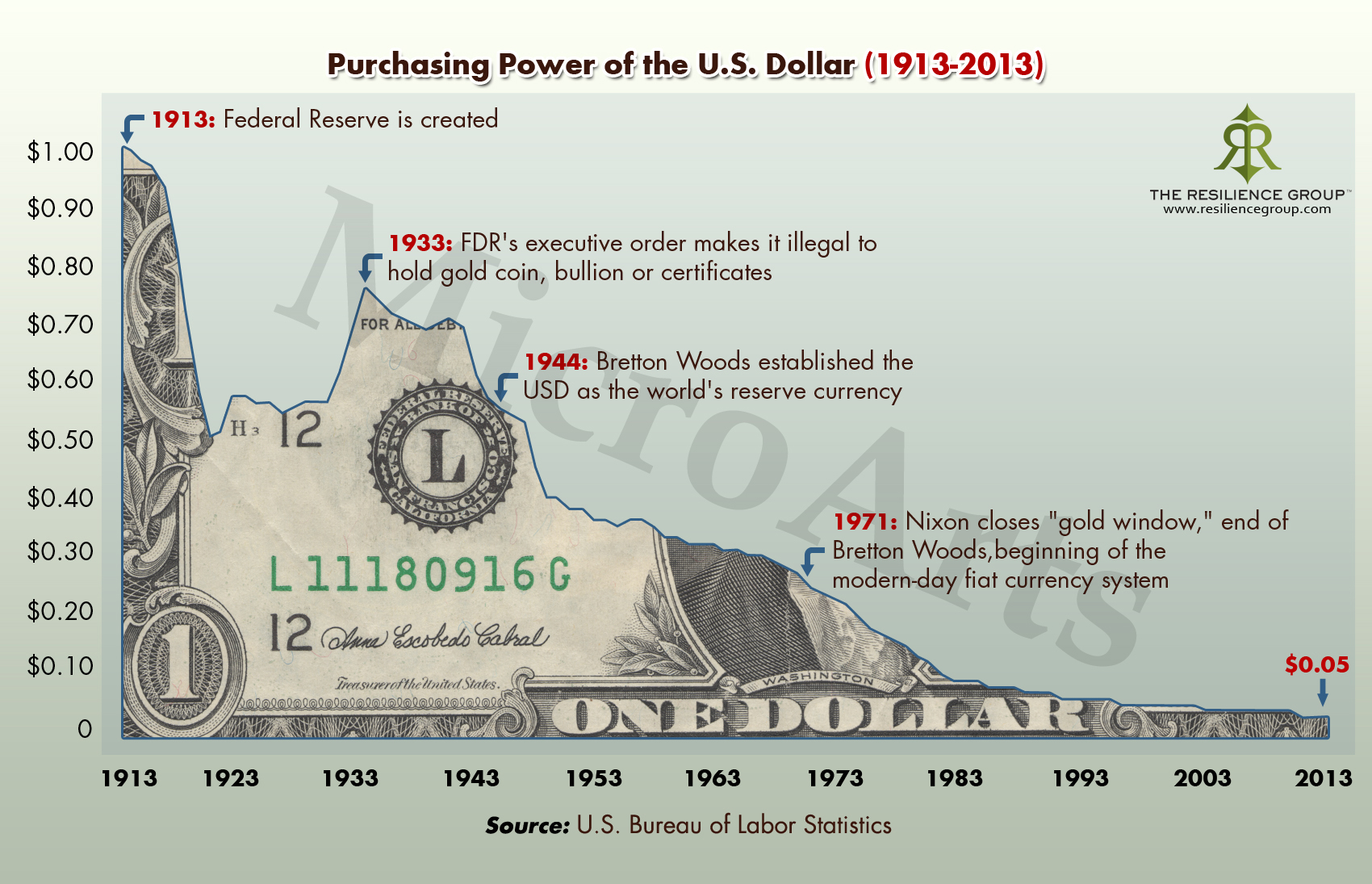
Likewise, as previously noted on this site here, the dollar has lost essentially all of its purchasing power since 1913.

purchasing-power-of-the-us-dollar-1913-to-2013_517962b78ea3c

(above graphic taken from: http://visual.ly/purchasing-power-us-dollar-1913-2013)

Rose finishes his point:

“Well, I’m sure many savers would actually prefer it if we had deflation. ‘What, prices of things actually going down?  That would be fantastic!”

Unfortunately, it is “fantastic”–as in “pure fantasy”–because the banks and the all-important Financial System are all about seeing to it that prices always go up, never down.  That ensures that you must always borrow money from the Financial System, never able to survive off the fruit of your own labor (as discussed in yesterdays post: PRICE-RIGGING IS THE NAME OF THE GAME: TAIBBI’S LATEST).  Ah, the system works!

Posted in Debt, Debt Slavery, Everything Is Rigged, fiat currency, Financial Terrorism, Keiser Report, Price, Price-fixing, Redistribution, Rent-seeking, Rentier, Reverse socialism, Wage slavery, Wages, Wealth transfer | Tagged , , , , , , , | 3 Comments

MERS ASSIGNMENTS “HAVE NO EFFECT”; MERS ADMITS TO NO CONTROL OVER NOTES

Jeff Barnes of Foreclosure Defense Nationwide breaks down the significance of the decision by the Supreme Court of Rhode Island in the case of Chhun v. MERS:

“The homeowners had sued for declaratory relief, quiet title, and punitive damages, alleging that the MERS Assignment had no effect as it was signed by someone who was an employee of Aurora (and not MERS), and that MERS did not order the assignment to Aurora. The Court found that these allegations satisfied the requisite pleading standard and reversed the Superior Court’s ruling.

Why this particular case is a come-to-Jesus on the part of the Rhode Island Supreme Court I couldn’t tell you, but the fact that MERS–the computer database that is named in mortgages and on assignments, not the parent corporation, MERSCORP–has no employees is not new. The fact that the signers/executors of the MERS assignments do not work for MERS and in fact work for the would-be foreclosing entities is not new.

MERS assignments have no effect

But the best part of the Chhun ruling is that, at least in the Chhun case, the MERS assignment was found–correctly–to have no effect [UPDATE 4-18-14: the Chhun ruling did not decide that MERS assignments have no effect, it only reversed a lower court’s motion to dismiss]. I have written about this before and have shared it with others, but in my own lawsuit against MERS and others, MERS came out and admitted that their assignments have no effect.  I know of no other such admission (not saying one doesn’t exist), so I always feel compelled to share it, especially now that the fact that MERS assignments have no effect has been acknowledged by the highest court of a state [see above Update from 4-18-14]–so here is the admission of MERS–it’s actually a three-part admission from interrogatories I propounded to MERS and signed by William Hultman:

“Interrogatory #4: MERS is only able to transfer what it actually holds and cannot transfer a negotiable instrument by virtue of a transfer of real property.

Interrogatory #7: Any language in the assignment which claimed to assign the note could not do so, as notes do not move through assignments in the land records.

Interrogatory #13: The MERS assignment can only assign the interest that MERS is holding.  When MERS is named as the beneficiary, it holds legal title to the Deed of Trust and can assign the Deed of Trust.  Unless MERS is the note holder it cannot transfer the note since the note moves through endorsement and delivery pursuant to the Uniform Commercial Code.”

These interrogatories can be read and downloaded here: MERS INTERROGATORIES

Do you see the pattern?  MERS has no control over the note and openly admits it.  MERS still perversely claims to have control of the deed of trust/mortgage, but this is impossible if they don’t have control of the note, since the note and mortgage are inseparable AND the note is the greater of the two; the mortgage is worthless without the note.  Therefore, MERS cannot legally assign the deed of trust/mortgage because MERS has no control of the note, and openly admits to having no control over the note.

The Chhun decision is great news to be sure, but decisions like it should have been legion over the past five years or so; instead such decisions have been the vast minority.  Hopefully Chhun will have a snowball, snowpocalypse effect on MERS and foreclosure fraud…

IMPORTANT NOTE/DISCLAIMER:  The above article is not and should not be construed as legal advice and was not written by an attorney.  It is merely a collection of common-sense, rational observations written by a sane, rational layperson with common sense.  It is recommended that you consult with an attorney for any and all legal advice and/or action.

Posted in Foreclosure, Foreclosure fraud, MERS | Tagged , , , , , , , , | Leave a comment

SOLAR PANEL NOSTALGIA: CARTER, REAGAN, OBAMA

Had a lovely discussion with a gentleman from SolarFirst this morning at a Home Depot. He was gonna give me the pitch, but I quickly told him I was a renter.  He kept talking though, and I got sucked in.  I asked him if he knew about Carter installing solar panels on the White House in 1979 that Reagan subsequently removed.  He hadn’t heard about that despite the fact that he was in the solar biz, and I asked him, “Can you imagine what life might have been like by now had those solar panels that were put there when we were in elementary school had stayed there?  If the country had followed that lead?”  We both shook our heads.

What I didn’t know was that Obama had solar panels reinstalled on the White House in 2010.  Even a stopped clock tells the right time twice a day…

Posted in Off-the-grid, Washington | Tagged , , , , | Leave a comment

PRICE-RIGGING IS THE NAME OF THE GAME: TAIBBI’S LATEST

Matt Taibbi comes through again with another bombshell of a story about a little-understood provision of the 1999 Financial Services Modernization/Gramm-Leach-Bliley Act:

“A tiny provision in the bill also permitted commercial banks to delve into any activity that is ‘complementary to a financial activity and does not pose a substantial risk to the safety or soundness of depository institutions or the financial system generally.‘”

Notice that the bill is concerned not with the safety or soundness of say, the public at large, or inflation, or any such thing. It’s only concerned with safety and soundness of banks and the “financial system.” Most people use the term “financial system,” interchangeably with the word “economy,” but they are two VERY different things. They are NOT synonyms.

The Financial System is the slave system where we are forced to get “loans” from banks for everything from cars, to houses, to education, to electronics, etc. The economy, on the other hand, is the actual fruit of the labor we perform as individuals, providing goods and services to each other. This bill wasn’t worried about protecting that, oh no–the economy can go straight to hell (and it has), but the Financial System must ALWAYS be safe and sound.

Pricing is what makes the Financial System possible

So what’s the best way to always ensure that people will need loans from the Financial System and not be able to rely on the fruits of their own labor in the real economy?  Rig prices upward, always upward.  And this raising of prices must always be done without providing any extra benefits or value.  For example:

“For instance, in just the past two years, fines in excess of $400 million have been levied against both JPMorgan Chase and Barclays for allegedly manipulating the delivery of electricity in several states, including California. In the case of Barclays, which is contesting the fine, regulators claim prices were manipulated to help the bank win financial bets it had made on those same energy markets.

And last summer, The New York Times described how Goldman Sachs was caught systematically delaying the delivery of metals out of a network of warehouses it owned in order to jack up rents and artificially boost prices.

Supply and demand is a lie

Forget “supply and demand” as the arbiter of prices–that’s like the economic version of the Tooth Fairy or the Easter Bunny.  Taibbi points out that this price-rigging is quite intentional, as noted by Chase’s Blythe Masters:

“Loosely translated, Masters was saying that there was a limited amount of money to be made simply trading commodities in the traditional legal manner. The solution? ‘We need to be active in the underlying physical commodity markets,’ she said, ‘in order to understand and make prices.’

We need to make prices. The head of Chase’s commodities division actually said this, out loud, and it speaks to both the general unlikelihood of God’s existence and the consistently low level of competence of America’s regulators that she was not immediately zapped between the eyebrows with a thunderbolt upon doing so. Instead, the government sat by and watched as a curious phenomenon developed at all of these new bank-owned warehouses, in the aluminum markets in particular.”

And with the banks having “made prices,” we the people are gouged just that much more. So on top of taking millions of homes, driving borrowers to suicide and bankruptcy, engineering the greatest transfer of wealth from the bottom to the top in human history (see :10 in the video at the beginning of this post), every aluminum can has a higher price–adding seemingly petty insult to grievous injury, as Taibbi points out:

“Every time you bought a can of soda in 2011 and 2012, you paid a little tax thanks to firms like Goldman. Mehta, whose fund has a financial stake in the issue, insists there’s an irony here that should infuriate everyone. ‘Banks used taxpayer-backed subsidies,’ he says, ‘to drive up prices for the very same taxpayers that bailed them out in the first place.'”

Obviously the price of aluminum cans is the least of our worries…

Posted in Asset Bubble, Conspiracy, Debt, Debt Slavery, Everything Is Rigged, Financial Terrorism, Foreclosure, Price, Price-fixing, Rent-seeking, Rentier, Reverse socialism, Wealth transfer | Tagged , , , , , , , , , , , , , , , | 1 Comment

Rocket Docket? Is it Time to Sue the System?

Now this is what I’m talking about. It’s time to stop wringing our hands, feeling pitiful, and wondering what we’re gonna do about all this. A capital idea, I say!

Unknown's avatarLivinglies's Weblog

 Is it time to sue the system?


A Federal lawsuit against the State for systemic violations of due process is long over due. 


The current system in most states includes some version of the rocket docket. Even without that the bias is clearly  there, but with the “expediting” of claims due process is clearly the loser as the banks get richer on the misery of homeowners who legally have every right to win their cases.


The current thinking amongst court administrators and the judges who preside is the presumption that the truth lies in the assertions of the party initiating foreclosures in both nonjudicial and judicial states and dilatory tactics amount to lies of the borrower. The opposite is true and if challenged, it could easily be proven that the rocket docket has resulted in millions of wrongful foreclosures by parties who were simply greedy intermediaries using…

View original post 718 more words

Posted in Uncategorized | Leave a comment