While there is certainly much to appreciate in “The Secret Shame of the Middle-Class,” Neal Gabler’s recent article in The Atlantic, I still felt that it ultimately acts as an indictment of, rather than a gesture of solidarity with, the middle class.
His conclusion, although not expressed in so many words, is that while he shares our shame at having too much debt, we are right to be ashamed. Essentially, we dug our own graves.
Gabler’s article begins with this disturbing statistic:
“Since 2013, the Federal Reserve Board has conducted a survey to ‘monitor the financial and economic status of American consumers.’…the answer to one question was astonishing. The Fed asked respondents how they would pay for a $400 emergency. The answer: 47 percent of respondents said that either they would cover the expense by borrowing or selling something, or they would not be able to come up with the $400 at all. Four hundred dollars! Who knew?”
When the banks and their cohorts had more or less the same type of financial emergency—proportionally speaking—in 2008, did anyone associated with the banks come out and speak of the “secret shame” of the banks? No—instead, they acted with a complete lack of shame. They went to Washington and threatened to completely crash the economy unless they got a bailout.
One CEO sued the government (and won) because his share of the bailout wasn’t big enough!
The shamelessness of the banks knows no bounds. So it pisses me off to read that somehow you and I should be ashamed if we get into financial trouble, regardless of the reason. Gabler’s article is good overall, but he points out a number of times that he is far from alone in his debt predicament and so when he blames himself for said predicament, he is by extension blaming his fellow debtors for theirs. Yet he never once blames the banks-somehow the apparently extensive research he did for his article never led him down the path of the role of the banks in the country’s black hole of debt.
Here at LRM, I have written a great deal about the fact that banks create money out of nothing, ex nihilo, out of thin air. This assertion was made after extensive research into the money-creation process, and I found that this information was not only not secret, but also that the information is common knowledge among economists and those like me who take an interest in such matters. In fact, the only group which seems surprised to hear and then resists the fact that money is created out of nothing is, well, a rather large group—the general public.
This surprise and resistance of the general public is due to any number of possible reasons—misinformation, mis-education, apathy, lack of interest, genuine support for the current system, etc. But perhaps the biggest reason people tend to be surprised by and resistant to the idea—in the unfortunately unlikely event that they ever even presented with the idea—is that they think it can’t be true because there’s no proof that it’s true. They think that anyone who says that banks create money out of thin air is just a conspiracy theorist, a communist who hates banks and capitalism, a sufferer of paranoid delusions, or some combination of all of those.
Except they’re wrong that there’s no proof—in 2014, noted economist Richard Werner proved beyond a shadow of a doubt that any run-of-the-mill, local bank (not just the central banks of the world) can and does, as a matter of course, create money out of nothing. The only problem is that Werner’s findings are almost completely unknown–not just to the general public, but also to people like myself who actively seek out this information. Indeed, Werner’s case study was published in “The International Review of Financial Analysis” in December 2014 and I heard nothing about it at all until I stumbled upon it earlier this year. If it weren’t online, I likely would still have never heard about it.
Published under the title “Can banks individually create money out of nothing?—The theories and the empirical evidence,” Werner’s paper needs to become the new common knowledge. This article seeks to amplify Werner’s extremely important findings, and I am making this a series in order to keep the length of the articles to a bare minimum in order to avoid the dreaded “TL;DR” syndrome.
So let’s get to it.
How it was proven
Let’s begin with Werner’s conclusion: yes, banks can individually create money out of nothing. Here’s how he puts it (section 5.2 of the article):
“Thus it can now be said with confidence for the first time – possibly in the 5000 years’ history of banking – that it has been empirically demonstrated that each individual bank creates credit and money out of nothing, when it extends what is called a ‘bank loan’. The bank does not loan any existing money, but instead creates new money. The money supply is created as ‘fairy dust’ produced by the banks out of thin air.32 The implications are far-reaching.”
It sounds unbelievable, but Werner proved it: any time you were “lent” money from a bank, the bank created the money out of thin air. “What’s the problem with that?” is a question I’m sure some readers will be asking in their heads. Well, here’s a few:
1) The bank took no risk to “loan” you the money, because it just literally made up the money—so there’s really nothing to “repay” and there’s really no justification to charge interest because the bank is not having to do without the amount it “loaned” you.
2) Some people are turned away by banks when they ask for “loans” to start a business, buy a house or car, or go to college (or they’re charged exorbitant interest) and so banks are therefore allowed to pick winners and losers in society.
3) Banks are stealing money from you as a “borrower” because they’re charging you a rental fee (i.e. “interest”) on money which they a) didn’t have before you asked to borrow it, b) “created” by a few keystrokes into a computer, and c) therefore never really exists at all. In other words, you’re being charged money you actually have to perform labor for in order to “pay them back” money which certainly didn’t exist before you “borrowed it” and only exists—to the extent that it can be said to exist at all—as binary code in a computer database. If that’s not theft by fraud, then there is no such thing.
4) You can only get money by performing labor, whereas banks are allowed to just will it into being. It’s pretty easy to see who has the advantage in such a situation, and it isn’t you or me that has the advantage.
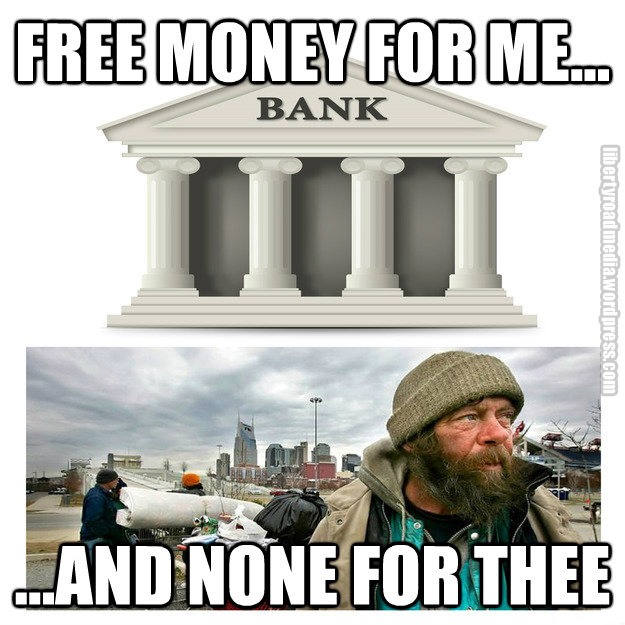
In the simplest possible terms, the problem is that banks get free, infinite money, and you don’t (hence the meme at the beginning of the article). They get something for nothing while trying their damnedest to make sure no one else does.
So how did Werner prove it? Pretty simple, really, yet quite revolutionary. He found a bank that would give him a loan and then let him see their books the day before and the day he got his “loan.” Werner’s summary (section 5.2):
“It was examined whether in the process of making money available to the borrower the bank transfers these funds from other accounts (within or outside the bank). In the process of making loaned money available in the borrower’s bank account, it was found that the bank did not transfer the money away from other internal or external accounts, resulting in a rejection of both the fractional reserve theory and the financial intermediation theory.Instead, it was found that the bank newly ‘invented’ the funds by crediting the borrower’s account with a deposit, although no such deposit had taken place. This is in line with the claims of the credit creation theory.”
Long story short, Werner asked for a loan. The bank created an account in his name and deposited €200,000 into it. The bank did not check to see whether or not it had that amount on hand to give to him, nor did they inquire of any central bank or other banking authority whether or not they had that amount to spare in reserves. They just made it up and put it into his account and Werner was in fact able to spend that money. The bank director admitted it in a signed letter to Werner:
“…neither I as director of Raiffeisenbank Wildenberg eG, nor our staff checked either before or during the granting of the loan to you, whether we keep sufficient funds with our central bank, DZ Bank AG, or the Bundesbank. We also did not engage in any such related transaction, nor did we undertake any transfers or account bookings in order to finance the credit balance in your account. Therefore we did not engage in any checks or transactions in order to provide liquidity.”
We’ll look at what all this means a little more in depth in Part 2.
Yesterday we pointed out that GE CEO Jeffrey Immelt attacked Bernie Sanders in a corporate propaganda piece masquerading as an op-ed in the Washington Post. Don’t hold your breath waiting for WaPo to allow Bernie to have the same free advertising space to rebut Immelt’s rant. Fortunately though, he doesn’t really need to because CNNMoney has taken it upon themselves to do it for him, even if they may not have meant to. Check it out:
A CNNMoney analysis shows how GE’s U.S. footprint has indeed shrunk dramatically over the past two decades.
Back in 1995, roughly 68% of GE’s 222,000 total employees were in the U.S, according to its filings with the Securities and Exchange Commission. By 2005, the percentage of American jobs declined to 51% and by the end of 2015, just 38% of its employees were in the U.S.
GE’s total global workforce has increased to 333,000. But it employs fewer American workers today — 125,000 versus 161,000 in 2005.
Bernie’s point about GE and its outsourcing of American jobs is thus proven. But CNNMoney didn’t stop there:
A glance at GE’s factories tells a similar story — that a majority of its expansion has happened overseas. GE has 10 fewer U.S. plants today than a decade ago. But the number of factories overseas has risen by 58. While it used to be split about evenly, today 59% of GE’s plants are on foreign soil.
So again, Bernie’s point is proven. But that’s not to say that both he and Immelt did not resort to a bit of hyperbole. For Bernie’s part in the New York Daily News, it was technically incorrect of him to say that GE pays no tax in any given year. That’s a slight exaggeration—GE did pay corporate income tax in 2014. But they didn’t in 2010-2013. Bernie’s larger point about GE and tax avoidance, though, is absolutely correct.
Regarding his hyperbole, Immelt protested in his WaPo op-ed advertisement that GE pays “billions” in “federal” taxes. Well yes, if you count things like payroll and unemployment taxes. But Immelt knows very well that when Bernie makes the somewhat hyperbolic point that GE pays “no taxes,” Bernie is talking about income tax, which Immelt also knows GE didn’t pay for four years. So while his statement about GE paying billions in taxes is technically correct, he purposely mischaracterizes Sanders’ larger (and absolutely correct) point.
So basically, Bernie is trying to compare apples to apples—the corporate income tax that GE has gotten out of paying in comparison with the personal income tax that individuals have to pay but can’t get out of paying. Immelt, on the other hand, compares apples to oranges—income taxes and payroll/unemployment taxes and hopes no one notices the nature of reality.
Bernie noticed, and so have the rest of us. And we don’t like it.
Immelt (or more likely, his PR department) had this to say:
We at GE were interested to read comments Monday by Sen. Bernie Sanders (I-Vt.), who told the New York Daily News editorial board that GE is among the companies that are supposedly “destroying the moral fabric” of America. The senator had been asked to cite examples of corporate greed at its worst. Somehow that got him to talking about us.
That’d be great, except Bernie never uttered the phrase “GE is destroying the moral fabric of America.” The only thing he said about GE specifically is that they are good at tax avoidance, which happens to be true. Why didn’t the GE CEO defend that practice in his free, feel-good ad for GE (that was an “op-ed” in name only)? I take that back, he did try to defend that practice, by simply saying Bernie is lying about it. Yeah…swing and a miss.
That’s the tactic–strawman. Argue against a position your opponent didn’t take. It’s a logical fallacy. Immelt made his fallacious argument flawlessly—perhaps because he wasn’t arguing so much as he was advertising.
Also, he didn’t see fit to mention the Fukushima nuclear reactors designed by GE that blew up in 2011, poisoning not just Japan but the Pacific Ocean with radiation. Reactors which GE’s own engineers said were unsafe and had critical design flaws. Why didn’t he mention that in his PR stunt? He also failed to mention that there are 20-odd of those same reactors in the US. But let’s focus on how god-awful socialism is and how guileless and wonderful GE is, that oughta fix the nuclear reactor problem.
So clearly we can see that the powers that be have entered the classic third stage of a movement’s march to victory: they tried ignoring him, they tried laughing at him (“he’s not a serious candidate,” “‘democratic socialist’—hardy har har”), now they’re fighting him because they now see (indeed, they always saw) that he is an actual threat to them. And we all know what comes next, right?
My thoughts exactly in a great new Truthdig article–the Panama Papers are great and all, but where the hell are the Americans mentioned? We’re expected to believe that Americans have clean hands in all this? Is that a joke? No Paul Singer? No Warren Buffett? No Martin Shkreli? Gimme a break. From the Truthdig article:
The Suddeutsche Zeitung, which received the leak, gives a detailed explanation of the methodology the corporate media used to search the files. The main search they have done is for names associated with breaking United Nations sanctions regimes. The Guardian reports this too and helpfully lists those countries as Zimbabwe, North Korea, Russia and Syria. The filtering of this Mossack Fonseca information by the corporate media follows a direct western governmental agenda. There is no mention at all of use of Mossack Fonseca by massive western corporations or western billionaires—the main customers. And the Guardian is quick to reassure that “much of the leaked material will remain private.”
Ford Foundation
Carnegie Endowment
Rockefeller Family Fund
W.K. Kellogg Foundation
Open Society Foundation (Soros)
Among many others. Do not expect a genuine expose of western capitalism. The dirty secrets of western corporations will remain unpublished.
It’s almost as though the whole reporting of the leak is being engineered to take down the competition to the Western system of finance. But I guess that’s probably just another Soros/Rockefeller conspiracy theory, right?
Or could it be that this sort of “warfare by journalism” is the neo-imperialism defined by Brian Becker (of the Party for Socialism and Liberation) as “advanced monopoly capitalism with banks at the very center of it,” at work in its highest and most refined form (watch from 6:57 in the video below)?
In a recent post (Judges: Not Dupes—TOTALLY In On It), we decided that when it comes to foreclosure cases, judges are not guileless, impartial innocents deceived by wily banks into throwing people into the street. No, the judges are (to admittedly varying degrees) willing to perform legal gymnastics if necessary (which they often are) to assure a favorable outcome for the banks, which almost always results in homelessness (temporarily, at least) and/or financial ruin for homeowners. This unfortunate situation has not escaped the recent notice of the Yale Law Journal, which published a Comment called “In Defense of ‘Free Houses’” in its February issue.
In the article, the authors point out that one of the maneuvers of legal gymnastics that judges often perform is to rule against the bank, but to do so “without prejudice” so that the bank can file the same suit again in the future if it wants to (which it often does). The article puts it like this:
“Recently, however, judges have avoided applying res judicata to foreclosure cases and have bent the rules to favor banks. For example, in Maine, where longstanding precedent established that a failed foreclosure bars any future attempt to collect on the debt,34two trial courts recently refused to dismiss cases with prejudice, even after the cases were tried to completion and the banks had lost. The judges in those cases were explicit that they did so to allow any subsequent actions the banks might want to bring and to avoid giving the homeowners a windfall.35”
The result of such a ruling? The homeowner likely spent a small fortune prosecuting the case, even winning on the merits, but the bank can always come after the homeowner again, at which time the typical homeowner will not have the funds to mount yet another defense against the banks, since unlike banks, homeowners cannot create money out of nothing. In effect then, a “without prejudice” ruling in favor of the homeowner is really a return to the status quo ante, as though the case had never been tried at all. Such a ruling is ultimately a victory for the bank, and a waste of money and effort for the homeowner. The knowledge of this state of affairs can have the effect of a homeowner not even filing suit against a bank in the first place because of the very real possibility of such wasted effort and funds.
The remedy? Follow the law, of course
It’s fascinating that only now, some 10 or so years since the foreclosure crisis began in earnest, one of the top law schools in the country suggests what utterly exasperated homeowners have been saying all along: “Simply follow the damn law.” The article sums it up thusly (and they only count from 2008, or maybe late 2007):
“Eight years after the start of America’s housing crisis, state courts are increasingly confronting an unanticipated consequence: what happens when a bank brings a foreclosure suit and loses? Well-established legal principles seem to provide a clear answer: the homeowner keeps her house, and res judicata bars any future suit to foreclose on the home. Yet state courts around the country resist this outcome.
[SNIP]
This Comment argues that this approach is misguided; courts should issue final judgments in favor of homeowners in cases where banks fail to prove the elements required for foreclosure. Furthermore, these judgments should have res judicata effect—thus giving homeowners “free houses.” This approach has several benefits: it is consistent with longstanding res judicata principles in other forms of civil litigation, it provides a necessary market-correcting incentive to promote greater responsibility among foreclosure litigators, and it alleviates the tremendous costs of successive foreclosure proceedings.”
“Well-established legal principles…provide a clear answer,” indeed. That’s all homeowners have ever argued and asked for—just have the courts follow “well-established” law, like Carpenter v. Longan, for example (after all, when precedent like Iqbal is invoked, for instance, the judges all fall right in line–not so with Carpenter). And don’t, as the Yale article—not me—put it: don’t bend the rules to favor banks. Those principles are all we’ve ever argued for here at Liberty Road Media, and indeed, those principles are among the main driving forces behind this blog. Yet that “clear answer” to foreclosure lawsuits has been overlooked and ignored by the courts for years now. Millions of foreclosures have been processed; millions of families have lost everything. While it’s nice to read a plea for sanity like this in the law review of an Ivy League law school, it still feels like too little, too late. An article like this might’ve done a world of good in say, 2009 or so. Printing it now reminds me of a comment made here at Liberty Road Media in May 2013 (5th Circuit Court Makes Mockery of Precedent):
“What is obviously happening is that the courts have bought into the crazy–yet mainstream–idea that all will return to normal once the “backlog” of foreclosures is “cleared.” So their goal is to “clear” the foreclosures without bringing the banks to their knees, because they have bought into the idea that the country would fall into ruin if the big banks were held accountable. Because, this meme goes, once the foreclosures–although unfortunate and maybe even mistaken and/or fraudulent as they may be–are all concluded and the banks are still intact, we’ll all be better off. They think they know what’s best for us.
Another way to look at it is this: the courts are mindlessly following a trend of displacing homeowners, just you know, because it’s cool. It’s trendy. Kind of like the trendy clothes people wear and then are horrified 20 years later when they see pictures of themselves wearing the once-trendy outfits. They think “How could I ever have let myself wear that?” And so it will be in 20 years or so that the law reviews and the blogs (or whatever media outlets exist by 2033) will lament the current smackdown of homeowners–“How could the courts have ever ruled this way? How could we have ever let the courts rule that way? How could we let the courts justify MERS?” As if we don’t know, right now as it’s happening, that the courts are not following the law.”
So, turns out it didn’t take 20 years for the first law review to start questioning the corruption of the courts regarding their handling of foreclosure cases. On the one hand, I’m glad that my above prediction turned out to be wrong. But on the other hand, what effect will this Yale article really have? Another prediction—pretty much none. I hope I’m wrong, though, because the behavior of judges described in the Yale article does nothing to inspire the home-owning public’s confidence in the impartiality and fairness of the courts. The behavior does nothing to stop “conspiracy theorists” (i.e., those who question known liars) from concocting “far-fetched” (i.e., completely reasonable) explanations for why judges would so blatantly–and in such great numbers–turn their backs on “well-established legal principles” that “provide a clear answer” to the foreclosure crisis.
At least there’s some cold comfort and bitter consolation that hey, we weren’t wrong when we noticed all that shady shit the courts were (and still are) doing.
(Part one, about Michael Tellinger and paying off bank “loans” with self-issued promissory notes, can be found here.)
What better day to write and post a story involving Irish banks and Irish ingenuity than St. Patrick’s Day?
Readers of this blog may remember that a big part of my solution to the problem of banks creating money out of thin air is to take that power away from the banks and give it to every natural person, since we the people already really have that power anyway but we are all forced by law to pretend that such is not that case. In other words, each person would have the power to issue US dollars without going through a bank. I call that “self-issued currency,” and here is how I envision it working:
It is beyond dispute that money can be–and has been–anything: gold, paper, shells, sticks, salt, binary code, cigarettes, fabric, etc., etc. So it stands to reason that money can (and arguably ought to) be the following: a check written by a buyer for any amount requested by a seller and drawn on a fictional, non-existent account. In other words, self-issued currency. And everyone would have this same check-writing power. The only problem with this scenario? No more poverty, no more control of the masses, no more larceny, no more want, no more war, no more prostitution, no more slavery, no more debt. Oh wait, those aren’t problems at all–unless you’re one of the few people benefiting from the present system of rapaciously fraudulent currency.
Very simple idea, that—checks written against fictional bank accounts. Very easy leap to make once you realize that money is and always has been created out of nothing and does not exist in nature (no, gold and silver are not money, only representations of it). Indeed, since money itself is fictional, fake, mythical, or however you want to put it, why not just let people pay for things with checks drawn on non-existent accounts? And I should make it clear that these checks would be denominated in the national currency of whatever country the check is written in. A number of critics of this check idea have taken it to mean that the self-issued currency would be the currency of the person issuing it, so that there would be millions of different currencies and said critics point out that such a thing would be impractical. That’s not what I mean at all, again, just to be clear.
Irish Bank Closures of 1970
Now, when I wrote about these drafts against fictional accounts, I had never heard about the closure of Irish banks in 1970. It wasn’t until sometime last year when I read Felix Martin’s 2014 book “Money: The Unauthorized Biography” that I knew anything about it. I was shocked and elated to read that my idea was not only not new or original, but that it had already been tried, and been successful! So what happened with the Irish banks in 1970? Martin’s book reproduces a notice that was run in the May 4, 1970 issue of the Irish Independent newspaper, which stated the following (p. 23):
CLOSURE OF BANKS
As a result of industrial action by the Irish Bank Officials’ Association for the past eight weeks, a position has now been reached where it is impossible for the undermentioned banks to continue to provide even the recent restricted service in the Republic of Ireland.
In the circumstances it is with regret that these banks must announce the closure of all their offices in the Republic of Ireland on and from Friday, 1st May, until further notice.
Nine banks were listed in the notice as being part of this indefinite closure. The “industrial relations” referred to in the notice were essentially a labor dispute.
The obvious question is, if banks are closed in a modern economy, how can commercial activity possibly continue? For the purposes of our self-issued currency solution, we might even go one further and assume that banks are not just closed temporarily but in fact closed forever, never to open again. How could the economy carry on then? Indeed, those inclined to argue for the continued existence of banks and their imaginary currency which they create out of nothing might want answers to questions like the following: How can people exchange goods and services without banks? How will everyday trading shake out? Won’t things just come to a complete standstill? How will buyers be able to trust sellers without banks as intermediaries? The bank defenders would assume that the answer to all of these questions would tend to show the inarguable need for banks to create and “lend” their imaginary money.
Fortunately, that didn’t happen at all in Ireland. Here’s how Martin describes what happened after the Irish banks closed (pp. 24):
“…the vast majority of payments continued to be made by cheque…despite the fact that the banks at which these accounts were all held were shut…For individuals in particular, there was really no other option: for any expenses in excess of the cash they had in hand when the banks shut their doors on 1 May, their only hope was to write IOUs in the form of cheques and hope they would be accepted.”
In other words, the Irish were self-issuing their currency and writing checks against what were, for the moment anyway, functionally non-existent bank accounts. That is, the bank accounts existed, but could not be accessed, so for all practical purposes, they didn’t exist for the period of the bank closures. But here’s the crux of what went on (p. 24):
“Remarkably, as the summer wore on, transactions continued to take place and cheques to be exchanged almost exactly as usual. The one difference, of course, was that none of the cheques could be submitted to the banks. With the banking system shut, however, cheques were for the time being just personal or corporate IOUs.”
So no, the Irish economy did not collapse without banks. People just wrote and accepted checks for the things they wanted and needed–and continued to do so for many months–even though there was no way to “clear” the checks. That is what you call self-issued currency in action. So, it’s been tried at least this one time and it worked like a charm. Martin again (p. 25):
“…the business lobby—encouraged by the banks and exasperated by the expenses they were incurring to find ways round the closure—began planting scare stories in the newspapers claiming, for example, that ‘a rapidly growing paralysis is spreading through the economy because of the banks dispute.’ But the evidence collated by the Central Bank of Ireland once the crisis was finally resolved in November 1970 showed quite the opposite. Their review of the closure concluded not only that ‘the Irish economy continued to function for a reasonably long period of time with its main clearing banks closed for business,’ but that ‘the level of economic activity continued to increase’ over the period.”
Not only no collapse, but also increased economic activity using self-issued currency? Sounds like a good outcome to me. Martin one more time (p. 25):
“Both before and after the event, it seemed unbelievable—but somehow, it had worked: for six and a half months, in one of the then thirty wealthiest economies in the world, ‘a highly personalized credit system without any definite time horizon for the eventual clearance of debits and credits substituted for the existing institutionalized banking system.’”
So that’s all self-issued currency really is, then—“a highly personalized credit system without any definite time horizon for the eventual clearance of debits and credits.” That’s because, in a self-issued currency system like the one I have described and the one that was temporarily in place in Ireland, there is no need to “clear” debits and credits.Indeed, if everyone has exactly equal access to money as would be the case when using self-issued currency, then the notion of a monetary debit or credit becomes obsolete. In the self-issued currency scheme, “money” is not a store of value or measure of value. It’s not really even a medium of exchange so much as it is an acknowledgment of an exchange.
Why even bother with a currency at all, one might wonder, if the self-issued currency essentially makes everything free? Well, that’s just it—things aren’t “free” in the self-issued currency scheme. Prices would still be denominated in the national currency and self-issued checks would be written for those amounts. But the checks would function more as a “thank you note”—again, an acknowledgment that person A did something for or gave something to person B. That’s what money is already, we just aren’t trained to think of it that way. That is, all money is already fake and already worthless, even in the Federal Reserve/modern central bank scheme under which we live. Indeed, “Federal Reserve Notes” and “thank you notes” are both notes, they’re only distinguishable by their legal status, not by their value. And that’s why self-issued currency is more palatable than no currency at all—because people want an acknowledgment of a transaction. They don’t want to feel that someone got something over on them or that somebody got something for nothing. For that reason, there needs to be some form of currency, but it should be self-issued and not state- or bank-issued.
Anyway, more on the “thank you note” currency in the future. Main takeaway—self-issued currency works! It’s been tried and proved to work. We just write each other checks and everyone has equal access to money and then suddenly there’s no poverty, no prostitution, better health, etc., etc.
Stay tuned for part 3!
And now for one of me favorite Irish-American tunes:
In the past couple of years, we’ve written a number of articles—not quite a series, but more than a couple—asking the following question regarding whether or not judges are impartial, or favor Goliath over David, or whether they really can do whatever they want or have to follow the law: “Judges—dupes or in on it?” After reading this short blog entry from Florida foreclosure defense attorney Mark Stopa (i.e., one of the good guys), I’m very much inclined to come down decisively on the side of totally in on it. Check out what this judge did, according to Stopa:
This case was over. Deutsche failed to meet its burden of proof, and an involuntary dismissal was required. The presiding judge knew it and admitted as much yet refused to rule accordingly. Instead, the court took a recess, went to its Chambers, sua sponte conducted a Google search to procure the missing evidence for Deutsche, resumed court, handed the internet printout to Deutsche, suggested Deutsche re-open its case, admitted the printout into evidence over objection, and used that internet printout as the basis for its ruling.
Essentially, the judge acted as an unpaid–and totally partial–advocate for the bank. He did volunteer attorney work for the bank right there in his chambers. Then he took off his helpful bank attorney hat, put on his judge hat, and then actually used the evidence he had just found to rule in favor of the bank! WTF? Forget acronyms, y’all—what the actual fuck?
I mean, it’d be one thing if judges did the same type of thing for homeowners every once in a while. The judge would still be acting ultra vires, or at least inappropriately, but at least it would level the playing field. But they don’t do it for homeowners (especially in Florida, the home of the infamous foreclosure rocket docket). As I put it in the first “Judges: Dupes or in on it?” article:
“Judges have to know what’s going on. They read the news. They’re not naive. We’re always told that judges can do whatever they want, and at some point one has to ask–if that is so, why does “whatever they want” almost always seem to be to throw homeowners in the street on the strength of fake documents?”
In the case Stopa is talking about, the documents may not have been fake, but as Stopa pointed out in his very damning brief, the documents were unauthenticated and were not certified copies. But the judge sure as hell did what he wanted and showed that his loyalties and sympathies lie not with impartial justice, but with the banks. Imagine if a homeowner had brought in a printout of a Google search conducted a few minutes earlier, waved it around and insisted that it be used to decide the case in his favor? Oh, the haughty sport his honorable Google searcher would’ve made of that. The derision would’ve been brutal—at the very least the “don’t confuse your Google search with my law degree” type of attitude would’ve been trotted out.
As you might unfortunately expect, the judge thought he did nothing wrong. His exact words, from Stopa’s appeal brief: “I feel pretty confident that I was within my rights as a judge to do what I did.” Unbelievable.
Anyway, to answer the age-old question that we here at LRM only started asking out loud about two years ago (after thinking it silently to ourselves for much, much longer)—”Judges, dupes or in on it?”—Stopa’s experience confirms what we suspected all along, that the latter is true, i.e., in on it. Rigged. And you can take that to the bank, pun very much intended.
I first came across the story of chemist Dean Moore and HSBC via this very tantalizing headline from Michael Krieger: “How the U.S. Government and HSBC Have Teamed Up to Hide the Truth From a Pennsylvania Couple”. After reading through Krieger’s story as well as a few other sources, it turns out that this situation between Moore and HSBC is of interest to those of us affected by and fighting foreclosure fraud and banks generally.
The foreclosure fraud connection is this—Moore’s wife got breast cancer several years ago and the Moores got behind on their death-pledge (what we’ve been trained to call a “mortgage”) with HSBC. Of course HSBC gave Moore the runaround about helping him. In fact, they gave him every version of their runaround, all on the same day, as Moore explains here:
“This is what really spurred this entire issue,” Moore told The Post in his first-ever interview about the case.
“This one particular day I got four individual, separate letters from the mailbox, all dated the same day. One was, ‘we’ve received everything,’ ” he said of his loan modification paperwork. “The second one was, ‘we received it but you’re missing parts two and three.’ The next letter says ‘you’re missing parts six and seven.’ And the final letter said, ‘sorry, time’s out.’ On the same day!”
This type of communication with a bank is so unfortunately familiar to so many anti-foreclosure fraud activists, but even many of them would have to admit that this is a doozy. And Moore was of course right to realize that these four separate letters from HSBC were a dead giveaway that something fishy, nay illegal, had to be going on.
HSBC: money-laundering
HSBC is no stranger to illegal activity and, as you may recall, was fined $1.9 billion in a settlement with the Department of Justice over charges that HSBC was involved in money-laundering for drug cartels and violating sanctions against so-called “terrorist” regimes in Iran and other countries. This settlement—really a “deferred prosecution agreement” (DPA)—was approved in July 2013 by District Judge John Gleeson. Now what does this have to do with Dean Moore and the modification of his death-pledge, you might ask?
Well, as part of the settlement/DPA, a monitor was appointed to make sure that HSBC complied with the terms of the DPA. That monitor is/was one Michael Cherkasky, and he prepared a report on HSBC’s compliance with the DPA and filed it with the DOJ in 2015. The existence of the report was publicly reported at the time, which is likely how Moore knew about it. Here’s an excerpt from a Bloomberg story about the filing of the report:
Cherkasky’s document speaks to the need for continued monitoring: At the current rate, he wrote, HSBC would have a hard time meeting its compliance targets within five years.
“Nearly two years after the entry of the DPA, the bank continues to struggle with a broad range of compliance and control deficiencies that pose an unnecessary level of financial-crime risk to the bank’s continuing operations,” Cherkasky wrote in the report.
I don’t know about you, but if I’m fighting HSBC (or any bank) over what is almost certain to be illegal actions of theirs against me and hear of a public report about their DPA which states that the bank is having problems with “a broad range of compliance and control deficiencies,” I’m going to be very interested in seeing that report. And of course, HSBC is going to be very interested in me and everyone else not seeing that report. And HSBC’s ally in keeping and/or attempting to keep the report secret? The DOJ, as it turns out:
Because of that risk, an explosive, 1,000-page report on the bank by a federal monitor detailing HSBC’s malfeasance should be kept under wraps, the Justice Department insisted to the judge in the letter.
Releasing the report could tip off criminals and provide them a blueprint on how to avoid money-laundering safeguards, Justice claims.
In addition, releasing the report could scare away regulators in Malaysia and Hong Kong — who have promised to cooperate but only if the confidential information they supplied remained under seal, the Justice Department said.
So the DOJ expects us to believe that it is thwarting criminals—i.e., those who might exploit the findings of this report—by helping criminals–i.e., HSBC–keep their criminality covered up. Oh brother. Don’t they get that we don’t buy their BS anymore?
The money-laundering/mortgage connection
Moore’s logic for wanting to see the report is explained here:
Moore contends that the report, which says that the bank has operational problems in its mortgage operations, could be relevant to his claim with the CFPB.
“It is my contention that the report would (or will) validate my claims that HSBC is in direct violation of multiple sections of multiple Consent Decrees,” he wrote in a letter to Gleeson.
(3) The OCC has determined the Bank has failed to comply with forty-five (45) actionable items under Articles III, IV, V, VI, VIII, and IX of the Consent Order, including the Bank’s obligations under the Consent Order with respect to the sub-servicing performed by the third-party servicer on its behalf.
(4) The OCC has determined the Bank is in continuing noncompliance with and in violation of the Consent Order, and continues to engage in unsafe and unsound practices.
So at least two government agencies—the DOJ and the OCC—have determined that HSBC is in violation of multiple legal agreements between the bank and the government, yet HSBC continues to be allowed to operate and no one is being prosecuted or put in jail. Moore is definitely onto something and apparently the same judge that approved the DPA regarding drug money-laundering is now inclined to honor Moore’s request to have the 2015 compliance report be made public.
It’s not at all surprising, of course, that a bank that engages in money-laundering also tries to scam homeowners looking for help on making their mortgage payments. But that’s not the only connection between money-laundering and mortgages, in my view. So-called “securitization” with the use of the MERS system to make ownership of promissory notes completely opaque, is the ultimate form of seemingly legal money-laundering. Indeed, as we have written here before at LRM, MERS is the “invisibility cloak of the banksters”:
Yes, the banks don’t want you to see what they’re doing–or not doing, as the case may be. Specifically, they don’t want you to see that they have separated your note from your deed of trust/mortgage. In my opinion (and I am not an attorney) there are two main, unstated reasons for the existence of MERS: 1) to separate the security document from the note and 2) to purport to rejoin them as if they’d never been separated at the time of foreclosure.
The purpose of point 1 above (the purpose of point 2 is self-explanatory): for banks/financiers to be able to pledge or “sell” the same note multiple times (see this, this, and this)–i.e., rehypothecate–without having to indicate that the note has been sold multiple times in the county land records (via assignments in said records that used to be required for each sale of the note).
In any event, HSBC is but the tip of the iceberg, and hopefully Moore’s request for the release of the HSBC compliance report will be granted and the rest of the iceberg will be revealed, or at least begin to be revealed.
IMPORTANT NOTE/DISCLAIMER: The following article is not legal advice and was not written by an attorney. It is merely a collection of common-sense, rational observations written by a sane, rational layperson with common sense. It is recommended that you consult with an attorney for any and all legal advice and/or action.
I happened upon this remarkable video recently, and was blown away by it—here, I thought, is what I have been calling “self-issued currency” in action, and not in some distant utopian future, but right now, in the dirty, smelly, messy present! For those not inclined to watch the video or who may have some problem with Michael Tellinger (the presenter), let me explain Tellinger’s concept in a nutshell.
For starters, Tellinger explains how, using his self-issued promissory notes, he paid off a deficiency judgment related to the foreclosure of some of his property . That is, he lost the property in foreclosure, and the property was sold at the foreclosure auction for less than Tellinger owed on the property, so the bank sued him for the difference. As he correctly points out, this is one of the most despicable things banks do, suing you because the property they’re taking from you didn’t bring in the amount that they “loaned” to you out of thin air when that property was sold out from under you.
Tellinger of course realized that banks create money out of nothing, which is really a shorthand way of saying that banks take your promissory note and sell it back to you in the form of “interest.” And he knew, correctly, that the particular bank that was stealing his property—Standard Bank of South Africa—like all banks, didn’t take any risks in this kind of “loan” transaction and therefore cannot and would not be hurt in any way if he didn’t pay them with money he worked like a dog to earn. So Tellinger did some research and realized that in South Africa, there is a remarkable High Court Rule which states the following, in Tellinger’s paraphrase:
We have it on record from a hearing in the South Gauteng High Court, in the matter between STD Bank vs Tellinger, that the banks accept payment in Bills of Exchange AND Promissory Notes.
According to Tellinger, the attorney for Standard Bank blurted out the above information in a hearing regarding the bank’s suit against Tellinger.
Tellinger then decided to turn the tables on the bank and give them a taste of their own medicine by repaying Standard Bank with his own risk-free, out-of-thin-air promissory notes! And according to Tellinger, it totally worked—he’s paid them roughly $800,000 rand (approx. US $69,000) and the bank has accepted his self-made, self-issued promissory notes as payment!
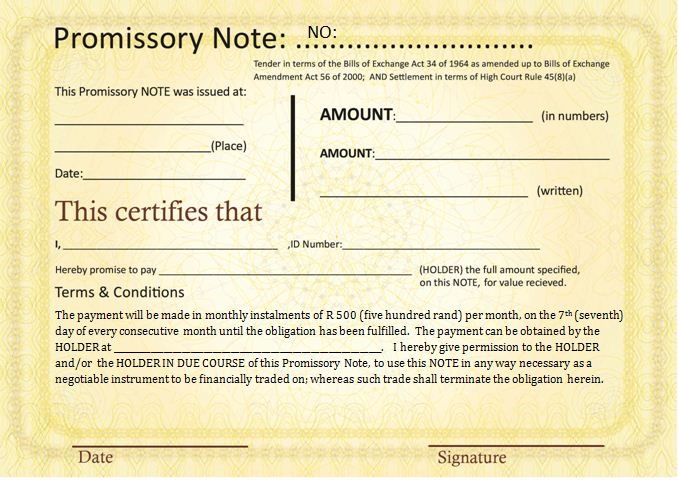
Here is Tellinger’s fill-in-the-blank promissory note:
How Does This Work? It’s all in the “promise to pay,” i.e., the “IOU”
You will have to watch the video for all the gory details, of which there really aren’t that many, but let me get right down to brass tacks. What Tellinger has done is used the bank’s weakness to his total advantage and that weakness is this: banks don’t deal with or trade in “money,” they deal with and trade in IOUs. Don’t believe me? Here’s the Federal Reserve on the subject of IOUs, from their pamphlet “I Bet You Thought”:
“Commercial banks create checkbook money whenever they grant a loan, simply by adding new deposit dollars to accounts on their books in exchange for a borrower’s IOU.
Money creation bookkeeping isn’t gimmickry. Far from it. Banks are creating money based on a borrower’s promise to repay (the IOU), which, in turn, is often secured or backed by valuable items the borrower owns (collateral).”
That is, most “money” that exists today is created as a “promise to pay” contained within a promissory note, and said notes are just black inkjet ink from desktop printers on generic copy paper from Office Depot. A legal “promise to pay” is indistinguishable in essence from an IOU one might write to a friend or family member in exchange for a loan—in fact, the Federal Reserve itself refers to promissory notes as IOUs, as can be seen in the above quote from “I Bet You Thought.”
Think about it—when you “borrow” money from a bank, you have to sign a promissory note in order to be given the “money,” right? But do you receive that “money” in cash, or even a check made payable to you? No, you don’t. Sure, a check may be written to the entity that will ultimately get the “money” that you are “borrowing,” but no cash or anything with intrinsic value (i.e., gold or silver) will change hands in the transaction—it’s all done strictly on paper. So in a very real sense, you have written an IOU to the bank for the amount of your “loan”—and that IOU is given the more formal-sounding, legal name of “promissory note.” And that IOU/promissory note is then the basis for the bank’s “funding check,” with that check itself being an IOU. It’s pretty clear, then, that banks deal all but exclusively with IOUs (they have to keep some cash around, but only enough to be able to meet expected daily withdrawal demands).
The brilliance of Tellinger’s strategy: feeding the system with liquidity
So why does Tellinger’s strategy seem to be working? Well, look again at his blank promissory note above—it offers to make a $500 payment in the national currency on the 7th day of every month. Tellinger explains in the video that the payments must be physically picked up at the address listed on the note, on the 7th of the month and only on the 7th of the month.
What that means is that the note is actually “worth” the specified amount of the national currency and in fact, the $500 can be had by doing what the note says. That is, Tellinger doesn’t refer to some mystical account in the national treasury that may or may not exist and try to use that as a way to pay the bank. No, he’s offering the national currency to the bank. They just have to come pick it up. Of course, no bank is going to actually send someone out to fetch the money on the appointed day. But they could, if they wanted to. In this way, Tellinger has created what banks love to create and trade–debt. Since it’s debt–it’s like all other “money,” and the banks accept it because they can trade it. As Tellinger says in the video (approx. 10:25):
“…your signature creates [on the self-issued promissory note] the liquidity and the value in that piece of paper [i.e., the promissory note]. So it turns it into a liquid negotiable instrument…with which the bank can trade.”
And that is the brilliance of Tellinger’s self-issued promissory note: it creates liquidity, which is the whole point of the insane system of money and debt that has been built up around us and pervades everything that we do and that we are. It facilitates trade. Again, banks deal in debts/IOUs—that’s their business model. Even cash, as Tellinger points out in the video, is just a bill (of exchange), or a note (even the humble U.S. dollar bill says right at the top that it is a “Federal Reserve NOTE”). In other words, all money is debt, even cash. In the bank’s own system, all debts are paid with…more debt.It sounds (and is) insane, but that’s the current system, and so since the bank knows that ultimately they can only be repaid with debt (again, because all money is debt), the form of debt—cash, note, check–with which one pays them back is more or less irrelevant.
So, according to Tellinger’s account in the video, the bank has accepted his self-issued currency. It’s beyond exciting. There are more details you’ll want to check out in the video, but that’s the gist of it. Tellinger states that this process should work even in the U.S. (I’m not so sure), but doesn’t cite the relevant code for the U.S. as he does for South Africa (which of course makes sense because he’s in South Africa and not the U.S.).
Please note that some people think Tellinger is a charlatan. I don’t necessarily endorse or not endorse this particular strategy at this particular time, I’m just pointing out that self-issued currency IS A THING, in South Africa at least. Is this “patriot mythology?” I don’t know. Would a US court have a problem with this? Don’t know. It’s damned intriguing, though. Let me state clearly and unequivocally: none of the above is legal advice and I am not an attorney.
Stay tuned for part two!
IMPORTANT NOTE/DISCLAIMER: The above article is not legal advice and was not written by an attorney. It is merely a collection of common-sense, rational observations written by a sane, rational layperson with common sense. It is recommended that you consult with an attorney for any and all legal advice and/or action.




 LIBERTY ROAD MEDIA