JUDGES: I’D FOLLOW THE LAW BUT I’M TOO BUSY GETTING LAID!

“Was that wrong?  Should I not have done that?  I tell ya, I gotta plead ignorance on this thing, because if anyone had said anything to me at all when I first started here that that sort of thing was frowned upon…” George Costanza

Saw this story on my Facebook feed today.  It’s from two weeks ago, but I didn’t know there were two judges that had done this (two that we currently know about–I doubt these cases are isolated).  I only knew about Steiner, who ordered Karen Rozier to turn in her guns and not “threaten” opposing attorneys.  Here’s the story about the judges and their sexy times:

“Orange County Superior Court Judge Scott Steiner was censured by the state Commission on Judicial Performance for engaging in sexual activity in his chambers on multiple occasions with women. The commission called it “the height of irresponsible and improper” behavior.

“It reflects an utter disrespect for the dignity and decorum of the court, and is seriously at odds with a judge’s duty to avoid conduct that tarnishes the esteem of the judicial office in the public’s eye,” the commission said in a written order.

The commission said Steiner also wrote a letter of recommendation for one of the women to the Orange County District Attorney’s Office and called there to express irritation when she was not hired…

The commission also censured Kern County Superior Court Judge Cory Woodward, who it said carried on an intimate affair with his court clerk from July of 2012 until May of last year, engaging in sexual activity with her in his chambers and in public places.

The commission said Woodward passed notes of a sexual nature to the clerk during court proceedings and lied about the relationship when confronted by his presiding judges in a bid to block her transfer.

Certainly gives new meaning to the question of whether or not judges are “in on it,” yes?

Oh, but don’t worry, good citizens!  Rest assured that both judges fully cooperated with the investigations and are vewy, vewy sowwy about their no-nos–it’s the Costanza defense, like in the YouTube clip above.  So they won’t have sex in their chambers anymore—great.  Now if we could just get them to follow the law, that’d be swell.

Posted in Judicial Misconduct | Tagged , , , , , , , | 1 Comment

BANKS PUT ALL RISK ON US, THEN TAKE ALL THE REWARD AND PRETEND THAT IS CAPITALISM

FREE MONEY

We all know that all fiat money, such as the U.S. dollar, is created out of thin air not by banks but by the people and only has value because said people ultimately have “faith” in it.  This is uncontroversial and neither my opinion nor an original observation of mine.  It’s simply the way it is.  For more information, check out the following articles:

BANK SAYS: IF YOU BELIEVE BANKS LEND DEPOSITS, YOU ARE WRONG

THE SOLUTION: SINCE THE MONEY ISN’T REAL, THE DEBT ISN’T EITHER

DOES MONEY EXIST?

Given that the above is true, then why do we see ghastly stories like this one that was making the rounds yesterday (that’s when I saw it, at any rate): “Unseen Toll: Wages of Millions Seized to Pay Past Debts”.  Here’s what we learn from the story:

“Back in 2009, Kevin Evans was one of millions of Americans blindsided by the recession. His 25-year career selling office furniture collapsed. He shed the nice home he could no longer afford, but not a $7,000 credit card debt.

After years of spotty employment, Evans, 58, thought he’d finally recovered last year when he found a better-paying, full-time customer service job in Springfield, Mo. But early this year, he opened his paycheck and found a quarter of it missing. His credit card lender, Capital One, had garnished his wages. Twice a month, whether he could afford it or not, 25 percent of his pay — the legal limit — would go to his debt, which had ballooned with interest and fees to over $15,000.”

Furthermore, and even more ghastly and disconcerting, we learn that Evans’ misery is a fluke of geography:

“Evans had the misfortune to live in Missouri, which not only allows creditors to seize 25 percent, but also allows them to continue to charge a high interest rate even after a judgment.

By early 2010, Evans had fallen so far behind that Capital One suspended his card. For months, he made monthly $200 payments toward his $7,000 debt, according to statements reviewed by ProPublica and NPR. But by this time, the payments barely kept pace with the interest piling on at 26 percent. In 2011, when Evans could no longer keep up, Capital One filed suit. Evans was served a summons, but said he didn’t understand that meant there’d be a hearing on his case.

If Evans had lived in neighboring Illinois, the interest rate on his debt would have dropped to under 10 percent after his creditor had won a judgment in court. But in Missouri, creditors can continue to add the contractual rate of interest for the life of the debt, so Evans’ bill kept mounting. Missouri law also allowed Capital One to tack on a $1,200 attorney fee. Some other states cap such fees to no more than a few hundred dollars.”

No risk for “lenders” because “loans” are not cash

One might wonder why Evans and millions of others are being hounded to pay these debts and having their wages garnished.   Even more to the point, one might wonder why this sort of collection effort is allowed.  I certainly did, because if we return to the opening paragraph of this post, we see the money that Evans “borrowed” was actually created out of thin air by the act of Evans asking for a “loan.”  Again, this is not my opinion.  The Bank of England explained it quite clearly in a recent press release:

“Commercial banks create money, in the form of bank deposits, by making new loans. When a bank makes a loan, for example to someone taking out a mortgage to buy a house, it does not typically do so by giving them thousands of pounds worth of banknotes. Instead, it credits their bank account with a bank deposit of the size of the mortgage. At that moment, new money is created. For this reason, some economists have referred to bank deposits as ‘fountain pen money’, created at the stroke of bankers’ pens when they approve loans.”

Did you get that?  They said it themselves—banks do not give “thousands of pounds of banknotes” when they make a “loan,” banks just credit an account with a bank deposit “of the size of the mortgage.”  In other words, bank “loans” are not cash, they are merely keystrokes in a database that says you now have money in an account whereas you didn’t have that money the few seconds before the keystrokes were made.  That’s it.

So since bank loans aren’t cash—says the Bank of England, not me—what risk is there in bank lending?  None at all.  But the idea that a bank “loaned” someone like Kevin Evans money—and took a real risk to do so—is the entire logic behind punitive wage garnishment, foreclosure, debt collection, etc.  But that idea is totally false.

How many times have we heard those words—“did you borrow the money?”  That’s the justification for our entire system, but it is based on an entirely false premise.  The question should really be asked back—“did you loan the money, or did you just hit an ‘Enter’ key on a computer?”  Because the real answer to that question is the latter, and that means that there is no risk in bank lending, whether that be for a mortgage, education, car, credit card, or what have you.

Some might scoff and say, “Well, but that’s the way the system works, and so you have to live with that.”  For now, maybe.  But that is the entire point of this site and the thousands of others like it—to raise awareness of what is actually happening and to question the not only the morality of such a system, but also the wisdom of such a system.  Yes, it may be legal, but is it right?  Hell no, it isn’t right.  It’s slavery by another name.  It certainly isn’t capitalism.

Capitalism IS risk, so we are not living under capitalism

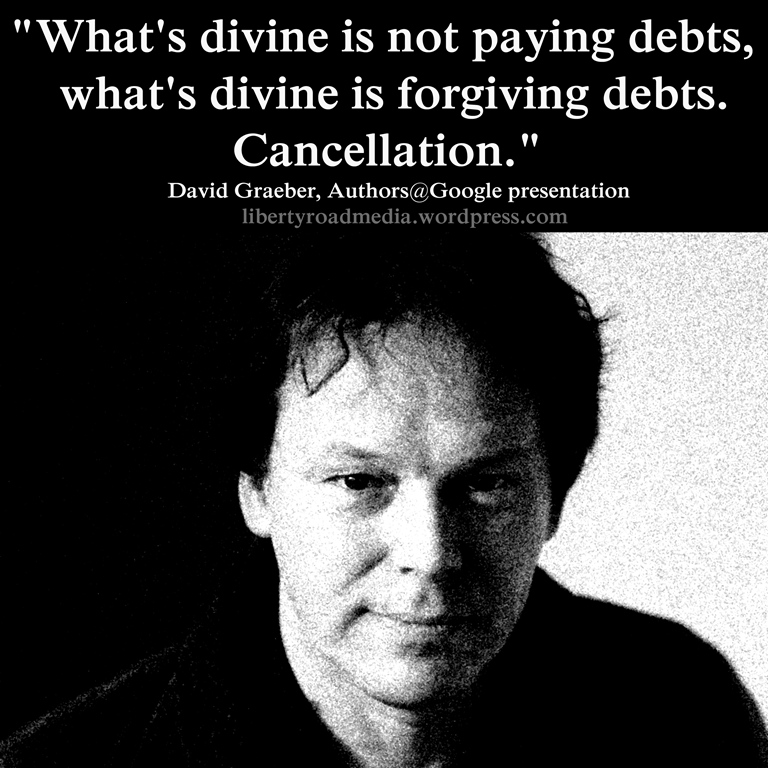
Divine is forgiving debts meme copy

Indeed, as Simon Heffer put it in The Telegraph when discussing the bailout of Northern Rock:

All capitalism is about risk. Rewards do not come otherwise. Sometimes risk is high; at others it isn’t. ”

So since banks can “lend” money at zero risk—as we have shown that banks do as a matter of course—there is no capitalism.  There’s especially not capitalism when the same banks can use the state to extract the artificial, fictional, risk-free money from people who can ill afford it, or even from those who can afford it.  The lie that banks lend money and take risks in doing so is now so thoroughly discredited that the current system which enforces that lie needs to be junked immediately in favor of one that accepts that all money is fictional and is only a means to an end, not an end unto itself.

I have proposed such a solution a number of times:

“Fiat currency is, in short, the most important financial invention ever because of the fact that–as the article states–it “is not backed by any tangible commodities.”  Fiat currency is the perfect form of money because it is admittedly and openly fictional, as all forms of money are (yes, even precious metals).  The problems with fiat only arise when: 1) it is treated as non-fictional and as the primary obligation of a person, taking precedence over life, liberty, and the pursuit of happiness, and 2) when the issuance of it is monopolized, which inevitably leads to the first problem.

Self-Issued Currency

The solution to these problems, then, is self-issued currency.  That is, every citizen in a fiat system ought to have the ability to issue his or her own money, up to any amount needed.  This will solve both of the problems above, because when self-issued currency becomes the norm, paying money will be as easy and as painless and as much as an afterthought as saying “Thank you” is now.  Problem one solved.  And obviously problem two is solved because there would be no monopoly on the issuance of currency, hence no unnecessary control over anyone or anything, either by the state or by the issuer of the state’s currency.

For those that might recoil in horror at such an idea, keep in mind that all money is fictional.  In fact, all money is already self-issued, as will be shown below.  Money must be created by someone, somewhere, because money does not exist in nature–except to the extent that a natural item like gold or salt might be assigned the properties of money.  Despite what the typical Western economics professor might say, money does not just naturally come into being as a consequence of people needing to exchange things.  Indeed, as Bartolome de las Casas observed of the native Cubans in the 16th century:

“…[the natives] put no value on gold and other precious things. They lack all manner of commerce, neither buying nor selling, and rely exclusively on their natural environment for maintenance. They are extremely generous with their possessions and by the same token covet the possessions of their friends and expect the same degree of liberality.”

That is to say, money is a creation of man, and as such, it should serve man, not enslave him.  Can it be that the “uneducated,” “pagan,” and “savage” natives of Cuba from centuries ago were more civilized and wiser about economics than we are today?  It certainly would seem so.”

I invite any critiques and/or suggestions on the above.  Whatever it takes to get this old paradigm immediately put out to pasture and give some relief to the millions of hard-working, honest people like Kevin Evans because to varying degrees, we are all Kevin Evans as long as the current system persists.  Let’s get a discussion going, a dialogue, let’s do something about all this!

Posted in Conspiracy, Crap-italism, Debt Slavery, Everything Is Rigged, Federal Reserve, fiat currency, Financial Terrorism, Financialization, Redistribution, Reverse socialism, self-issued currency, Too big to fail, Wealth transfer | Tagged , , , , , , , , , , , , , , , | Leave a comment

THEME SONG FOR LIBERTY ROAD MEDIA

Used to live off a Liberty Road in Mississippi.  My parents still live there.  I walked down Liberty Road from time to time and the name of the road and its potential for symbolism always stuck with me.  Tried to capture what I might think about while walking down Liberty Road…and liberty road.

This recording of the song is with my band Buffalo Nickel.  You can buy mp3s of the album (or just this song) at Amazon.com

Just To Be Free

(Clinton Kirby, BMI copyright 2011)

Walkin’ down Liberty Road

Carryin’ a heavy load

In your mind and you’re tryin’

Just to let it go

Everything you see stirs up memories

Mostly good, others might be best forgotten

Wouldn’t you like to be free with me?

Wouldn’t you like just to be free?

Walkin’ down Liberty Road

Your heart just might explode

From what you feel, it’s so real

Makes you kinda happy

Everything you see stirs up memories

No regrets or bad debts can keep you down now

Wouldn’t you like to be free with me?

Wouldn’t you like just to be free?

Posted in freedom | Tagged , , | Leave a comment

CALI ATTORNEY SPEAKS ON CURRENT STATE OF FORECLOSURE DEFENSE, GLASKI, AND JUDGES

california flag

Recently I had a discussion with a California attorney named David who defends homeowners against foreclosures.  David also allowed that he had once worked for a law firm that defended banks, so the combination of those two sides of  David’s experience were of course completely tantalizing to me.  He agreed to be interviewed and I sent him some questions via email.  What follows are David’s unedited answers to my 6 questions, along with an introduction by David himself.

Make sure you check out the whole thing, as David comments on Glaski and the granting of certiorari by the California Supreme Court to the Yvanova case (which held essentially the opposite of Glaski), as well as efforts to convert California from a non-judicial foreclosure state to a judicial one.

PREFACE: I have to preface my answers here by pointing out that I am a practicing lawyer here in California. As such, that is going to color my beliefs and my answers to these questions. I actively represent homeowners in foreclosure matters in California courts. If one wants to know what a lawyer thinks of this subject, my answers will be useful. If one believes that all lawyers are evil then what I say will not be of interest. I am just going to go ahead and answer things from my perspective and if one has or is contemplating legal action over a bad foreclosure, hopefully I will provide some useful information.

LRM: You remarked that you were used to case law that says “the banks win.” Can you elaborate on that?

Regarding case law that says “banks win” in California – In California there seems to be much case law that has developed over a long time, which effectively rules out many of the legal issues which can be successful in other states.

“Show me the note” defenses, for example don’t work in California.

Securitization arguments, with the narrow exception of the Glaski decision, which is currently being reviewed by the California Supreme Court, don’t work. There is even case law that an oral agreement or promise to delay a foreclosure sale is not enforceable by the homeowner, due to the fact that it is not in writing and should be considered an “oral modification to a written contract.” There is law that says once a Trustee’s Deed Upon Sale (the document that is created when title transfers at the foreclosure sale auction) is recorded, there is a legal presumption that the sale was conducted fairly. There is case law that says a homeowner doesn’t have “standing” to object to defects in the securitization process. It all adds up.

The net effect is that it limits the ways in which one can challenge a foreclosure. Even so, the only real chance one has of saving the home (as opposed to merely suing for damages post-foreclosure) is to get to court somehow before the foreclosure sale takes place, because once that TDUS is issued, it is all downhill for the banks. After that point, one can sue for money damages, but to get the house back you would usually need to prove fraud, which is proven to a higher burden of proof.

This is all in addition to the fact that non-judicial foreclosures are used 90-plus percent of the time here (as opposed to judicial foreclosures, which are in essence a lawsuit to obtain foreclosure and are the sole remedy foreclosing in some states), and when paired with a subsequent UD decision, it sometimes seems there is no due process to the homeowner. I could go on and on.

As lawyers practicing in this area in California, we’re often regaled by examples of how lawyers from other states “do it”, sometimes even by those lawyers. Anyone who has practiced can tell you however, that in California we have some of the most aggressive litigators there are. It is just that we are faced with a set of laws here which make it a very different playing field from, say, Florida. That being said, if you have a good case, pursue it timely, and hire a good attorney, there are still things that can be done to help you.

LRM: Do other attorneys (no names necessary, of course) that you have talked to feel that way?

The quick answer is yes. Well, good ones do. The quick buck artists, and those who are just too uninformed to know better don’t.

There are a lot of people who are well-meaning, but are inadequately informed.

But lawyers who are involved and knowledgeable about litigating these cases are aware of the challenges that we face here in California.

LRM:  You mentioned you had done work defending loan servicers–how did you get into and then out of that?

Since law school I have always been very adept at contractual law issues, earning top scores in several contractual-related courses. In part that was due to the fact that I studied economics as an undergrad and necessarily had some knowledge of banking and financial systems. Contractual law is something that I always have always found very second-nature.

Due to the glut of lawyers, most of the jobs that were available were for tort lawyers, and for the first few years of my experience I worked at some of the well-established local insurance defense firms. I worked for a very well-regarded local trial lawyer for several years, where I got invaluable experience. So, I received great training as a litigator, learned a lot about courtroom strategy, but I wanted to try something new. In the late 90s I was offered a job in the litigation department of a local firm that defended banks in wrongful foreclosure actions. It turned out that foreclosures were at a 22-year low at that point, but this firm had received a few wrongful foreclosure cases. I and other lawyers there worked hard and resolved those cases, some with trial and others without, and the work dried up.

I stayed there long enough to learn mortgage and foreclosure law well. I then put that to use years later in handling mortgage cases, including wrongful foreclosure cases for homeowners, and suits against loan modification law firms. (One of the things I do for my clients is I try to get their funds back from any loan modification or forensic audit or other foreclosure prevention scams).

The law remained largely unchanged for the next few years, until the National Mortgage Settlement and the Homeowners Bill of Rights legislation. When the HBOR was passed, a friend of mine extended me an offer to work on a contract basis full time for a local firm that represented servicers. My workload wasn’t what it could be so I took the assignment. That particular firm was counting on the HBOR having the result of turning California into a de facto “judicial foreclosure state” where non-judicial foreclosures were an option but where banks and lenders preferred to use the judicial foreclosure remedy. That business model didn’t take off and in retrospect seems rather foolish – banks and servicers love non-judicial foreclosures, they are cheaper, quicker, and the lack of due process to the homeowner means that there is a greater chance of succeeding. So, that is how I got out of working on the banking end.

But the good thing is that I got a very close inside view of what the banking industry, and the foreclosure law firm industry, thinks about the HBOR and its various issues. Many of the issues with the HBOR and the National Mortgage Settlement will take years to develop, as caselaw develops slowly (take Glaski for instance).

Since then, I have further engaged on the consumer side and have continued to get training and attend classes, participate in lawyers’ list serves, and to network with other attorneys to remain knowledgeable about the cutting edge of wrongful foreclosure litigation in California.

LRM:  Did you learn anything useful regarding foreclosure defense while behind enemy lines (i.e., defending servicers)?

Yes, very much so. There is no substitute for being employed at a firm that does one thing all day long, learning from others who have done the same. And I have to say that many of the issues I see foreclosure lawyers pursuing or inquiring about are complete non-starters here in California. My training allows me to be more selective and more accurate in my case evaluation. I know what works, what causes one to lose credibility with the Court, and how to deal with banking lawyers.

Many of the banking lawyers are fundamentally decent people, and if one starts accusing them of being in collusion with the banks and servicers to “steal the house,” suing the lawyers, etc. – which all might make for great grandstanding to non-lawyers – but without proof to support those claims it never goes anywhere (without proof) and it guts any respect the court or opposing counsel has for the case or the attorney. While most people tend to think of lawyers as powerful, equating an associate at a law firm who represents banks to a high level “bankster” would be like accusing the teller at your local branch of getting rich on the TARP bailouts. During the time, both times actually, that I worked on the “other side” of things, I was never asked to do anything unethical.

One thing I did learn from working on that side is that the quality of work by the plaintiff bar is usually substandard. For example, we would often see pleadings submitted by attorneys that contained very little in the way of supporting factual allegations. And we would frequently see Complaints which attempted to plead theories of liability that are not valid under California law. And I am talking about work coming from lawyers, not the work of pro per litigants and legal aid services (which usually have some of the same problems, in addition to the absence of an attorney). Quite often the Complaints and legal work would seem as if there were no underlying legal issue of merit, because if there had been, it certainly wasn’t being advanced in the papers that were filed. So, after awhile, one begins to get the feel for what one has to do to build credibility to the case.

I also learned that there are so many meritless (or at least poorly litigated) foreclosure cases, that if you can be the one who makes your case stand out and appear to have some merit, you can get a favorable resolution working with bank lawyers. Often the goal of wrongful foreclosure litigation is to encourage the bank to either stop a foreclosure proceeding, or to enter into a monetary settlement with the Plaintiff. Sometimes the bank will offer new loan terms, and forego the foreclosure, as a part of a settlement. One must litigate in a manner that builds credibility if this is to happen.

If one appears to be merely engaging in delay tactics, or pursuing litigation to see if the bare fact of a lawsuit – any lawsuit – is going to cause a bank to change its approach, in my experience the days of success for those strategies are few. Unfortunately, the majority of the cases I saw when I was on the “other side” were of that nature. And often, the eventual result of such approaches is that the client is left in a financially worse position – after paying attorneys fees, court costs, and any additional fees to the other side – from pursuing questionable cases.

So, what I try to do is to handle a case in such a way that the banks and the courts and the decision makers will take it seriously. And that includes having a professional relationship with, and respect for the other counsel.

I feel like what I‘ve learned has value, and is a fairly rare commodity in the plaintiff’s bar. I’m not going to risk my credibility in the legal field by engaging in a liar’s contest with the lawyers and non-lawyers who are not as qualified.

Of course, I’ve learned things on the plaintiff’s side as well. I’ve learned how emotional people get over losing a home, and how attached they are to their houses. I am humbled to have as a friend a former client who told me that his mortgage case, which involved a wrongful foreclosure, was the most difficult thing he’s ever gone through in his life. I enjoy the camaraderie that one gets from dealing with a “real” person (as opposed to someone working in the loss mitigation department of a corporation) and especially like achieving good results for real people.

LRM:  Do you think judges are naive about the foreclosure fraud or do you think they’re somehow in on it, even if being “in on it” means not “opening the floodgates”? What I’m really trying to get at is, why are judges letting this go on?

In answering this question, I have to go back to my preface that not all foreclosures are considered bad or wrong or fraudulent. I would like to change the lack of due process one gets in California with the non-judicial foreclosure followed by quickie UD system, but that is a legislative issue more than anything else. And I am working on proposals to change the legislation in California that relates to foreclosures, including one which proposes to make California a judicial foreclosure state.

First it is important to consider what the role of the judge is. At the Court level where facts are tried – the judge in trial court (which is either Superior Court in California State Courts, or District Court in Federal Courts) is required to follow the law as it exists at the time he or she makes the ruling. That means that the judge has to follow the precedent and statutes that are already there.

If one is bringing a case, knowing that it is contrary to existing law, just know that the trial court judge is not going to change existing law. One would have to be prepared to appeal the case to generate an appellate court opinion, which if published, would be citable case law precedent to do that. And sometimes, one would even need to plan to seek writ to the California Supreme Court to change a law, or to change it statewide.

The question asks about whether judges are naïve about fraud or in on it. In my experience, judges generally are not naïve. But you have to be able to prove the fraud, and especially with fraud, that becomes very case specific.

Sometimes, what certain litigants believe is a bad judge is really a judge who is restrained from considering certain issues because of the state of the law. In those instances, hopefully the homeowner’s attorney has prepared his or her client for the possibility that the judge may not see the great relevance of, for example, the fact that a certain loan servicer was known to employ robosigners. That won’t be because the judge is in on it, it might be because the legal theory that those facts relate to is just a non-starter in California (see above for answer to number 1).

That being said, any system is going to be imperfect and any system with people in it is going to be corruptible. I find that it is not productive for me, or my clients, to go into court believing the system is so corrupt that all the judges have been bought off, and that the only reason I would ever lose a motion is due to corruption. Such things can become self-fulfilling prophecies and most of the time I have a good idea of whether a strategy is going to work or not.

The lawyers I know who feel, or who say they feel, that the corruption is pervasive seem to play off of those beliefs in order to deflect their clients ire at losing. The lawyers I know who think that way also tend to lose a lot. Again, self-fulfilling prophecies. One has to ask, if the system is so pervasively corrupt, then why would anyone bother with an attorney who believes that?

Over any given year of practice, there will be a few times where a judge has made a ruling that is so contrary to the law or facts, or where the judge has seemingly bent over so far to try to help the other side, that I get suspicious. But it’s rarely provable. Ultimately, if you suspect something fishy is going on you have to weigh your options and decide the best approach for your case.

It’s far more likely that a judge (and there is one I am thinking about in particular right now) is frustrated with the glut of foreclosure cases, and due to his past as a member of a certain political group, or involvement with a certain real estate company, might be very one-sided about how he or she approaches foreclosure cases. One simply has to try to avoid such judges (with CCP 170.6 challenges among other things). If the bad judge or judges can’t be avoided, then you have to play the hand you are dealt, which may mean settling as opposed to going to trial.

If one does get a judge that is corrupt or unprofessional, I am a big supporter of one’s right to challenge questionable behavior by a judge, especially if that takes the form of unfair or unbalanced treatment from the bench. There are procedures for reporting a judge to the Judicial Council or to the Presiding Judge. In my career, I’ve reported one judge and have left it up to my clients whether to report judges in some other instances.

But I think the issue underlying the question, is one of why are the laws what they are? That comes from decades if not centuries of lawmaking and legislating in California which favors banking interests. Until the recent foreclosure crisis this was not something the average person cared about. Before that, everyone assumed that only bad people suffer foreclosures, and there was little political capital to make any changes. I think the political capital is there, and the case volume is there as well, to see the problems with the current system. The legislature is there and can be lobbied for these changes, and that is something I am a big believer in. I participated in a recent law day where a consumer lawyer’s group I belong to met with legislators and their aids about certain legal changes they were advocating for. I have started a legal foundation, which will be working towards this issue in the next year.

LRM: As I mentioned to you, some judges refused to follow Glaski back in 2013. But now that the CA Supreme Court has refused to have it de-published, do you think Glaski will help make any difference for the better for homeowners?

Since you’ve provided me these questions to answer, Yvanova was accepted for Certiorari by the California Supreme Court. I imagine that one of the reasons that this happened is that there is currently a split of authority in California with Glaski (and cases following it) and Yvanova (which rejects Glaski) being the law, depending upon one’s jurisdiction. From a due process perspective, I’d like to see it Glaski upheld.

Some who favor Glaski, myself included, feel that the case law that is critical of Glaski is inadequately reasoned. Sometimes the cases critical of the Glaski decision are conclusory in their analysis, merely stating that they find it “unpersuasive.” We can expect that the California Supreme Court will expound on it quite a bit more, but that decision is a few months in the future at least.

Posted in Foreclosure fraud, Securitization Fail | Tagged , , , , , , , , | 5 Comments

JUDGES: DUPES OR IN ON IT?– PART 2

You may remember the LRM story from March of this year which asked the question—in the context of mortgage foreclosures—“Judges: Dupes or in on it?”  From that article:

Judges have to know what’s going on.  They read the news.  They’re not naive.  We’re always told that judges can do whatever they want, and at some point one has to ask–if that is so, why does “whatever they want” almost always seem to be to throw homeowners in the street on the strength of fake documents?

However, at some point we have to ask ourselves, are the judges really dupes?  That is, do they really buy all the BS that Wells Fargo and the other banks are feeding them?  Do they really look at a case where there are affidavits swearing that an unendorsed note is true and correct and then suddenly a “ta-da”-endorsed note appears as a deus ex machina and say, “Yeah, I totally buy that?” Given the education and experience level of most judges that hear these cases, one would expect them to have pretty sensitive bullshit detectors.

The only other explanation is that the judges are somehow complicit.  That’s an uncomfortable statement to make and even more uncomfortable to actually contemplate.  And it seems almost impossible to pull off, but then again, it is being pulled off…”

And so it goes throughout the judicial system, as we see in this recent story in which a federal judge ruled that while the actions of squeaky-clean, harmless, upright (yeah, right) banks such as JP Morgan and Goldman Sachs did create greater profits for said banks, there was no conspiracy among them to do so.  The Daily Mail has the details:

…eight small U.S. aluminum consumers, which allege Goldman Sachs, JPMorgan Chase & Co and Glencore conspired to drive up prices by reducing supply.

One of the companies, Superior Extrusion, filed the first case in August last year, triggering over two dozen other companies to follow suit in what has become the highest profile legal action to rock the base metals market in two decades.

In an 85-page ruling last Friday that struck a big blow to their case, Judge Forrest said the plaintiffs did not show sufficient evidence that the banks and merchants intended to manipulate prices.

She did concede that the defendants’ actions had driven up prices of aluminum, which is used to make beverage cans and airplanes.

A distinction without a difference

Indeed, the judge put that last point this way:

“…this was an unintended consequence of rational profit maximizing behavior rather than the product of conspiratorial design,” she wrote.

That’s like saying an “unintended consequence” of a mugger putting a gun to a person’s head is said person giving all their money and jewelry to the mugger.  The judge attempts to  draw a line between “rational profit maximizing behavior” and “conspiratorial design” but since the effect of either is ultimately the same, she gives us a distinction without a difference.

The destruction of “price discovery”

Max Keiser and Stacy Herbert use this decision to illustrate one of their recurring themes—the evisceration of the “price discovery” mechanism, i.e., the mythical “invisible hand” idea that the free market will dictate the proper price for everything, making it okay that we all have to use money to pay these prices because the prices will always be set by the invisible, but assuredly correct if not benevolent hand of the market.  From their discussion (begins at approximately 9:41 in the video at the top of the page):

STACY: So they did this by basically…you would put in your delivery order.  You would request delivery on your order of aluminum and it would take up to 16 months.  So in that time, you were paying for a warehousing fees, and it drove up the profits for Goldman Sachs, JP Morgan, and and Glencore.

Well, it also drove up the price, obviously, of cabinets, flashlights, strollers, swimming pool enclosures, cans of Coca-Cola…And the judge found:

‘In an 85-page decision, U.S. District Judge Katherine Forrest in Manhattan said there was no showing that the defendants intended to manipulate prices, though it was clear that their actions affected the aluminum marketplace.

‘As cast in the complaints, this was an unintended consequence of rational profit maximizing behavior rather than the product of conspiratorial design,’ she wrote.’

So here she takes, Max, here this woman—Judge Katherine Forrest—takes Adam Smith’s thing and says that ‘the monkeys in the trees throwing money to these people who are scrambling for the stolen money’—this is ‘rational profit maximizing behavior.’

MAX:  Right. Exactly.  This repudiates all we know about economics—that she has no idea how economics works.  Obviously if you allow for fraud—this is what Adam Smith warned about in Wealth of Nations and The Theory of Moral Sentiments.  When you allow people to get together and collude and fix prices as these bankers do, you’re gonna have destruction of the price discovery mechanism.  The ‘invisible hand’ is worthless if you allow fraud to take place on this epic scale.

So clearly the judge has no—I don’t know why they would have a judge who’s an imbecile, who’s a financial illiterate, who has no idea actually how these markets work.  Obviously unless we’re gonna find out, in a year or two, ‘Yeah, she took a big fat bribe.’

STACY: So, let’s look for example, at JP Morgan.  They bought Henry Bath, which has been established since 1794.  They’re one of the founding members of the London Metals Exchange.  So we have over 200 years of data on how long it’s taken them for 200 years to deliver on clients requesting delivery.

MAX: Right—200 years of data.  It makes a perfect—200 years of records—to make an informed decision.  The judge looked at 200 years of data and made a ruling that repudiates everything that was staring her right in the face.  That is the definition of crony capitalism.  When the judicial system is in the pocket of bankers to rig markets, that’s crony capitalism.

Sounds an awful lot like the foreclosure fiasco—centuries of data, in this case, property law dictating how notes and mortgages move and behave being repudiated by courts all over America in order to help out the big banks.

Nothing new, unfortunately

Unfortunately, none of this is really new, which really isn’t all that surprising.  A great link came across my Facebook feed this weekend which tells the story of the Pullman strike of 1894.  In it, we learn that the government’s courts have always been joined at the hip with big business to the detriment of the working class:

[US] Attorney General Richard Olney was a leading railroad attorney who’d twice turned down appointments to the Massachusetts Supreme Judicial Court in favor of the railroad clients that paid for his Boston mansion. Though Olney accepted President Cleveland’s appointment to lead the Justice Department, he did so only after the President agreed that Olney could also remain in private practice. Yet, rather than treating Olney’s advice as suspect because of his obvious conflict of interest, Cleveland viewed Olney’s railroad ties as something that gave him insight into how to handle the strike.

[SNIP]

In the final days of the strike, Eugene Debs was jailed for defying a federal court order requiring his union to stand down and effectively give up its First Amendment rights. In order to obtain this order in the first place, Attorney General Olney’s handpicked lieutenant, a railroad attorney named Edwin Walker, worked closely with two judges — one of the judges had recently delivered a speech claiming that a single national union could “destroy the basis on which business in the long run can be successful and debase the man” — to craft an order that would give the Managers’ a total victory over the ARU if the union complied with it. After Debs defied the order, he was tossed in jail for contempt of court, where he shared a cell with five men, six mattresses laden with bed bugs, and numerous rats who would wander freely throughout the jail.

[SNIP]

Debs would eventually seek his freedom in the Supreme Court of the United States, but he would not have it. To the contrary, the Court’s decision in In re Debs asserted a truly breathtaking vision of the judiciary’s own power to shut down labor’s attempts to force negotiations with management. In essence, the Court’s opinion established that federal courts could issue sweeping anti-union injunctions with nationwide implications upon their own authority, regardless of whether elected officials had actually given them that power. In the coming decades, the courts would become the arch-enemies of labor. By the 1920s, after watching an entire generation of judges’ efforts to thwart the labor movement, American Federation of Labor President Samuel Gompers warned that “[t]hose who seek to retain the injunction evil and to expand it are doing the greatest disservice to our system of jurisprudence, and in fact to our system of democratic government.”

The Debs decision, moreover, was the harbinger of an era when the justices frequently treated laws intended to protect workers from rapacious employers as unAmerican and unconstitutional. In the years following Debs, the Court struck down laws intended to prevent employers from overworking their employees and laws guaranteeing workers’ right to organize and form unions. They declared the minimum wage to be an affront to the Constitution. And they doomed a generation of young laborers to a childhood toiling in coal mines and cotton mills. Few institutions inflicted more suffering on more Americans than the Supreme Court of the United States, and American workers bore much of the brunt of this suffering.

Indeed, the foreclosure fiasco and the fact that arguably, every market is rigged are merely a continuation of this policy of the courts inflicting suffering on American workers.

Posted in Conspiracy, Crap-italism, Everything Is Rigged, Financial Terrorism, Keiser Report, Price-fixing, Rent-seeking | Tagged , , , , , , , , , , , , , , , , , , , | 2 Comments

WANT TO “BEHEAD” ISIS? GET U.S. OFF OIL ASAP

UNCLE SAM BEHEADS ISIS copy

A recent Bloomberg article notes that “ISIS” is more or less a “Taliban with oil fields”:

“The Islamic State, which now controls an area of Iraq and Syria larger than the U.K., may be raising more than $2 million a day in revenue from oil sales, extortion, taxes and smuggling, according to U.S. intelligence officials and anti-terrorism finance experts. ”

Well, that’s very interesting, isn’t it? What if there were to be a sudden drop in demand for oil?  Wouldn’t that be a good thing in that it would diminish the money that “ISIS” has coming in?  And who could lead the way in such a drop in demand?  Why, none other than the world’s largest economy (for now, anyway): the good ol’ U.S. of A.

Does the technology exist?  Would it be possible?  An article at Scientific American from 2011 offers one take on it:

“Switch fleet vehicles to natural gas. Converting hundreds of thousands of cars, vans and buses to natural gas is technically not difficult, and because they operate from central hubs, they can easily fill up on natural gas there; there would be no need for a nationwide network of natural gas stations. Furthermore, many short and even long-haul trucks could operate in the same manner if only a small number of natural gas stations were built along major interstate highways.”

And of course, there’s Tesla and other electric cars:

When industry analysts, financial analysts and the motoring press have all lavished praise on a car, there’s a fair chance it’s a pretty good car.

That’s the case for the Tesla Model S electric car, particularly as two market analysts from Credit Suisse have seen fit to provide a point-by-point breakdown on just why the car is so good.

They even go as far as to say that Tesla has proven electric vehicles are “inherently better”, even if the general public doesn’t know it yet.”

So getting off oil in a big way, it can be convincingly argued, is not only possible in the short run, but also quite desirable in terms of geopolitical and health impacts (smog, emissions-related issues).  And thereby, lowering demand for oil would hurt the cartels and the oil peddlers, just as lowering demand for marijuana—by legalizing it, of course–has hurt the Mexican cartels that dominate the illegal drug trade:

The DOJ’s National Drug Intelligence Center, which has since been shut down, found in 2011 that the top cartels controlled the majority of drug trade in marijuana, heroin, and methamphetamine in over 1,000 US cities.

Now, those cartels and their farmers complain that marijuana legalization is hurting their business. And some reports could suggest that the Drug Enforcement Agency (DEA) is more interested in helping to protect the Mexican cartels’ hold on the pot trade than in letting it dissipate.

Seven Mexican cartels have long battled for dominance of the US illegal drug market: Sinaloa, Los Zetas, Gulf, Juarez, Knights Templar, La Familia, and Tijuana. While some smaller cartels operate only along border regions in the Southwest and Southeast, giant cartels like Sinaloa have a presence on the streets of every single region.

The Washington Post reported on Tuesday that pot farmers in the Sinaloa region have stopped planting due to a massive drop in wholesale prices, from $100 per kilo down to only $25. One farmer is quoted as saying: “It’s not worth it anymore. I wish the Americans would stop with this legalization.”

So why don’t we do it?

If getting off oil would have all these benefits–which would include stopping wars over energy—why don’t we do it?  Because it would stop wars over energy, that’s why!  As Smedley Butler, the most highly-decorated Marine in his day, said:

WAR is a racket. It always has been.

It is possibly the oldest, easily the most profitable, surely the most vicious. It is the only one international in scope. It is the only one in which the profits are reckoned in dollars and the losses in lives.”

War is more profitable than all the weed in Mexico and all the oil in the Middle East.  But that doesn’t change the fact that it really ought to be our patriotic duty and our goal as a nation to get off oil right now in order to stop these resource wars.

Posted in Everything Is Rigged, Iraq, ISIS, Middle East, oil, petrodollar, Price, War Is A Racket, World War III | Tagged , , , , , , , , , , | Leave a comment

RED ALERT—EVICTION OF MICHIGAN FORECLOSURE FIGHTER SET FOR TOMORROW, PEACEFUL PROTEST PLANNED

Stop Evictions _ letras enteras

You may remember reading the story of KathyJo Enders Torrenga and her family here on the site.  They are scheduled to be evicted from their Muskegon, Michigan home tomorrow morning.  This is happening despite the fact that the Torrengas have never missed a payment in over 20 years.

The thing that separates Torrenga from many of the people that are preyed upon in this manner is that she has not gone gentle into that good night.  She has chosen to stand up for her rights, and in so doing, she is standing up for the rights of every homeowner and would-be bank victim.  So anybody in the area that can get there, please do so!  Can’t have too many witnesses!  Contact info:

phone: 231-736-5235

email: greeneyes4224@gmail.com

https://www.facebook.com/groups/312950218852826/ Michigan Foreclosure Fraud

Here is a press release from the Torrenga family:

Please help save The Torrenga’s home with a Peaceful protest!

Tuesday September 2, 2014 6:30 AM

4224 E Laketon Ave, Muskegon, Mi 49442

Twenty two years ago, Kathy Torrenga and her husband, Dave, high school sweethearts, moved into their new home located in Muskegon, Mi. The first night in their home Kathy went into labor with their first born child. Now, with their impending wrongful eviction just days away, Kathy is in the labor of writing up their appeal, on her own! She has been unable to find an attorney to help defend her families home, from a company that does not exist in the state of Michigan. Something she pointed out to the Judge, but somehow that major detail was ignored, as well as left off the written transcript from their August 9, 2014 hearing.

How did this nightmare happen? Life was so good! They had always made their payments on time, at least 99.9% of the time. How could this be? Dave and Kathy are not deadbeats!

It all started in October 2010, when the Torrenga’s received an envelope addressed to Dave, with no return address, and nothing inside except a money order they had sent in as payment for December 2009, it had not been cashed. They had no idea why it was being returned to them. Kathy called the mortgage company’s customer service number and discovered the company was “out of business” and that a welcome packet should be received from the new lender soon.

Next they received in the mail, one thin paper from BAC HLS stating that they were the new “servicer” with a phone number to call, within three days. Kathy called immediately. She was told BAC HLS was a debt collector. They wanted to know what was owed on the mortgage, and what the Torrenga’s monthly payment amount was. Kathy was confused why they did not know these things already. Hadn’t SOMEONE been keeping an accounting of what they had been paying for years? It was at this time that they were told they were in FORECLOSURE! They were in a PANIC. They were not behind! Their payment to the old company wasn’t even due yet. That was when the nightmare started.

For almost three years, Kathy and Dave complied with each and every demand Bank of America Home Loan Servicing requested. At the same time, Kathy put her life on hold to research and investigate what had happened. She discovered what our Government most likely now knows, and is in fear of, a “slippery slope” verdict.

Bank of America didn’t do their paperwork on the Torrenga’s property and they have definitely underestimated the will of these homeowners.

For more information on this story contact:

phone: 231-736-5235

email: greeneyes4224@gmail.com

https://www.facebook.com/groups/312950218852826/ Michigan Foreclosure Fraud

Posted in Bank of America, civil rights, Everything Is Rigged, Financial Terrorism, Foreclosure fraud, Paper terrorism, Securitization Fail | Tagged , , , , , , | 1 Comment

SHOCKING INJUSTICE: MILGRAM EXPERIMENT TECHNIQUE IN AMERICAN COURT

So, having just written and posted an article about the nature of justice and whether or not it is random, I then encounter an article about more courtroom horrors:

A Maryland judge ordered a sheriff’s deputy to shock a defendant who would not stop citing “sovereign citizen” doctrine during a court hearing.

According to the court transcript and reported last week by the Baltimore Post Examiner, Judge Robert C. Nalley asked 25-year-old Delvon King, who was representing himself, to stop talking.

King, who was outfitted with an electronic shocking device on his leg, continued to challenge the validity of the case against him citing “common right and common reason,” and the judge ordered a Charles County sheriff’s deputy to administer the shock.

“Do it,” the judge ordered, according to the transcript. “Use it.”

The transcript does not indicate that King made any threatening movements toward the judge or anyone else in the courtroom or attempt to flee.

King immediately crumpled to the ground when the shock was delivered.

“He screamed and he kept screaming,” said his father, Alexander King. “When the officer hit the button, it was like an 18-wheeler hit Delvon. He hit the ground that quick. He kept screaming until the pain subsided.”

As I read the article, I wondered how long the shock went on.  I mean, how long was the shock actually delivered?  A microsecond?  One whole second?  Five seconds?  Apparently the pain was excruciating, and that was obvious to everyone in the courtroom.  One wonders how many times and how long the deputy would have continued to administer the shocks.  Until the young man suffered grievous injury, perhaps?  If the famed Milgram Experiment is any indication, the answer to that last question is yes:

“Indeed, by the fall of 1963, the results of Milgram’s research were making headlines. He found that an average, presumably normal group of New Haven, Connecticut, residents would readily inflict very painful and perhaps even harmful electric shocks on innocent victims.

The subjects believed they were part of an experiment supposedly dealing with the relationship between punishment and learning. An experimenter—who used no coercive powers beyond a stern aura of mechanical and vacant-eyed efficiency—instructed participants to shock a learner by pressing a lever on a machine each time the learner made a mistake on a word-matching task. Each subsequent error led to an increase in the intensity of the shock in 15-volt increments, from 15 to 450 volts.

In actuality, the shock box was a well-crafted prop and the learner an actor who did not actually get shocked. The result: A majority of the subjects continued to obey to the end—believing they were delivering 450 volt shocks—simply because the experimenter commanded them to. Although subjects were told about the deception afterward, the experience was a very real and powerful one for them during the laboratory hour itself.”

So what, you say—he’s in jail.  Why should I care?  Because if  we allow these devices to be used like this, i.e., as a free-speech impairment device, it won’t be long before such devices are in your or your child’s school.  Keep in mind, the man who received the shocks in the story above had not yet been convicted of anything. 

Shock bracelets have been looked into by the government—and rejected, for now—as a way to provide “safety” aboard commercial airliners:

So is the government really that interested in this bracelet?

Apparently so.
According to this letter from DHS official, Paul S. Ruwaldt of the Science and Technology Directorate, office of Research and Development, which was written to the inventor whom he had previously met with, Ruwaldt wrote, “To make it clear, we [the federal government] are interested in … the immobilizing security bracelet, and look forward to receiving a written proposal.”

The letterhead, in case you were wondering, is from a U.S. Department of Homeland Security office at the William J. Hughes Technical Center at the Atlantic City International Airport, or the Federal Aviation Administration headquarters.
In another part of the letter, Mr. Ruwaldt confirmed, “In addition, it is conceivable to envision a use to improve air security, on passenger planes.”
Would every paying airline passenger flying on a commercial airplane be mandated to wear one of these devices? I cringe at the thought. Not only could it be used as a physical restraining device, but also as a method of interrogation, according to the same aforementioned letter from Mr. Ruwaldt.

Posted in civil rights, Kangaroo court, Police State, Uncategorized | Tagged , , , , , | Leave a comment

JUSTICE IS RANDOM?

justice_thumb.png

Justice is supposed to be blind, but is it also supposed to be random?

I recently read where a foreclosure defense attorney who is definitely one of the good guys and has gotten many favorable rulings for homeowners said that—paraphrasing—his victories are “random” to a larger degree than most people would think.

He does point out that he still actually has to do the work, i.e., put together a proper pleading, cite the relevant law correctly, make the right arguments, etc.  In other words, what is meant by “random” in this case (pun intended) is not that he can just show up empty-handed and with no case preparation and it could go either way.  Rather, what he means is that it depends on which judge shows up, which attorney for the bank shows up, how the relevant documents are phrased, etc.

Still, this attorney’s comment confirms what a number of people in the anti-foreclosure community have long suspected—that “the law” really has nothing do with whether or not one will be made homeless or not.  The facts of the case are not the sole deciding factor.  Maybe not even the biggest deciding factor.  Maybe not even part of the court’s calculation.

Get off your high—and low—horse

I want to make clear that I do not at all mean to impugn this attorney in any way.  I’m just glad that someone within the system and who is squarely and unequivocally on the homeowners’ side admitted it.  It explains a lot and in some ways helps comfort the disturbed and disturb the comfortable.

That is to say, when a homeowner bemoans the loss of their home despite the law and the facts being in the favor, that homeowners’ disappointment and anger is easily painted by some as sour grapes and/or conspiracy theory.  In fact, it is often homeowners who win their cases—or strongly believe that they will win—who gloat over those who lost, accusing the losers of not doing it right, not understanding the issues, not having the right attorney, not having an attorney at all, not using the magic words and the magic argument, etc.  Turns out, though, that it’s random, so the losers shouldn’t feel so bad and the winners shouldn’t feel so good because it could’ve gone either way at any time.

Is this acceptable?

The question must be asked, though, is this apparent randomness acceptable?  Is there not some way to prevent said randomness?  I was under the impression that law school would’ve taught that following the law is the goal, but apparently in law school, those who can most successfully argue both for and against the law are the superstars.  This is presumably done in order to promote arguing for the law by having a student come up with—and then counter—arguments against it.  Indeed, this article from Westlaw sums this point up quite well:

The other side.

The hardest part of legal analysis, I think, is to keep one’s mind open to all sides of an issue. We tend especially in the adversary process to blot out opposing positions. We take a stand and justify it. But there is almost always another side, or several. And you can’t be sure that your view is (a) correct or (b) properly articulated and defended, unless you have asked yourself: “What can be said against my interpretation of the facts and the law, what would the other side argue?” A really good examination answer not only suggests the preferred solution, but it develops both sides of the problem.
You should master the technique of arguing in the alternative. If you deal with an issue and resolve it, and you are aware that had you resolved it the other way you would have had to deal with other issues consequent to the other solution, argue the point in the alternative. Don’t duck issues that the facts do invite you to discuss.”

Yes, it is certainly good to know what your opponent might try to use against you.  But one would think that just because an attorney who has become a judge has been trained to argue “in the alternative,” that does not mean that said alternative can be seen as being an acceptable decision.

Meanwhile, those of us who didn’t go to law school are taught that the law is the law—i.e., it is what it is–not what it can argued either way that it is (or is not), judges are impartial, and the truth will out due to the adversarial nature of the system, etc.  A Raw Story columnist puts it this way:

“In his diatribe, Senator Cornyn also said that the judiciary should be “an enforcer of political decisions made by elected representatives of the people.” I guess he hasn’t read a rudimentary civics textbook recently. The job of enforcing the nation’s laws would not be the job given to judges—the job of a judge is to interpret the laws, and when necessary, to arbitrate between laws that are in conflict with each other or with the Constitution. Judges are meant to be impartial and completely separated from and unaccountable to the elected representatives of the people. That is why federal judges are appointed to life terms, and thus removed from the political ebb and flow governing the daily life of politicians today.”

I realize that to some degree, this is getting out in the weeds, but then again, so is the idea that a homeowner who goes to the trouble to hire an attorney (or not) to fight a bank can keep or lose her house based on essentially nothing more than chance.

Solution?

Don’t have one, really.  Some would say that, “well, any system that involves humans is going to be imperfect.”  Yes, of course.  But we’re not really talking about imperfections or honest mistakes here, we’re talking about randomly making people homeless or not despite a clear, widely-known, openly-acknowledged pattern of fraud by these banks.

I actually do have kind of a solution, not that I think it will be implemented—or even that it should be implemented.  Just an idea.  Perhaps cases should be presented to judges as the fact pattern only, without any identifying details of the parties or their representatives (or lack thereof), just as in law school: A alleges that B defaulted on a loan with a, b, and c evidence, while B alleges that A committed fraud with x, y, and z evidence.  The judge doesn’t know which bank or servicer is involved and doesn’t know whether the homeowner is black or white, rich or poor, skinny or fat.  Nothing else but the facts of the case.  Like, nothing else.  Maybe that would help.  Or not.

But we gotta do better than random…

Because sometimes justice is buck naked, a little annoyed, and looking right at you with that sword raised…

Posted in civil rights, Conspiracy, Everything Is Rigged, Foreclosure fraud | Tagged , , , , , | 2 Comments

TOO MANY BROKE PEOPLE

fuel-gauge_thumb.jpg

We pulled in to the crowded gas station, and the pumps that weren’t yellow-bagged had people already pumping gas, so we pulled in behind a soccer grandmom in a white Toyota SUV to wait our turn for a pump.  Presently, my oldest son—who is 10 years old–said, “Y’know, I feel bad for people like that.”  I turned to look at him and saw that he was looking out the window at a woman sitting on the tailgate of her dilapidated pickup truck, holding a sign that said:

OUT OF GAS

BROKE

I hadn’t noticed her until that point, and as my wife got out of the car, headed into the store to get a few last-minute items, she gave the woman a few dollars.  Before I could reply, the white SUV in front of of us pulled out and it was our turn at the pump.  I noticed the price of the gas as I was pumping: $3.85.  Not as high as I’ve seen it here in Southern California, but not cheap.  I began to wonder how much gas the woman needed and thought that she wouldn’t be able to get very much with just the amount we had given her.  I wondered how far she had to go to get home.

I finished pumping and pulled ahead for the next person in line behind me to get access to the pump I had just used.  There was an open area by the curb just ahead of the broke pickup truck woman, so we pulled in there to wait for my wife to come out of the store.  I handed my son a few more dollars to give to the woman, and he was glad to go give her the money.  When he got back in, he made this simple yet profound pronouncement:

“Y’know the problem with today’s society? Too many broke people.

I told him that he was absolutely correct and was about to start pontificating when he continued:

“And y’know what happens when people are broke?  They might have to turn to crime.”

He was on a roll, and he continued:

“When I was in Mississippi, I saw at least 4 broke people. At least.  They were all broke and out of gas and couldn’t go anywhere.”

He had recently visited his grandparents in Mississippi over summer vacation, but this was the first time he had mentioned seeing these people.

The Powwow awaits

At this point, my wife came out of the store and got back in the car.  As we drove away, I asked my son to repeat his observations to her.  We were heading east down the 76, toward Pala, on our way to the 7th Annual Honoring Traditions Powwow, with a lively discussion about my son’s observations helping us pass the time.

He wondered if the broke woman couldn’t get a job for some reason and that her lack of employment might be why she was broke.  I told him being broke doesn’t necessarily mean one doesn’t have a job, that there is a phenomenon known as being “working poor.”  I told him that the fact that there are in fact too many broke people is not an accident—that as Stanley Druckenmiller and Dylan Ratigan–among others–have pointed out, we are witnessing (in Druckenmiller’s words):

“…the biggest redistribution of wealth from the middle class and the poor to the rich ever.”

We pointed out that my son’s observation about broke people having to turn to crime is also apparently part of the overall scheme, because in many states private prisons are guaranteed a high level of occupancy, as pointed out here in the Washington Post:

“The report from In The Public Interest, a transparency watchdog group, finds many state, county and local governments that outsource prisons to private corporations frequently sign contracts that guarantee a certain occupancy rate in prison beds. If governments don’t meet those quotas, the contracts require them to pay the firms for unoccupied beds.

Almost two-thirds of the agreements between county and local governments and private prison contractors have occupancy rate clauses, the study found. And in several states, those rates are sky-high: Three Arizona contracts require 100 percent occupancy; three Oklahoma contracts guarantee 98 percent occupancy. Two contracts in Louisiana guarantee that 96 percent of prison beds will be filled.

And of course the whole point of this is that once the broke person has turned to so-called crime due to broke-ness and been put in one of these private—or public–gulags, that broke person then becomes super-cheap labor for those that rendered the inmate broke in the first place, as pointed out in this Fortune story (you really must read the whole thing—it’s frightening) called “Prison Labor’s New Frontier: Artisanal Foods”:

’States like Colorado and California are at the forefront of a growing trend,’ says Genevieve LeBaron, who has studied the issue as a politics professor at the University of Sheffield in England. CCI, a self-funded state agency, is leading the charge with a burgeoning $65 million business that employs 2,000 convicts at 17 facilities. The idea: Offer small businesses a flexible workforce and give prisoners the chance to stockpile earnings and skills needed for life outside prison bars.

Says John Scaggs, Haystack’s marketing and sales director, referring to CCI: ‘They have land. They have human capital, the equipment. If you can think it up, they can do it, and do it fast.

[SNIP]

The practice has long been controversial. Prisoners earn meager wages and have no recourse if they’re mistreated, LeBaron argues. Plus, they can take jobs from law-abiding citizens. “It’s hugely concerning in the face of economic instability and unemployment,” she says.

Counters Smith: “These are coveted jobs.” Base pay starts at 60¢ a day, but most prisoners earn $300 to $400 a month with incentives, he says. To be hired, inmates must get a GED and maintain good behavior for six months.

Avocado Bag

One of the great things about driving the 76 is the preponderance of fruit stands on the side of the road, particularly those that sell bags of 25 avocados for $5.  They’re small, of course, but they’re locally-grown—nearby Fallbrook calls itself “The Avocado Capital of the World” and the freeway that we took to get to the 76 has signs posted billing that section of it as “The Avocado Highway.” We stopped to get a bag of 25/$5, and the seller had merely pulled up his truck onto the shoulder (which was almost a turnout-type of area) and set up a couple of folding tables in a L-shape underneath an EZ Up with his wares displayed beneath it.  A few yards away, another vendor had done the same thing with some different produce.

We pulled up to the avocado guy, who was selling every bag for $5—bags with 25 small ones, or bags with 4-5 big ones.  Quickly got my 25/$5, paid him and was back on the 76.  I pointed out to my son that vendors like that one were facing extinction, even though that is one of the oldest ways to make money (if not the oldest, wink wink), i.e., sell products on the side of the road.  For example, here is a story from Forbes (“The Inexplicable War on Lemonade Stands”):

In Coralville, Iowa police shut down 4-year-old Abigail Krstinger’s lemonade stand after it had been up for half an hour. Dustin Krustinger told reporters that his daughter was selling lemonade at 25 cents a cup during the Register’s Annual Great Bicycle Race Across Iowa (or RAGBRAI), and couldn’t have made more than five dollars, adding “If the line is drawn to the point where a four-year-old eight blocks away can’t sell a couple glasses of lemonade for 25 cents, than I think the line has been drawn at the wrong spot.”

Nearby, mother Bobbie Nelson had her kids’ lemonade stand shutdown as well. Police informed her that a permit would cost $400.

Meanwhile, in Georgia, police shutdown a lemonade stand run by three girls who were saving money to go to a water park. Police said the girls needed a business license, a peddler’s permit, and a food permit to operate the stand, which cost $50 per day or $180 per year each, sums that would quickly cut into any possible profit-margin.

In Appleton, Wisconsin the city council recently passed an ordinance preventing vendors from selling products within two blocks of local events – including kids who want to sell lemonade or cookies.”

Or how about this story from 2009, regarding the very place where we were:

A similar effort to investigate roadside produce vendors has taken shape in San Diego County.

‘We long had suspicions that illegal roadside vendors were a source for selling stolen product, but they are also undercutting the legitimate price of the product for legitimate growers,’ said San Diego County Deputy District Attorney Elisabeth Silva. ‘We’ve got a long tradition in this state for roadside stands, for farmers putting their product available directly to the consumer at a roadside stand and I don’t think the general public has any idea that they are contributing to a major theft problem’ by patronizing illegal roadside vendors.

In the Valley Center area of San Diego County, Silva and the Sheriff’s Department have cracked down on roadside vendors who sell avocados, citrus fruit, tomatoes, cut flowers and decorative plants. Like their counterparts in other counties, they first educated vendors about licensing and vending permit requirements and then checked back to see if those rules were followed.

What has happened is so far everybody who has received a warning and some education has left. It’s been real cost effective,’ Silva said.”

Turns out the state will get its cut one way or the other—either through the required permits or through locking people up.

Arriving at the Powwow

Powwow pic

We began to see signs for the powwow, and began to wind down the conversation because we would soon be getting out of the car.  We did point out that we were entering a reservation, which is where the Indians were made to live after having their land stolen, which of course fit into the overall theme of the conversation we were having.  Indeed, the history of these particular Indians on the tribe’s website puts it this way:

The land they had lived on for countless generations…now is controlled and used to the exclusion of the [Indians] by Americans who displaced them. As the Spanish, Mexicans and, later, the American trailblazers grew in number in the region, the [Indians] began to work in serf-like relations to the newcomers.”

Interestingly, the “eviction” of the Kuupangaxwichem (what the Indians who now live in the area referred to themselves as) wasn’t until the twentieth century—1903, to be exact.  The Indians had lost a quiet title case and fought it all the way to the U.S. Supreme Court, which affirmed the lower court’s decision, meaning that the Indians had to go.  The case, Barker v. Harvey, basically stands for the absurd principle that there is no more aboriginal title in California because Indians did not file to have their claim to their land approved by a 3-member board set up for that purpose under the federal Land Claims Act of 1851.  There was a two-year period to do so, and no Indians in California filed, so courts thereafter uniformly ruled that Indians in California had lost their aboriginal title.  Here are the relevant sections of the law as quoted in the U.S. Supreme Court case of Botiller v. Dominguez (1889):

“’SEC. 1. That for the purpose of ascertaining and settling private land claims in the State of California, a commission shall be, and is hereby, constituted, which shall consist of three commissioners, to be appointed by the President of the United States, by and with the advice and consent of the Senate, which commission shall continue for three years from the date of this act, unless sooner discontinued by the President of the United States’

[SNIP]

Section 13 declares:

‘That all lands, the claims to which have been finally rejected by the commissioners in manner herein provided, or which shall be finally decided to be invalid by the District or Supreme Court, and all lands the claims to which shall not have been presented to the said commissioners within two years after the date of this act, shall be deemed, held and considered as part of the public domain of the United States…

So having decided that the Kuupangaxwichem had to go, they were forcibly evicted from their ancestral home, as described on the website of the Pala Indians:

President Rutherford Hayes, prompted by the Supreme Court holding, declared the Indians ‘trespassers’ and ordered the tribe relocated to Pala, California, just beyond the Palomar Mountains where a 10,000-acre reservation had been established. Pala was a Luiseno reservation then, not Cupa. This act marked the first time in U.S. history that two distinct Indian tribes were herded together in one reservation. This was a blemish upon a nation that prided itself on leading the world into the 20th Century and the cultural and political renaissance that accompanied such a transition.

On the morning of May 12, 1903, Indian Bureau agent James Jenkins arrived with 44 armed teamsters to carry out the eviction. Rosinda Nolasquez — the last survivor of the expulsion — later testified that ‘Many carts stood there by the doors. People came from La Mesa, from Santa Ysabel, fromWilakal, from San Ignacio to see their relatives. They cried a lot. And they just threw our belongings, our clothes, into carts.’

The 40-mile journey from Cupa to Pala took three days. The Cupeños call it their ‘Trail of Tears.’”

And so we see that the people being broke, imprisoned, reduced to serfdom, and foreclosed and evicted is a longstanding American tradition.  It’s just that now it’s finally having that Niemoller effect—first they came for the Indians…and now they’re coming for the rest of us.

Too many broke people.  If a 10-year-old can figure that out, why do so many other people have such difficulty with the concept?  Hopefully they won’t, after seeing the evidence presented here.

Posted in California, civil rights, class war, Conspiracy, Crap-italism, Debt Slavery, Everything Is Rigged, Eviction, Federal Reserve, Financial Terrorism, Financialization, Foreclosure fraud, history, Police State, Redistribution, Reverse socialism, Wage slavery, Wealth transfer | Tagged , , , , , , , , , , , , , , , , , , | Leave a comment