By: Clinton Kirby and Glenn Augenstein
August 7, 2014
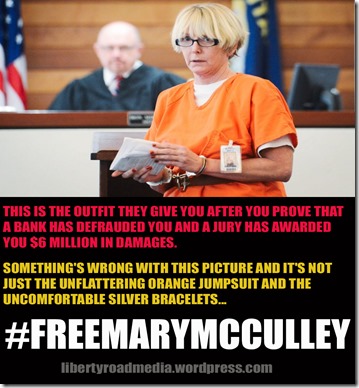
Readers of this site and/or those who otherwise follow the news about Mary McCulley may recall the interview with her published here on May 7, 2014, titled: “The $6 Million Woman: Interview With Mary McCulley.”
The May 7, 2014 story was published the day before a hearing to determine whether or not Mary would be released from prison. For reasons of discretion the entirety of the interview was not printed. Why give the government anything to use against her in the hearing the next day?
This led to some confusion about the nature of what actually happened in Mary’s case, and we received a number of emails about some of those issues. Had we decided to publish the interview in its entirety, the confusion would have been kept to a minimum. The questions we received ranged from the nature of the gun charge that kept her in jail for nearly a year, to why she entered a guilty plea regarding the charge of impersonation of a government official if she wasn’t guilty.
We didn’t disclose any more details in response to those questions but always wanted to because we felt that the story was incomplete without them. Mary has now appealed her sentence. As part of that appeal a number of documents have become publicly accessible. Within those documents are a number of details that Mary revealed in her interview but which, out of deference and discretion, we previously omitted.
The railroading of Mary McCulley
The omitted details touch on the nature of the plea-bargain system Mary was subject to. They also touch on the veracity and truthfulness of the story told to the government that led to her current incarceration. In the lay opinion of these writers, Mary was railroaded. Here we present sufficient facts for readers to come to their own determinations.
It is important for people to know the travails of those who, like Mary, fight back against fraud and corruption, so the people can appreciate the full magnitude of not only Mary’s courage (and those like her), but also of the enormity of the problem. It is important for them to know this so that: 1) they know they are not alone in this fight should they choose to engage; 2) they know they’re not crazy—the fraud they’re witness to is not imaginary, 3) and they can be aware how far the system may go to deprive them of their liberty and property.
Below are selections from publicly accessible documents in Mary’s appeal. Minimal commentary is included.
So why did she plead guilty if she wasn’t guilty?
In this exchange with J. Mayo Ashley, Mary’s second court-appointed public defender, Mary explains why she pled guilty to the impersonation charge even though she wasn’t guilty (from the transcript of a hearing on May 8, 2014 regarding whether or not Mary could be let out of custody and report on her own recognizance to the facility in which she would ultimately serve her sentence — the motion was denied):
Q (attorney Ashley) And you previously appeared before this Court and pleaded to impersonating a federal employee; is that correct?
A (Mary) I believe an employee of the government is what the terms were, yes.
Q And it is your position that you were somehow coerced into that plea; is that correct?
A Verbatim, what was said to me was that if I didn’t take a plea deal, I was not going to be able to take US Bank to trial.
Q Okay.
A Whether that’s coercion or intimidation, I don’t really know the terminology, but they made it very, very clear. And the importance of taking the bank to trial, as evidenced by these findings of fact, was not about the money. When Mr. Racicot talked about my bizarre behavior, which I’m assuming was in 2012, when I was in the civil litigation, what I witnessed was officers of the court fabricating evidence, making false statements to the judge, affidavits from senior vice-presidents of the banks that were false, and this was a very, very difficult thing for me to comprehend, not being a lawyer, not understanding that. And it was very, very disturbing.
Q But going —
A And —
Q But going back, Ms. McCulley —
A So — yes.
Q — you did tell this Court that you impersonated a federal employee?
A I impers- — I made up the name of the company. I was honest about that, DICS. I never used the word “federal,” I never said “United States,” and I did not use the word “government,” and there’s no such company.
Q Okay. But in any event, at that point, did you tell the Court that you were concerned about doing what you were doing?
A I believe I made a statement in September when the hearing was vacated that it was very important for me to take the bank to trial, and I believe, when the judge asked me if there was a side deal, I made a comment about going to trial with the bank. So at that point, I didn’t have a choice. I mean, it was very clear to me: “Take a plea deal, or you’re not going to go to trial with the bank.” So that’s what I did.
And that is what I did.
Q And the plea in this case, a criminal case, that occurred prior to —
A In October.
Q — to the civil case going to trial in Bozeman; is that correct?
A Correct. Correct.
Q Okay. And you’re basically telling the Court now that there was newly discovered evidence, or at least in your opinion newly discovered evidence, from the civil case that would somehow alleviate your situation here; is that correct?
A Yes. In my opinion, the government was misled, and if they reviewed the findings of fact by Judge Brown [LRM NOTE: Judge Brown presided over McCulley’s suit against US Bank in which a jury awarded her $6 million in damages] and the mentions of the closing 11 times where a lot of the documents were forged, altered, copied, those are the witnesses in this case.
Q Okay.
A So I gave Mr. Racicot [LRM NOTE: Racicot is the government prosecutor in the impersonation case] about 30 or 40 exhibits that were relative to the credibility of the witnesses against me —
Q Now —
A — and I feel like, yeah, yes, it does shed new light. It’s new evidence and proof.
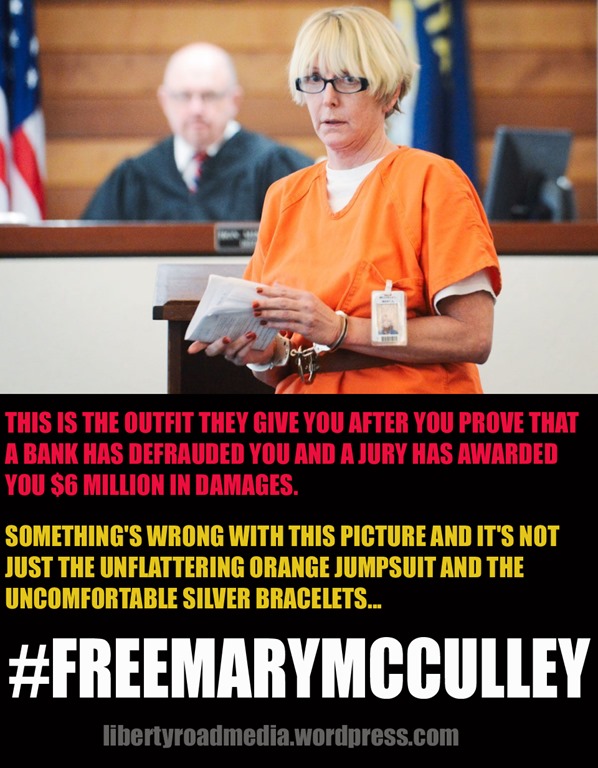
We think it should be noted that Mary originally pled not guilty to the impersonation charge, before she was railroaded into believing the only way she could take US Bank to trial—the trial at which a jury awarded her $6 million in damages—was to plead guilty to the impersonation charge. This information comes from a sworn declaration executed by Mary dated July 7, 2014, which states:
“In or around June 2013, I was indicted on several charges stemming from a civil law suit that I filed against the witnesses in 2009. I pled not guilty to the charges because I am not guilty. The indictment came just months after I won my appeal against US BANK, and the Montana Supreme court remanded the case back for trial.
I explained to my court appointed lawyer that the witnesses were not being truthful, and in fact were involved in the mortgage fraud that was slated for trial Feb 3, 2014. I explained that I believed they instituted this malicious prosecution to derail my lawsuit against them. My attorney stated this was not a defense, that he did not believe me, and said that if I did not take a plea deal, I would not be able to take the bank to trial for the fraud.
I understood that if new evidence arose, I would be able to withdraw my plea. At the plea hearing, I was reluctant to say that the company I created was ‘federal’ but my attorney pulled me aside and threatened me, and I then said “yeah federal whatever.” ( see transcript)”
So what about the gun charge?
Here is Mary’s explanation of the gun charge–which a jury of her peers ultimately found to be only a misdemeanor (see point #14 below)—from another sworn declaration by Mary, dated July 28, 2014:
“My name is Mary Ann Mcculley, I am currently incarcerated in SFF Hazelton, Bruceton Mills, West Virginia. I am making this declaration under penalty of perjury, all of these statements are true to the best of my knowledge.
1) April 25, 2012, I was arrested and charged with assault with a weapon, a felony.
2) I drove myself toward the Law and Justice Center to turn myself in for what I thought
would be an accidental concealed weapon violation.
3) The facts showed that I had left a 22 caliber birdshot pistol in an overcoat.
4) I was interrogated by Detective Ferguson for hours, I asked for an attorney 6 times, and they ignored my request. They failed to read me my rights before throwing me in a high security cell.
5) The affidavit of probable cause, and the reports filed by the police stated I had slammed down some papers, and said ‘This is my final offer you will sign’ and alternately ‘This is the last paper you will ever sign,’ and then pulled a gun and pointed a gun on the witnesses. This later proved to be false.
6)I was represented by a public defender, Chris Petaja.
7)I was held on a million dollar bail, despite not being a flight risk and being indigent.At the time, my civil lawsuit against the witnesses was due on appeal at the Montana Supreme Court. I was pro-se.
8)The witnesses against me were the defendants in the civil fraud case, Mcculley v US Bank and American Land Title Company. These are some of the same witnesses against me in these recent charges [LRM NOTE: i.e., the impersonation charges].
9)The DVD of the Witness interviews, given to us by the prosecution was blank.
It was six months before a DVD of the witness interviews was provided to us.
10) Upon review of the witness interviews, taped by the police officers immediately after the incident, it was discovered that the statements made by the police on the affidavit were false. There were no demands, no threats and no witness said that I had pulled a gun or pointed a gun at anyone. In fact, they specifically said I DID NOT threaten anyone and did not point a gun at anyone.
11)Subsequently, my attorney filed a motion for a Franks hearing, and a motion to dismiss the assault with a weapon charges, arguing the affidavit was fourth level hearsay and the charge arguably should have been a concealed violation.
12)The State conceded the information on the affidavit was false, the judge denied us the right to question the police officers, who had been subpoenaed- and I was rearranged with a new version of the story, after being held for nine months at this point on a million dollar bail.
13) During my incarceration, I managed to file my appeal against US Bank and American Land Title Company, hoping to overturn the summary judgment rendered by Judge Brown of Gallatin County.
14)I went to trial for the Assault with a Weapon charge in Feb. 2013, and was found not guilty of the weapon charge. I was released after serving nearly twice the maximum time for a misdemeanor assault.
15) In April 2013, against all odds, the Montana Supreme Court reversed and remanded that US Bank stand trial for fraud. I was indicted on these new charges within months of winning my appeal.
16) It is undisputed that one of the Governments witness was the manager of American Land Title Company where most, if not all of the fraudulent documents were signed and/or altered. According to discovery produced by one of the witnesses for the Government, the lawyer for the title company, the government witness was the one who altered the $735,000 Deed of Trust after I had left the closing, and was acting as an agent for the bank.
17) At all times these witnesses lied to the government and had motive to lie. US Bank was found guilty of actual and constructive fraud in February 2014. There is no question as to the participation of the government witnesses in the fraud and I gave the court these exhibits and documents on Feb 18 2014, when I testified and hoped to withdraw my plea.
18) Because the police filed the false information regarding the gun story on the arresting documents, and conceded doing so, I filed a lawsuit against them in Federal Court just prior to sentencing on April 25, 2014, alleging libel, slander, and intentional infliction of emotional distress etc 1983. The story, fabricated by these officers, was published from Seattle to Washington DC via the AP newswire.
19)This fictional version of events of April 2012 made it into the PSI. I objected and provided my attorney Michael Donohoe with the witness interviews and files from the district case to prove it was false. Donohoe, however, failed to correct the PSI – or properly object to the damaging false information.
20)This story, admittedly made up by the Bozeman police named in the lawsuit, was used by Judge Haddon in sentencing me with the upward departure. In fact, he read this story in the May 8 hearing, as if it was true and factual when it is actually complete fiction.
21)I had also repeatedly begged Mayo Ashley to correct the PSI and also provided him with the info needed to prove the story was false, but he said that ‘ no one pays much attention the the PSR’ and he did not file the objections.
22) No one outside of these witnesses, who the record shows have not been truthful with this court or with law enforcement, nor were they truthful with the court in the US Bank civil trial, has ever claimed I was a ‘danger to the community.’
23) The court received numerous letters acknowledging who I am in support of me , which the Judge ignored.
24) I moved home to be my mothers primary caretaker in 2010. My mother is 82 and in very poor health. Despite plenty of evidence that I am her primary caregiver, including regular visits from my pre trial probation officer, Judge Haddon claimed he had no evidence that was the truth.
25) I believe that I have more than served my time for an act of carelessness in 2012, ten months for an accidental concealed violation that had a maximum sentence of 6 months. To use this mistake to label me as ‘dangerous’ is not proper.
26) The government is in possession of extremely incriminating new evidence against the witnesses, and I want to withdraw my plea based on these facts and go to trial to clear my name.”
A good summary of the absurdity
The frightening absurdity of Mary’s railroading is laid out very plainly by her current attorney Lenore Albert (this is from pp. 17-18 of Mary’s “Urgent F.R.A.P. 9 Motion” which seeks a stay of Mary’s sentence as well as release pending the outcome of the appeal):
“She suffers from PTSD and is sitting in a medium security prison in Hazelton although, she herself, was never charged with a violent crime. In fact, she has no other prior criminal history other than the related state criminal proceeding where she was found not guilty for the charge of assault with a deadly weapon (the only other violent criminal charge she has ever had).
She was merely a photographer fighting bank fraud in pro per in a Montana civil court where she eventually won $1 million in actual damages for fraud plus punitive damages for the bank’s bad behavior that included, lying to the tribunal. Now how can the federal government rely on the statements by those same people in asserting their prosecution (of a purported crime that is rarely ever prosecuted and never prosecuted when there is no financial gain in reality, especially when it is reported on the eve of civil mediation by the opposing party who feigns the belief that the company D.I.C.S. is a federal agency of the FBI that he believed Ms. McCulley worked for–even though she had deposed that same man seven (7) months previously).
Then the USDOJ prosecuting the case, is not just any USDOJ, but the governor’s son. So in sum, this Court would have to come to the conclusion that a local ex-cop’s son (Tom Cahill) and the governor’s son (USDOJ Racicott) both had the reason to believe that Ms. McCulley impersonated a FBI agent to Tom Cahill because she walked up to him the day before their mediation and said she worked for a company called DICS. So that leads to the reasonable conclusion, she must be an employee of the FBI and is falsely impersonating one. This is what the people’s federal taxes are paying for?
Then in February it was proven that Tom Cahill is the same person who actually assisted in committing the fraud by changing the terms on the loan documents and/or land records. Yet, the USDOJ still does not dismiss the case even though the complaint was brought solely on the witness statement of Tom Cahill and his wife. There was no other independent evidence. Being thrown in prison in order to try to stop a person from continuing their civil suit for fraud, after being told they had to plead to one count or else they would not get their case to civil trial, is irreparable harm. It not only harms Ms. McCulley, but it also harms the federal government, the overcrowding of the BOP, and the people.
Finally, Ms. McCulley has been the sole caretaker of her elderly mom who has alzheimers. They were living in Kentucky. Ms. McCulley should be released to take care of her mom. Her mom’s health is also at stake. She already lost her uncle during her civil trial, it is doubted the government would want to sit idly by and see if Ms. McCulley’s mom also dies pending her incarceration.”
And there you have it
It is our hope the information presented here will help garner more support for Mary in the minds of the public and help create a groundswell of outrage against her incarceration leading to her release, and to righting the wrongs committed against her. From our own cases we know the filing of these types of motions, pleadings, and other papers feel like screaming pointlessly into a void. Does anyone even read them? Let’s all help assure that Mary isn’t screaming pointlessly into a void…and make sure she can catch a train straight back to the outside!





 LIBERTY ROAD MEDIA