With the intense focus on the supposed Islamic Bonnie and Clyde team of Syed Farook and Tashfeen Malik, a lot of people seem to have forgotten that the initial reports of the San Bernardino shooting on December 2 fingered 3 white guys. Cops on KTLA reported that witnesses said as much. One Sally Abdelmageed was an eyewitness to the tragedy, and she spoke to CBS news, as related here by Zero Hedge:
“I heard shots fired and it was from you know an automatic weapon. […] very unusual. Why would we hear shots? As we looked out the window a second set of shots goes off […] and we saw a man fall to the floor. Then we just looked and we saw three men dressed in all black, military attire, with vests on they were holding assault rifles. As soon as they opened up the doors to building three […] one of them […] started to shoot into the room.”
When asked what the gunman that shot into the room looked like the eyewitness replied:
“I couldn’t see a face, he had a black hat on […] black cargo pants, the kind with the big puffy pockets on the side […] long sleeve shirt […] gloves […] huge assault rifle […] six magazines […] I just saw three dressed exactly the same”.
“You are certain you saw three men,” the newscaster asked Abdelmageed.
“Yes,” said Abdelmageed.
“It looked like their skin color was white. They look like they were athletic build and they appeared to be tall.”
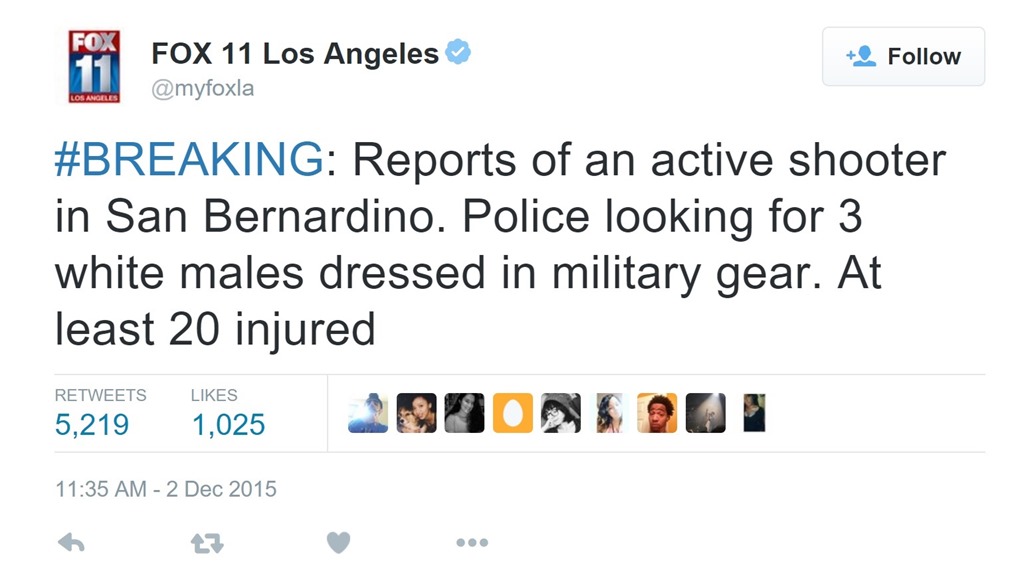
Indeed, the Fox affiliate in Los Angeles tweeted that police were seeking 3 white males in relation to the shooting, in this tweet helpfully screen-capped at patheos.com in a story by Lilandra Ra:
Hard to mistake 3 tall white guys with athletic builds for a guy and a woman who by most accounts is somewhat petite. You’d think witnesses would’ve noted that. On the one hand, the argument could be reasonably made that in the chaos of the moment, ascertaining the number of attackers might be difficult. On the other hand, though, that same chaos would likely burn the image of the attackers into one’s mind.
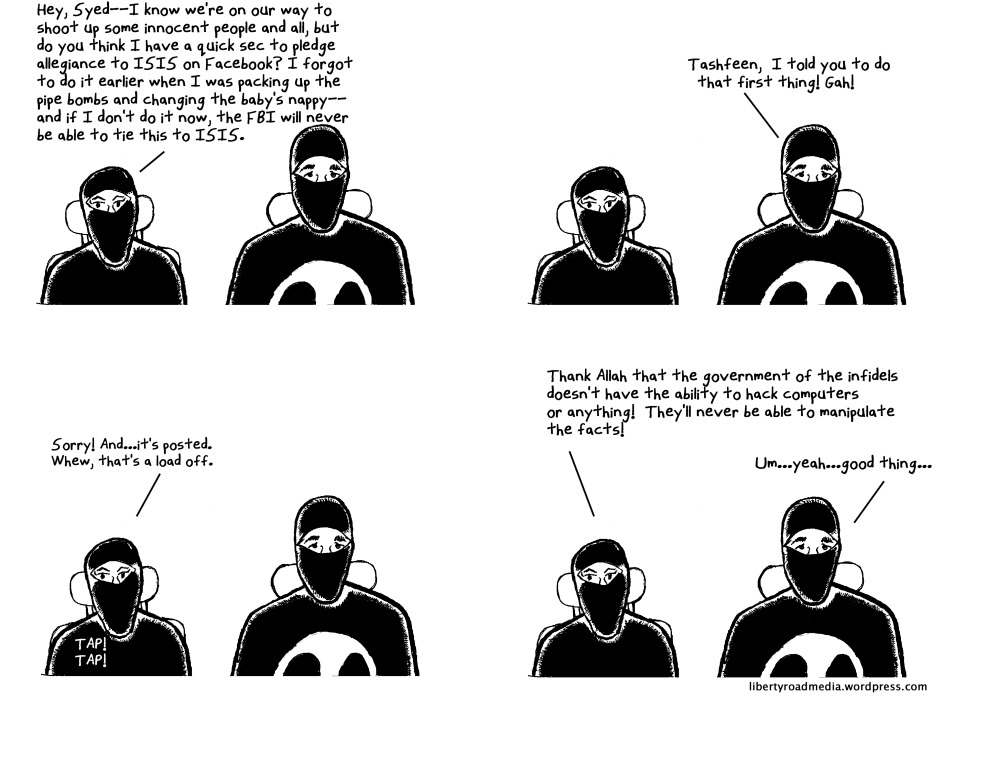
One of the more ridiculous aspects of the story, the “inexplicably intact passport” trope, we might call it, was that Tashfeen Malik “pledged allegiance to ISIS” on Facebook just before the attack. We imagine that (extremely unlikely) scenario here:
Oh, the smugness that doth flow from those who fancy themselves to be cold realists, allegedly harboring nary a scintilla of fantasy about the way the world doth “really work”—a way which these smug folk unfailingly describe with a single, hallowed (by them) word: “capitalism.” And the evil, fantasy-addled, childish, hand-holding, paternalistic, murderous, incentive-sapping, good-for-nothing opposite of the sacred capitalism for the smug folk? Again, a single word: “socialism.”
The main point
All I really want to do herein is to show how “socialism” is already a very accepted economic reality in the so-called “capitalist” systems of the western world. Not so much in the sense that it benefits the ordinary worker, although there is that aspect: social security, fire departments, national post offices, public schools, and the like.
Let’s not mince words: banks ARE socialism.
How’s that, you say? Confusion about banks being socialist is completely understandable, given that banks are always portrayed as being the pinnacle and linchpin of capitalism. Well, what is one of the most mainstream pejoratives regarding “socialism?” If you said “free stuff,” you…really know your mainstream pejoratives!
“O’Reilly pointed out that Sanders’ plan calls for free Medicare for all Americans, an increase in Social Security payments, guaranteed paid family and medical leave, tuition-free schools at all levels and much more.
‘The freebies and programs Sen. Sanders supports would cost the American taxpayer $18 trillion over a decade,’ O’Reilly said. ‘Obviously, that’s not fiscally possible unless the federal government begins seizing assets, which is certainly in line with the socialist philosophy.’”
The idea is that “free stuff”—whether money or goods—is objectively bad and of course, unaffordable when that “free stuff” goes to you or me, i.e., regular people. It’s objectively bad because it “kills our incentive” to work (i.e., be wage slaves) and it’s unaffordable because the tax money couldn’t be raised to pay for it. That’s the mainstream story, anyway. These are the reasons “socialism” supposedly “will never work.”
Those arguments are nowhere to be found, however, when discussing the free stuff—mainly money—that is given to the banks. We see O’Reilly above complaining that the supposedly horrible “socialist” programs of Bernie Sanders will cost us long-suffering taxpayers “$18 trillion over a decade.” That’s a drop in the bucket compared to the at least nearly $13 trillion that was spent on the bank bailout—i.e., free money to the banks—in only one year, as mentioned in this PBS article about the true cost of the 2008 bailout:
According to a team at Bloomberg News, at one point last year [2009] the U.S. had lent, spent or guaranteed as much as $12.8 trillion to rescue the economy.
That number sounds a little low, though, doesn’t it? Yeah, I thought so too, and it turns out ol’ “Feel The Bern” himself helped instigate an audit of the Fed which revealed the bailout number to be somewhat higher, more like $16 trillion, as pointed out in this story from Forbes (as opposed to say, “Socialism Today”): “The Fed’s $16 Trillion Bailouts Under-Reported.” Here’s some of what the article had to say:
“The audit of the Fed’s emergency lending programs was scarcely reported by mainstream media – albeit the results are undoubtedly newsworthy. It is the first audit of the Fed in United States history since its beginnings in 1913. The findings verify that over $16 trillion was allocated to corporations and banks internationally, purportedly for “financial assistance” during and after the 2008 fiscal crisis.
Sen. Bernie Sanders (I-VT) amended the Wall Street Reform law to audit the Fed, pushing the GAO to step in and take a look around. Upon hearing the announcement that the first-ever audit would take place in July, the media was bowled over and nearly every broadcast network and newspaper covered the story. However, the audit’s findings were almost completely overlooked, even with a number as high as $16 trillion staring all of us in the face.”
If that isn’t “socialist”/”free stuff” enough for you, don’t forget good ol’ quantitative easing, or QE as it’s more commonly referred to. That Federal Reserve handout to the banks started in 2008 (continued through most of 2014), for a total of almost $4.5 trillion, or almost $1 trillion a year given to banks. Free stuff for banks. Here’s a little blurb on that fiasco:
“It’s the end of an era. The Federal Reserve has called time on its $4.5tn quantitative easing programme on Wednesday after more than five years. It was a radical departure for monetary policy, designed to steer the world’s largest economy through the depths of the financial crisis. As the US backdrop steadily improved in the aftermath of the Fed’s cash injection, the central bank gradually slowed its bond-buying programme from $85bn a month to $15bn a month. Here are six key charts tracking the period since QE began in late 2008…”
So with just the bailout and QE, we can see that banks were given free stuff—i.e., money—to the tune of over $20 trillion (with a “T”) in just 5 years. Pretty good deal for the few thousand people (give or take) that really run/profit from commercial banking. But O’Reilly is worried about something that could improve the lives of hundreds of millions of people that would cost less than that in twice the number of years?
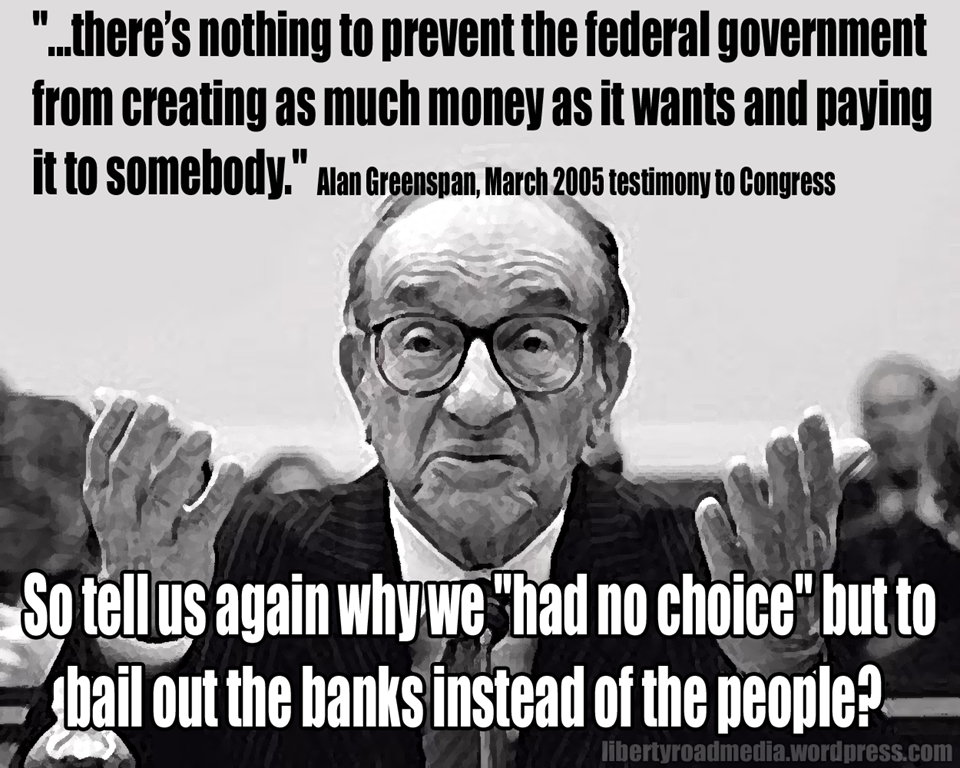
So, socialism: good or bad? Well, I think we can see that socialism is a great thing if you are the beneficiary of it, as we can clearly see that banks are. Has all the free money rid the banks of their incentive? No, it clearly hasn’t. Has it been “affordable?” Well, since the money was created out of thin air, pretty much. That doesn’t mean that taxpayers aren’t put on the hook for it, but the Fed could print up $20 trillion tomorrow and give it to the banks. And then do it again every day for the rest of eternity. Because that’s how money really works. It’s an illusion—that’s the nice way to say it. What it really is is fake. Pure and simple. And that part about the Fed printing up as much as they want? That’s not a joke. Alan Greenspan said it:
We also know it ain’t no joke because it clearly happened in real life. I’ll give you that they didn’t print up $20 trillion in one day. No, they just printed up $9.1 billion a day, every day for 6 years (I figured up 2008-2014, $20 trillion/2,190 days=$9,132,420,091 per day). Printed it up “out of thin air”–that is, the money did not exist before it was just willed into being, ex nihilo. And then gave that to the banks. THAT is “how the world really works.” And it’s socialism/”free stuff”—for the banks.
But now the “serious” and “sober” pundits want to complain that doing the same for me and you—i.e., bailing us out instead of the banks–is gonna be a big problem and they vilify socialism, the very teat from which their banking paymasters have been suckling since 1913. So which is more “socialist”—Bernie or bailouts? Bailouts by far, as Bernie’s plan will only cost $18 trillion in money out of thin air over a decade—by the numbers of some of the main naysayers, while the bailout cost $2 trillion more than that in only 5 years. It’s time for the capitalism cheerleaders to admit to themselves that socialism is and has always been the real economic model on which this country has run. It’s just been socialism for the rich and for the corporations, who supposedly “deserved” it or “earned” it. Time for that socialism to go where it really belongs–to the people.
Go figure—Bernie Sanders is less socialist than banks. I hear a campaign slogan in there somewhere…
It seems that there are those who just cannot accept the idea that what Officer Ben Fields did to the young female student in the South Carolina classroom was unjustified, even though his boss has now fired him and said that Fields acted in violation of his training. Still, some vehemently defend Field’s violent takedown of a non-violent, non-threatening young woman.
Dueling objectives
But the question must be asked—what was the objective here? It seems to me that there is 1) the sort of reasonable objective, which is to get the student to obey the rules, and then there is 2) the objectionable objective, which is to summarily and violently demonstrate what happens to those who won’t comply, a show of force to intimidate others into compliance, which is just a hop, skip, and jump away from terrorism (and maybe not even that far from it).
Most defenders of what happened in that classroom use the reasonable objective as a cover for the objectionable objective. That is, the defense of Field’s violence boils down to something like this: “Well, the girl was being disobedient and defiant and wouldn’t listen to any authority figure, so what choice did they have but to manhandle her?” It seems to make sense on the surface—she repeatedly disobeys, so she must be dealt with.
How to peacefully get someone to leave a room against their will
But what is it that everyone, including Officer Fields, wanted this girl to do? They wanted her to leave the room. It was a pretty simple request, which she obviously didn’t go along with.
However, there are better, easier, and completely non-violent ways to make a student leave a classroom. One obvious way—carry her desk out of the room with her sitting in it. The teacher could’ve helped carry it. It’s clear that the girl’s weight and size was not an issue for Officer Fields. Or, slowly and carefully push the desk out of the classroom, with her still sitting in it. Problem solved—she’s out of the room, and class can continue. No one gets hurt, no one loses their job. The reasonable objective—getting the students to follow the rules—has been achieved.
Everything looks like a nail…
No one objects to making sure that students follow reasonable rules, like not disrupting class. Schools did that fine without police officers for decades, and continue to do so. Indeed, apparently only around 30% of schools have “resource officers” like Fields, yet apparently continue to function and even thrive.
But when you bring in a hammer—i.e., a police officer—every problem looks like a nail, as the saying goes. So simple, non-threatening, non-violent—and completely normal–non-compliance like this South Carolina teenager exhibited gets converted from “she’s in a bad mood” to “take her down with extreme prejudice.” A hammer’s gotta hit a nail, after all.
And a lot of the public buys into this logic, mostly because of the myth that police presence “keeps us safe.” It’s hard to argue that this teenager in South Carolina was “kept safe” or that Fields’ violent treatment of her kept any of the other students safe. In fact, just the opposite is true—the girl was physically hurt and one leg of her desk almost hit the student behind her in the face when it went flying.
Common sense
On Facebook, I was accused of not using “common sense” in rendering my judgment of the classroom incident. It was so obvious to my accuser that this girl deserved to be thrown about the room, all because she, like every teenager at one point or another, refused to do something an “authority” figure asked of her. However, as can be seen, behavior like that of the police officer is only “common sense” if one thinks that the true objective of school, rules, and school rules, is to enforce the rules on pain of, well…pain.
However, it makes much more sense to find the least combative and least harmful, and non-violent way to resolve such situations. Like simply carrying or dragging the girl’s desk out of the room, with her in it. So, to the Richland County School District and any other school districts around the country, I’m available for common sense consulting for a reasonable fee!
She continued to refuse, and at that point the video shows the deputy flipping the teen backward and then throwing her across the room. At that point, Lott said, Fields did not use proper procedure.
“I can tell you what he should not have done: He should not have thrown that student,” Lott said during a news conference.
And so the classroom cop has been fired:
COLUMBIA, S.C. (AP) — A deputy was fired Wednesday after video showed him flipping a teen backward out of her desk and tossing her across a classroom, with the sheriff saying the officer did not follow proper procedures and training.
Note that last par: the sheriff—not “bleeding heart libs” or “Black Lives Matter” or supposed foot soldiers in the non-existent “war on cops”—said that the officer did not follow procedure or training. The sheriff said that.
The sheriff did not say that non-compliance by a student justifies treating a student the way the classroom cop did. That’s because the sheriff knows that’s not true, and all of us who saw the video and shared it and expressed our outrage also know that’s not true. But police state defenders like Harry Houck want very badly for non-compliance to justify violence by cops, as he noted in a CNN interview we wrote about yesterday:
“It’s as a result of a failure to comply. If that girl got out of the car — got out of the seat when she was told, there would be no problem,” Houck insisted. “But apparently she had no respect for the school, no respect for her teacher, probably has no respect at home or on the street, and that’s why she acted the way she did.”
This is great news, but imagine if there had been no video, and no outrage on social media. This classroom cop would still be prowling the halls, threatening the very people he was supposed to protect. So if that’s what it takes to keep the police state in check (and maybe even begin to wither away), always keep your phone at the ready, have a YouTube account, and keep ample space available for recording at all times.
By now, most people have seen the video of a South Carolina school cop throwing around a non-violent teenage girl like a ragdoll:
Very shameful behavior on the part of the cop. Such use of force could possibly be justified if the teenage girl were armed, threatening the cop or other students, acting extremely violently, strung out on drugs and a danger to herself or the other students and/or the teacher, etc. None of that seems to be the case. Not from what can be seen in the video, anyway.
The cops, however, do justify this use of force for the following reason: she didn’t comply. She didn’t get out of the desk when the cop told her to. Therefore, non-compliance is the excuse for the violence that ensues. That is the purpose of the police state—to coerce compliance with whatever you are told to do. Doesn’t matter whether it’s legal, lawful, justified, or not—you are not allowed to not comply. That’s the message, spelled out very clearly by former NYPD cop Harry Houck in a CNN discussion about the South Carolina school incident:
“It’s as a result of a failure to comply. If that girl got out of the car — got out of the seat when she was told, there would be no problem,” Houck insisted. “But apparently she had no respect for the school, no respect for her teacher, probably has no respect at home or on the street, and that’s why she acted the way she did.”
That’s when you know you’re in a police state—when you, as a citizen, have no choice but to comply or die. Comply or be violently manhandled. Compliance is above every other consideration. That’s not freedom. Not even close.
We are not put on this earth to obey cops. They work for us—at least, we pay their salaries, so they’re supposed to work for us. But clearly they are working for someone who doesn’t have protecting our freedom as the first consideration—no, whoever they are working for has our compliance as the first and only consideration.
Professor Max “Planck” Keiser again breaks down for us what is really going on in Episode 827 of the Keiser Report. Professor Stacy “Einstein” Herbert tells us that in the past few episodes, she and Max had been talking about charts that showed the real economy diverging from the financialized economy in a way that had never happened before.
As she says:
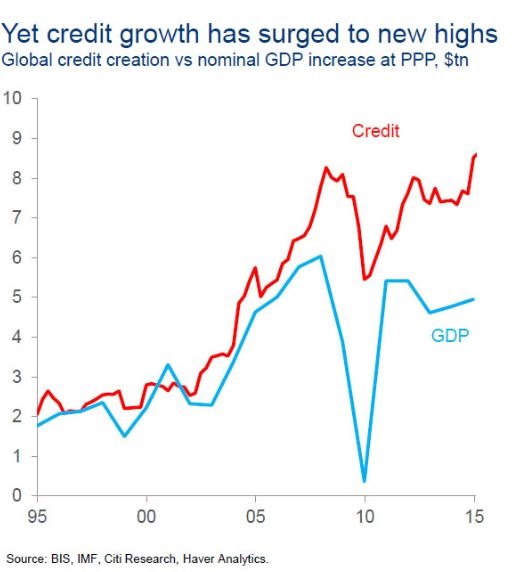
“I thought about this from Episode 825 where we looked at that chart of the red line credit growth and the blue line GDP…”
“…because there has to be—just like when an astrophysicist, or somebody like Einstein looks out into the universe—they’ve never actually observed a black hole. What they are able to determine—that there are black holes—is by the effect around it.
So I was like, ‘there has to be some hidden force there that we’re not capturing’ [she points to the chart, pictured above]…All sorts of charts in our financial universe used to go together, now they’re separating.”
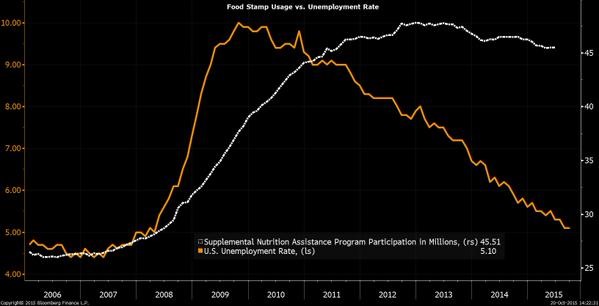
She then shows the chart above titled “Food Stamp Usage vs. Unemployment Rate” (unemployment is the orange line, food stamps the white line). Indeed, in both charts, it is obvious that until about 2007 or so, credit and GDP moved together as did food stamp use with unemployment.
So what happened? What changed?
Back to Stacy:
“As you can see, there’s some sort of hidden force there that’s driving them apart in a way that shouldn’t exist.”
Shouldn’t exist, that is, if the markets weren’t rigged and the whole financial system weren’t based on fraud, securities that are as valuable as empty paper bags, etc.
Stacy once again:
“So there’s a hidden force, and I think this is the financial fraud and the deflation going on.”
Max, as usual, sums it all in very pithy phrase:
“The black hole of debt is starting to warp the financial universe.”
But when debt is created by a bank, it writes a positive entry for itself on the asset side saying “Here’s a loan, which we’re going to get an income stream from you out of,” and a negative entry for itself on the liability side saying “Here’s the money we have loaned you.”And it’s simply double-entry bookkeeping. There’s no cost involved in doing it. So if we set it up and rewrite it, debt can be written off easily, and in fact if you don’t allow debt write-offs, capitalism will always collapse into a black hole of debt. And that’s what we’ve got. Greece, unfortunately, is deepest into the black hole.
And that is the problem with the fake money system—i.e., “quantum-tative” easing (based on Max and Stacy’s comments above)–to which we are currently more or less enslaved. The fake money created by the banks and enforced on pain of asset confiscation (i.e., foreclosure) if not outright imprisonment is the problem. And only until there is some kind of national acknowledgment, even in secret, that this is so—and then action taken to correct it–the problem will continue until either a) everyone in America but the 1% is starving and homeless, or b) WW III begins.
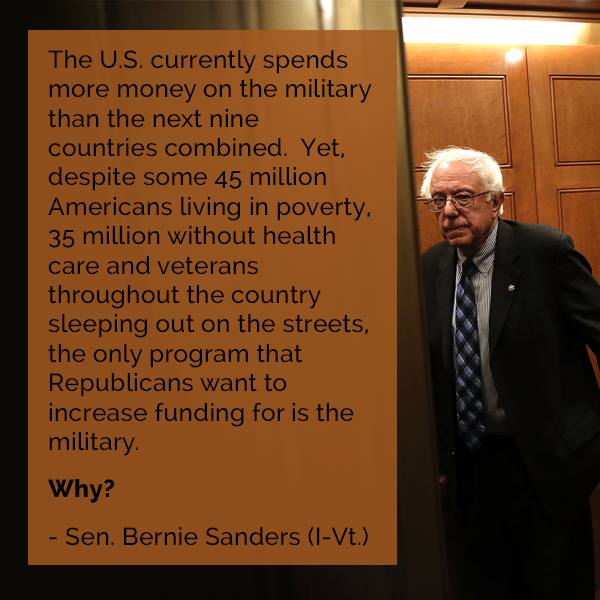
Last night on Facebook, I was asked this question after I posted the above meme:
If Sanders is so against the bloated military budget, why does he keep voting in favor of it?
My knee-jerk answer was essentially, “nuance,” i.e., defense spending gets tied to other things. I did a little research, and then answered a little more coherently:
“Consider HR 2642. It contained an expansion of GI Bill benefits that he co-sponsored. But it was attached to Iraq War funding, so he voted yea. I should point that the HR 2642 I’m talking about was from 2008, and is but one example of this apparent contradiction between Sanders’ rhetoric and voting record. I think that he’s actually quite consistent between record and rhetoric when viewed in the milieu of the tit-for-tat, compromise world of Congress. A good analysis that confirms my first impression above can be found here…”
Michael Arria’s widely read but rarely analyzed Alternet article “Bernie Sanders’ Troubling History of Supporting US Military Violence Abroad” mentions in passing:
“While it’s true he voted against the Iraq War, he also voted in favor of authorizing funds for that war and the one in Afghanistan.”
Arria’s statement is correct but also distorts Sanders’ stance on funding the Iraq war by omission. His voting record on the bills that funded the Iraq war show that he voted against them more often than he voted for them. Additionally, his ‘yea’ votes show that there were other considerations at play.
On the most recent episode of the Keiser Report, Max and Stacy open the show with a discussion of the chart below, which shows that the top 1 percent of the world’s population owns half of the world’s wealth, and comes from a report discussed here: “Richest one per cent owns more than half the world’s wealth”:
Max Keiser explains one aspect of how this extremely inequitable situation came to be beginning at approx. 1:14:
“Let me give you a brief history on how this all took place and why it all happens. You see, to make the comparison to the atomic age, when it was possible to split the atom. You created atomic weapons, and the balance of power of the world changed, and we live in a new post-nuclear age. Or a nuclear age.
Now in the 1970’s and early 1980’s, it was possible to split risk and reward, with something called the ‘Options Volatility Formula.’ And thus began the age of the derivative contract. And the derivative contract allowed for the top 1% to siphon off cash without taking any risk. That’s how the top 1% becomes the top 1%—not by making more, but by taking less risk.
They put all of their financial risk into the public domain, where it shows up as infrastructure collapse, or taxes, or corrupt politicians, or corrupt police—and the concentration of wealth that is the result of being able to borrow at zero percent, grab assets without taking any risk is this [referring to the global wealth pyramid chart above].
The solution is to re-introduce risk in an equitable way into the global markets. But that conversation’s not even taking place on any level because no policymaker in the world understands the history of derivatives, the options volatility formula, and the progress of this concentration of wealth in the top 1%. So there’s nobody even talking about it, so I don’t see any solution happening, other than what we’re seeing, which is the youth of the world staging a global insurrection against banking occupation. We’ve talked about GIABO [Global Insurrection Against Banker Occupation] on this show for years…and bankers are an occupying force, using…modern weapons of financial terrorism…derivatives.”
Here is the video of the above:
In other words, it is not “capitalism” that has enriched this 1% of the world’s population. No, because capitalism is supposedly all about risk. This is expressed rather succinctly and eloquently by British journalist Simon Heffer here:
“If you don’t want to accept that you might lose money at capitalism, then don’t play the game.
This ought to be self-evidently true for shareholders – but it applies to depositors, too. All capitalism is about risk. Rewards do not come otherwise. Sometimes risk is high; at others it isn’t.”
“Did you get that? [The Bank of England] said it themselves—banks do not give “thousands of pounds of banknotes” when they make a “loan,” banks just credit an account with a bank deposit “of the size of the mortgage.” In other words, bank “loans” are not cash, they are merely keystrokes in a database that says you now have money in an account whereas you didn’t have that money the few seconds before the keystrokes were made. That’s it.
So since bank loans aren’t cash—says the Bank of England, not me—what risk is there in bank lending? None at all.But the idea that a bank “loaned” someone…money—and took a real risk to do so—is the entire logic behind punitive wage garnishment, foreclosure, debt collection, etc. But that idea is totally false.
How many times have we heard those words—“did you borrow the money?” That’s the justification for our entire system, but it is based on an entirely false premise. The question should really be asked back—“did you loan the money, or did you just hit an ‘Enter’ key on a computer?” Because the real answer to that question is the latter, and that means that there is no risk in bank lending, whether that be for a mortgage, education, car, credit card, or what have you.”
Since there was no risk taken by the banks, there is no cause for reward. It’s very simple. Max Keiser commented on this phenomenon before, perhaps nowhere more aptly than this exchange with the great Michael Hudson, transcribed in this LRM post headlined “THE BANK VS. YOU: ASYMMETRICAL WARFARE”:
Max Keiser (begins at 17:42): If we look at the recent history of these financial predators going back 5 or 6 years, they were making these no-income, no-asset loans–NINJA loans–to people, really in a way that was completely asymmetric, if you will, in terms of their risk. Because the banks were able to sell that risk on whereas the homeowners accepted all the risk. They got these homeowners into enormous debt. Then all the banks decided, “You know what, we’re going to go into debt, we’re gonna have a banking crisis because we inflated a huge bubble.” Then they went in and they illegally foreclosed on these properties—they stole the property from these people that they fraudulently sold the mortgages to to begin with, trading on inside information against their clients as Goldman Sachs did. Now what you’re saying is, 5 or 6 years later, after basically throwing these people out in the street, they end up buying them for all cash, with money that they get at 0% interest rate. They charge them rent on people that were living there to begin with, and now they’re in a crisis again, which will probably lead to another bailout of the hedge funds like we saw with Long Term Capital Management. Is that about it?”
Michael Hudson (nodding in agreement during the entire breakdown above): That’s EXACTLY what’s happening, Max. You’ve got it.
Does this describe capitalism? Because if it does, I want no part of it and don’t understand why anyone else would, either. It’s a sucker’s game—a rigged casino.
In a very revealing appearance on Gary Dubin’s vital radio program—“The Foreclosure Hour”—Washington attorney Scott Stafne accurately gets to the core of what is behind not only the crisis faced by homeowners trying to save their homes from foreclosure via a “judicial” system that has been purposely set up to keep them from winning, but also the crisis that is American “capitalism” (at approximately 41:20 in the mp3, which can be found here):
“We were intended to have the rights that our creator gave us. They were called natural rights. And we tended to be able to exercise them. You can’t exercise them now unless you paid to do so. And that, I think, is the fundamental problem of our age. Everything is now defined by money. There is no purpose to anything except by money. I thought about what you and I had talked about, and I think we forget that human beings—we ourselves—are resources. But the way that our crony capitalism has developed, human beings are viewed only as consumers who should be required to pay or die. What do you think happens to the families that are evicted into the elements? Do you think our government studies it? They don’t. They don’t care.”
Pay or die. That really is the mantra. That really is the mentality. In fact, a Louisiana credit union actually had an ad campaign with a slogan based on that mentality:
This is a screenshot of a ridiculous ad for the sale of money, attempting to put a positive spin on the “pay or die” motto of the oligarchy that runs the U.S., embedded in this post to make a point–this is NOT a paid ad on this site.
Life takes money? How in the hell did this get to be a thing? Pay or die, because we all know that life takes money, honey. And these banks are happy to sell you some—that they just “created” by turning your promissory note into a “funding check” for your “loan.” It’s a complete deception. An utter fabrication. An illusion.
And speaking of illusion, Dubin reads Stafne some very pertinent comments he received from a California paralegal named Charles Cox, a name that a number of anti-foreclosure-fraud activists will recognize (approx. 35:18 in the mp3):
“He [Charles Cox] writes me:
‘I’ve been trying to encourage everyone to stop the ‘robo’ thing. It is forgery, plain and simple. The banksters capitalize on obfuscation. The ‘lender’ is not the lender. The ‘trustee’ is not a trustee. The ‘loan’ is not a loan. The ‘security instrument’ is not a security instrument. The applicable law does not apply. It is all an act, based in fraud from origination. None of the trusts actually exist. Most of the lenders do not even exist. It’s all smoke and mirrors from the inception.
There is no such thing as title to real property. Think of the title to your car: personal property with a document—any lien is usually indicated on it, you can pay it off, it is signed, you keep ownership then and can go anywhere with it. No license is required if it’s not on the street; you can freely transfer ownership. Whereas if you own real property, you don’t really own real property, it’s owned by the states. We only have a bundle of rights to the possession and ownership of real estate, which can be taken away through eminent domain, nonpayment of taxes, and the police power.’ And let me add—foreclosure.
So therefore, the whole thing is a scam. The language is just designed to obfuscate the fraud.”
This may all sound kind of confusing to those not familiar with the concept of allodial title, which is apparently what Cox is referring to, even though Dubin doesn’t indicate that Cox used that particular term in their correspondence. Cox may very well have used the term, on the other hand—the point is that Dubin doesn’t tell us.
What is “allodial title?” Just what Cox said—that you don’t own real property. The state in fact owns your property (and everyone else’s), and has title superior to yours. This is as good an explanation of allodial title as can be found online: “Allodial Title as explained by Thomas Jefferson.”
And thus the illusion is complete—the bank is said to create money from your promissory note (even though your promissory note is actually the money), in order to pay for property which you don’t actually own, and you must pay the bank interest for this “privilege,” which is commonly referred to as land/home “ownership.” In other words, the bank sells you fake money to pay for property you will never really own, and no one bothers to explain any of this to you. Except Charles Cox and Gary Dubin just did.
P.S.–Also on the corruption of the courts, Stafne pointed out the obvious truth of the oligarchy the U.S. has become:
“There’s no difference in our system now—with these judges that have the power to do what they want based on their own gut feeling—than there was in Russia back when it was the Soviet Union, or China…”
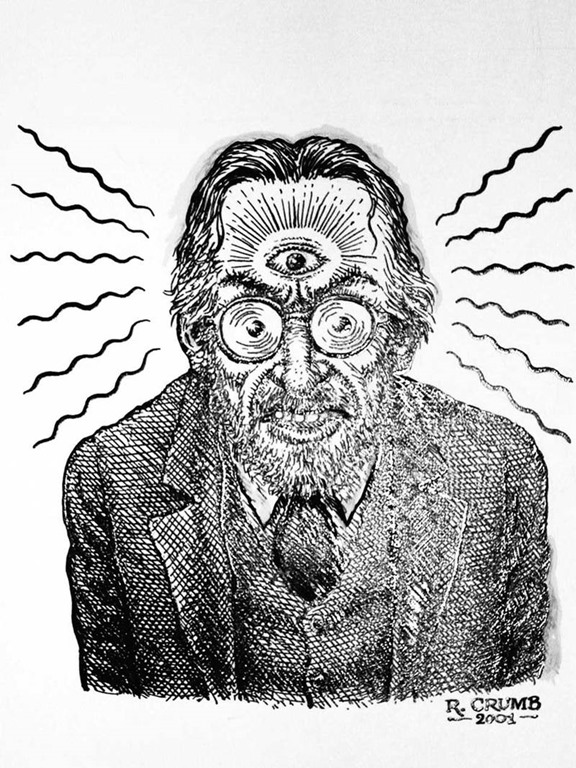
I’ve been an R. Crumb fan for years, and these comments of his about the ongoing ripoff of society by the banks–from a new article in the New York Observer–only deepen my admiration for him:
“…The documentary The Sorrow and the Pity by Marcel Ophuls is one of the best documentaries ever made, just people talking for hours, it’s fascinating, everybody should watch it. The Nazis could have never survived without the help of big banks and corporations, many of them American.If the Weather Underground was bombing banks I’m all for it as long as they weren’t killing too many people,” Mr. Crumb said.
“That was their creed at first, to bomb empty buildings,” I said.
“We should still bomb motherfucking banks,” he said.
“What did you make of Occupy Wall Street?” I asked him.
“I thought it was a worthy effort,” he said.
“I walked through Zuccotti Park and these fools were calling for ‘good’ banks, the church and Thomas Jefferson’s ideals.”
“That’s sad. 2008 was the biggest robbery in history and who goes to jail? Some poor black kid who stole some sneakers at a fucking Wal-Mart if he gets lucky enough to not get shot in the back on his way there,” Mr Crumb said…”






 LIBERTY ROAD MEDIA