“Racial Wallpaper”: Take Down The Rebel Flag

As per usual, it’s hard to beat the commentary of Jon Stewart and his heartfelt take on the Charleston massacre was no exception to that rule.  Stewart absolutely nailed the toxic stew of poverty, paranoia, and white supremacy–masked with slogans like “heritage, not hate”—that cling to and suffocate the minds of many in the Deep South like the humidity the region is infamous for:

“This wasn’t a tornado. This was a racist,” Stewart said of Roof. “This was a guy with a Rhodesia badge on his sweater. I hate to even use this pun, but this one is black and white. There’s no nuance here.”

He also tore into what he described as the prejudice steeped into the culture, noting that several roads in South Carolina are named after Confederate generals, who fought a war to keep black people from being able to use them.

“That’s insanity. That’s racial wallpaper,” Stewart said. “You can’t allow that. Nine people were shot in a black church by a white guy who hated them, who wanted to start some sort of civil war. The Confederate flag flies over South Carolina, and the roads are named for Confederate generals. And the white guy’s the one who feels like his country’s being taken away from him.”

Having spent most of my life thus far in the other state that still flies the rebel flag (or Confederate battle flag, as many in the area are wont to point out)—Mississippi, which actually uses that flag as part of its state flag to this day—I can attest that Stewart’s comment about “racial wallpaper” is a precise identification of the problem.  It’s an intentional poisoning of the well, sowing the seeds of white racial superiority with each new generation.  Which is why back in 2000/2001, there was a push in Mississippi to have the rebel flag removed from the state flag, replacing it with a new design.

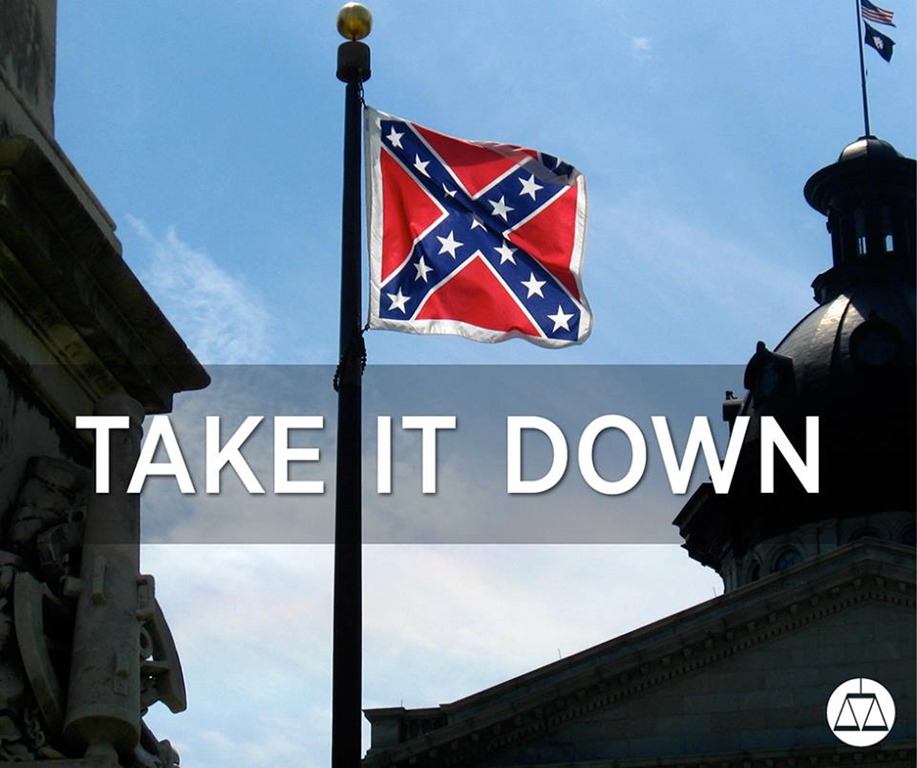
During that campaign, I wrote a song called “Take Down The Rebel Flag” which talked about Mississippi and South Carolina and which I hoped would be used as a sort of “We Shall Overcome” for the anti-racial wallpaper crowd.  It never was, although it did get a decent write-up in the local paper and my band Buffalo Nickel recorded it for our first album “Up on Blocks”.  I was reminded of the song’s applicability to the Charleston situation when I saw that someone had posted a meme on Facebook with the words “Take It Down” over a picture of the rebel flag flying in the breeze.

Take It Down

The song says exactly that:

Take down the rebel flag/Burn it instead of crosses/Let’s cut our losses/and take down the rebel flag

Life in Mississippi’s/bad enough for hippies/even worse if I weren’t white/who cares about colors/all men are brothers/get Jackson to do something right

Take down the rebel flag…

In South Carolina/life could not be finer/for sons of the Confederacy/rebellion is swell and rebellion sure smells when /it’s against common decency

Take down the rebel flag…take it down

The Southern Cross sure looks great/to some Southern natives/like a swastika makes a Nazi feel alive/But some of us just can’t relate/to a flapping symbol of endless hate/hey, the Civil War ended in 1865

It’s time to take down this ugly racial wallpaper, y’all.

Posted in freedom, history, racism, Terrorism, Tyranny | Tagged , , , , , , , , | Leave a comment

All Debt Is Odious: Greek Report Gets It Mostly Right

Grexit on, Grexit off…Grexit on, Grexit off…that’s been the story for a while now, but could a new report by the Debt Truth Committee of the Hellenic Parliament which declares that Greece’s debt to the Troika is odious flip the Grexit switch into a permanent “on” position?

If a debt is deemed to be “odious,”  it doesn’t have to be repaid.  Investopedia explains:

“Money borrowed by one country from another country and then misappropriated by national rulers. A nation’s debt becomes odious debt when government leaders use borrowed funds in ways that don’t benefit or even oppress citizens.”

Perfectly acceptable definition, but it doesn’t go far enough.  That is to say, it only applies to governments/countries/nations/states.  It pointedly does not apply to individuals.  But why shouldn’t it?  As you read the excerpts below from the executive summary of the Hellenic Parliament’s Truth Committee on Public Debt, notice that the very same logic that is used to declare Greece’s debt to be odious holds true for individual debt, too.  Especially when you remember—or realize for the first time if you’ve never heard it before—that all of these “loans” were created out of thin air, which is a shorthand way to say that the money to fund the loans did not exist prior to Greece requesting it.  Works exactly the same way for individuals, as discussed in many articles here at LRM.

Below I’ve just selected quotes that highlight all of this, from this copy of the Truth Committee’s report at Zero Hedge:

“It has also come to the understanding of the Committee that the unsustainability of the Greek public debt was evident from the outset to the international creditors, the Greek authorities, and the corporate media. Yet, the Greek authorities, together with some other governments in the EU, conspired against the restructuring of public debt in 2010 in order to protect financial institutions.” 

That’s the point of all of these fake loans, fake and odious debt—to protect financial institutions, particularly at the expense (pun intended) of the people.

“…the increase in [Greece’s] debt was not due to excessive public spending, which in fact remained lower than the public spending of other Eurozone countries, but rather due to the payment of extremely high rates of interest to creditors, excessive and unjustified military spending, loss of tax revenues due to illicit capital outflows, state recapitalization of private banks, and the international imbalances created via the flaws in the design of the Monetary Union itself.

“State recapitalization of private banks” obviously is a more accurate term for a “bailout.”  Again, this is all about protecting financial institutions, not people.  The taxpayers are forced to make the banks whole while the taxpayers themselves are told they’ve been profligate and therefore must be subject to austerity measures.

“…the measures implemented under the “bailout programmes” have directly affected living conditions of the people and violated human rights, which Greece and its partners are obliged to respect, protect and promote under domestic, regional and international law. The drastic adjustments, imposed on the Greek economy and society as a whole, have brought about a rapid deterioration of living standards, and remain incompatible with social justice, social cohesion, democracy and human rights.”

Exactly—the banks get bailed out, the people get shaken down.  This is not just in Greece—it’s everywhere.

“The debt to private creditors should be considered illegal because private banks conducted themselves irresponsibly before the Troika came into being, failing to observe due diligence, while some private creditors such as hedge funds also acted in bad faith. Parts of the debts to private banks and hedge funds are illegitimate for the same reasons that they are illegal; furthermore, Greek banks were illegitimately recapitalized by tax-payers. Debts to private banks and hedge funds are odious, since major private creditors were aware that these debts were not incurred in the best interests of the population but rather for their own benefit.”

That last sentence perfectly sums up my point above, since it is always true both for nations as well as for individuals: private banks are always “aware that…debts [are] not incurred in the best interests of the population but rather for their [that is, the banks’] own benefit.”  And so we see that this document ends up saying exactly the same thing over and over, but in slightly different ways, which is basically comes down to this: the banks have been allowed to run amok, allowed to pretend that what they were/are doing is legal and helpful, and we are totally calling bullshit on that.  My only gripe is that, as stated above, this logic ought to transfer to private debts as well, since they work in exactly the same way.  But that leap never seems to be made, even in a document as apparently revolutionary as this one.

GIABO!  Grexit! Jubilee!  Self-issued currency—this is the answer.

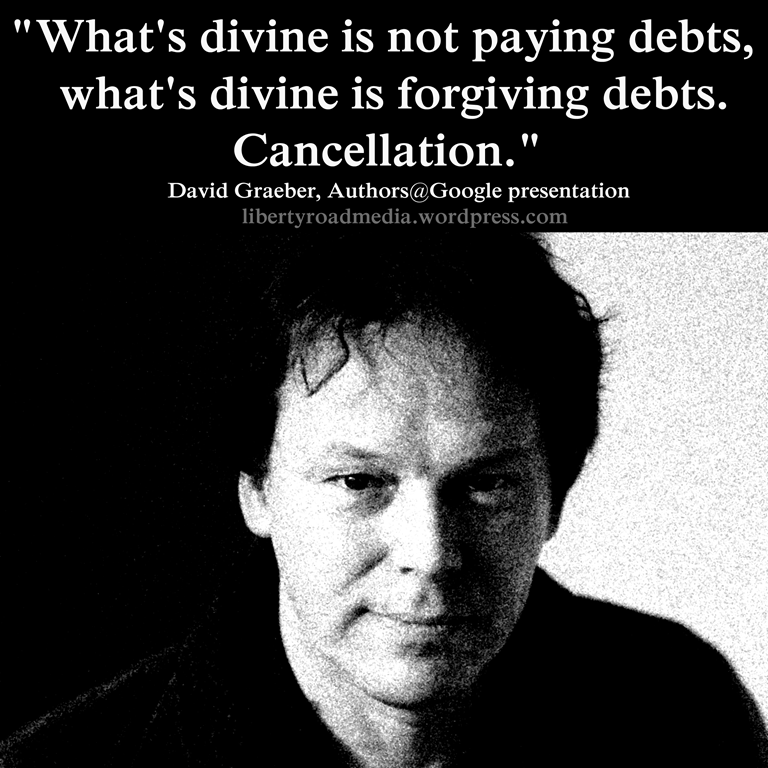
Divine is forgiving debts meme copy

Posted in Conspiracy, Crap-italism, Debt, Debt Slavery, Everything Is Rigged, fiat currency, Financial Terrorism, Financialization, Redistribution, Rent-seeking, Rentier, Reverse socialism, Tyranny, Wealth transfer | Tagged , , , , , , , , | Leave a comment

Mantras of Slavery, Mantras of Freedom

Chris Hedges gets it so right in his latest piece (latest piece I’ve read, anyway) for Truthdig.  While the piece is ostensibly about the farce elections in America, Hedges can’t help but get in as many digs at the system as he possibly can (which is a good thing if you ask me).  One particular dig involved something I’ve been wanting to write about for a while, and I hadn’t thought to use the word he used—“mantra”—but Hedges explains what I had been thinking very well:

“Neoliberal ideology infects every institution and belief system. Those who suffer deserve to suffer. Victims are responsible for their victimhood. We can all achieve wealth and prosperity with hard work. This mantra permits us to be cruel and heartless to the weak and the vulnerable, especially the poor as well as women and children, whom we discard as human refuse. Our warped neoliberal vision is defined as progress. ”

Not an original insight, necessarily, but still a very powerful one.  And that word “mantra” nails it.

What is a mantra?

I really like The Free Dictionary’s definition of the word “mantra”:

A sacred verbal formula repeated in prayer, meditation, or incantation, such as an invocation of a god, a magic spell, or a syllable or portion of scripture containing mystical potentialities.”

A sacred verbal formula, repeated.  And repeated.  And repeated.  Hedges mentions 3 of them: 1) those who suffer deserve to suffer; 2) victims are responsible for their victimhood; and 3) wealth and prosperity are available to everyone with hard work.  Those are all good examples of sacred verbal formulas which are drummed into our consciousness over and over at school, at church, in the media, and everywhere else until we start repeating these mantras in our own heads, imagining that we came to these conclusions ourselves rather than being forcibly led to them.  And of course, these mantras are really not sacred to us—they are instead sacred to those who would control us.  We tend to treat them as sacred because they are repeated so frequently and so imperceptibly that they do seem to be basic truths of the universe.

Something for nothing and respect for authority

The mantras I had been wanting to write about—without calling them that in my thinking until I read the Hedges piece—are these two: 1) no one should get something for nothing; and 2) people ought to have respect for authority.  I wanted to write about them after I heard an unbelievable interview with a white female resident of the Craig Ranch subdivision in McKinney, TX following the indefensible behavior of Officer Eric Casebolt.

I actually have written a little bit about the conundrum of something for nothing:

“The other big reason has to do with the principle of “something for nothing.”  We are all taught from essentially birth that getting something for nothing should not be allowed, that we must work (i.e. perform some sort of labor) in exchange for the things we want or need.  This is a universal principle, and one that those in control of the money supply have always endeavored to subvert.  With the advent of fractional reserve banking, the subversion was complete and therefore banks are allowed to get something for nothing–i.e., money and property along with all the benefits of having those things–while citizens are barred from doing so.  Yet it is the money and labor of the citizens that allows the banks to get something for nothing.

We are allowing ourselves to live under a system in which banks SELL us money (called “interest”) that WE create for them.  That is, it is our deposits and promises to pay that allow banks to “lend” in the first place, yet they have the chutzpah to charge us for lending that same money back to us (or to our fellow citizens).   And this is the genius of fractional reserve banking (from the perspective of the banks, of course): it is merely a system which allows banks to get something for nothing while preventing the people who perform the actual labor from doing the same thing.”

To me, that’s one of the founding myths of modern finance—indeed, of the harmful fiction that we know today as “money”—that no one should get something for nothing (even though everyone gets everything they really need–life, five senses, body, mind, oxygen, sunlight, etc.–for nothing).  So therefore, what proceeds from that premise is that we should all perform labor for someone else to earn imaginary chits created by a handful of powerful people in order to have legal access to even the basics of life.  This arrangement necessarily leads to the creators of the imaginary chits getting the very thing they’re supposed to be trying to keep us from getting, but since the “something for nothing” mantra has taken such deep root, hardly anyone even notices that is happening.

And I realized, as I watched the interview with the Craig Ranch lady, that she was uttering another mantra of slavery, i.e., that we must have “respect for authority.”  Here is the video where she says it (approx. 1:00 ):

“…he was not out of line…I completely support him drawing his weapon…I think he deserves a medal for what he did…those kids were taunting them and cursing them out, have no respect for authority…[the kids’ parents] didn’t even care one bit about how [the kids] were treating the officers…”

Could there be a more perfect encapsulation of the mindset of a slave?  That the threat of deadly force is justified even against unarmed children merely for speaking to an “authority” figure in some way that the authority figure didn’t like?  No wonder this country is in such trouble—people like this condescending woman have internalized the mantras of slavery.

Hedges, on the other hand, gives us the seeds for mantras of freedom:

Every action we take now must be directed at ripping down the structures of the corporate state. This means refusing to co-operate. It means joining or building radical mass movements. It means carrying out sustained acts of civil disobedience, as Kayactivists are doing in Seattle and fishing communities such as Kodiak, Cordova and Homer, as well as a dozen indigenous tribes, are doing in Alaska, to physically halt fracking, drilling for oil and natural gas or U.S. Navy training exercises in the pristine waters of the Arctic. It means striking for a $15 minimum wage. It means blocking city streets to demand an end to the indiscriminate use of lethal force by militarized police, especially against poor people of color. It means, in large and small ways, acts of open rebellion. It means always having as the primary objective the disrupting and overthrowing of corporate power. It means not playing the game.

My mantras of freedom? Radical equality! When freedom’s illegal, gotta be an outlaw!  Resistance is victory!

Be An Outlaw Sound Cloud

Click for my tune “Be An Outlaw”–the theme song for the “One Mom On A Borough” (http://www.blogtalkradio.com/onemomonaborough) show!

Posted in civil rights, Debt Slavery, freedom, Police State, Resistance, Wage slavery | Tagged , , , , , , , , | Leave a comment

FAKE MONEY THEN AND NOW: IRELAND EDITION

Irish flag

Two pieces of information have struck me recently, both concerning Ireland at first glance, but really concerning all of humankind when you really think about it.  Let me discuss the second piece of info first, which is summed up quite nicely by the headline to a piece in the Irish Independent:

“Banks issue legal proceedings to repossess 50,000 homes”

From the article:

“New figures provided by Central Bank Governor Patrick Honohan show that half of what is being classed as solutions for those in arrears are made up of threats to repossess homes.

Some 100,313 residential mortgage holders in default were offered a proposed solution. But 49,000 of these were issued legal letters, seeking repossession.

The Central Bank allows the lenders to count legal proceedings seeking repossession as a mortgage solution.

These letters are issued when the mortgage holder is not engaging with the bank, or the bank decides that the mortgage is unsustainable as the borrower will be unlikely to meet the repayments.”

So this is what the “end of austerity” looks like?  Half the people in “default” were offered a “solution” that was simply a threat to foreclose on them?

The reason this is so screwed up is twofold:

1) All the money that was “loaned” to these homeowners who are being threatened was made up out of thin air, a shorthand term for self-issued currency that is legally treated as being issued by a bank—in other words, the money didn’t even exist until an Irish borrower wrote the bank a check which the bank deposited into an account as if it were cash.  This is what is called a “loan” in the modern, predatory finance system.  The check written by the “borrower” to the bank is legally called a “promissory note,” but that is only to confuse the “borrowers” to make them think the bank actually loaned them money rather than the other way around.  And so the check is deposited, which means it is a “loan,” because loans are deposits.  And deposits are loans.  Not in reality, of course.  In bank-fake-fraud-debt-slavery world.

2) Ireland knows, or should know, that fake money that is known to be fake—i.e.,  what I have written about a number of times as “self-issued currency” doesn’t create problems—it solves them.  Ireland should know this because this is exactly what they did in the so-called “Irish Banking Crisis” of 1970 (the year before the Nixon Shock, interestingly enough)—used fake money that everyone knew to be fake.  That event is the first piece of information I referred to above.

Irish Banking Crisis of 1970: Self-Issued Currency proven to work

Here’s a pretty good synopsis of what happened, according to an article in the Harvard Business Review:

Once upon a time, there was a country where bankers disappeared. The bankers, fed up with regulation, dissatisfaction, and downright hostility, decided to unleash the planet-destroying superweapon in their arsenal: they went on strike, not once, but three times.

Here’s what orthodox economics would have predicted for a country without banks: A collapse in the money supply, a credit crunch, a trade implosion, mass unemployment, an atomized GDP, and the gears of industry and commerce grinding to a crashing halt. Imagine all the veins in your body suddenly shrinking and collapsing — Avada Kedavra!! — and you might begin to see how economists conceive of banking shutdowns.

This is no fairy tale, so we don’t have to imagine what happened next. And what did come next was something really, really interesting — and just a little bit awesome. Instead of Ragnarok ripping prosperity to shreds, the economy continued to grow. Though the money supply did contract sharply, neither trade, commerce, nor industry came to a grinding halt.

How? People created their own currencies, to substitute for the collapsing money supply. They kept using checks to pay one another, but then, people’s checks began trading within communities. Here’s how Antoin Murphy, one of the few scholars to have studied these strikes, which took place in the 1970s, describes it: “a highly personalized credit system without any definite time horizon for the eventual clearance of debits and credits substituted for the existing institutionalized banking system.”

Notice that last part again: people “created their own currencies” and “kept using checks to pay one another.”  This is exactly what I have prescribed as the solution in my articles on self-issued currency:

“The solution to these problems, then, is self-issued currency. That is, every citizen in a fiat system ought to have the ability to issue his or her own money, up to any amount needed.  …when self-issued currency becomes the norm, paying money will be as easy and as painless and as much as an afterthought as saying “Thank you” is now.

[SNIP]

It is beyond dispute that money can be–and has been–anything: gold, paper, shells, sticks, salt, binary code, cigarettes, fabric, etc., etc.  So it stands to reason that money can (and arguably ought to) be the following:  a check written by a buyer for any amount requested by a seller and drawn on a fictional, non-existent account.   In other words, self-issued currency.  And everyone would have this same check-writing power.”

I should point out that I came to the “self-issued currency” idea without any knowledge of the Irish Banking Crisis, where people did exactly as I have proposed above.  And I say that not to say that I am so smart or any such thing—I bring it up because if a relative economic neophyte like me can come up with a solution that not only could work but also actually has worked, that must mean that the idea of self-issued currency is a very simple, rational, obvious conclusion to reach.  I mean, what other conclusion can you really come to when you realize that money is always fictional and created out of nothing and want to solve the problem of never-ending debt slavery?  Not banning cash—that’s draconian and end-times-ish (you don’t hear many people talking in hushed tones about “the cashless society” these days).  Not repossessing 50,000 homes—that’s just theft.

And in the same way that the idea of banning cash keeps being bandied about (more seriously than ever of late), so does the idea of a basic income, or a basic guaranteed income, such as what’s described here in The Atlantic:

Santens is 37 years old, and he’s a leader in the basic income movement—a worldwide network of thousands of advocates (26,000 on Reddit alone) who believe that governments should provide every citizen with a monthly stipend big enough to cover life’s basic necessities. The idea of a basic income has been around for decades, and it once drew support from leaders as different as Martin Luther King Jr. and Richard Nixon. But rather than waiting for governments to act, Santens has started crowdfunding his own basic income of $1,000 per month. He’s nearly halfway to his his goal.”

That’s a much better idea than banning cash, to be sure, but it’s unnecessary.  It’s like a halfway point between what we have now and self-issued currency.  But self-issued currency is not a difficult road, as demonstrated by Ireland.  In fact, it’s a very easy road because the only difference between self-issued currency and what we have now is one simple concept, i.e., that banks and not people create the currency.  Once we can accept the fact that the people (i.e., you an me) already self-issue currency (every time we take out a “loan” or use a “credit” card), we can easily agree that we ought to legally acknowledge that such is the state of things and do away with the idea that a bank creates money by accepting a check (i.e. promissory note) from a borrower that the borrower then owes to the bank.

P.S.: There’s a much better description of the Irish banking situation in the book “Money: The Unauthorized Biography” by Felix Martin, but I can’t quote from it just now because I don’t have a copy on me at the moment.

Posted in Crap-italism, Debt Slavery, Everything Is Rigged, fiat currency, Financialization, Nixon Shock, self-issued currency | Tagged , , , , , , , , , , , , , , , , , | Leave a comment

“Welfare State for the Banking System,” Not You and Me

Stacy Herbert nails what is wrong with the current order of things:

“(approx. 7:38) This is the class war that Warren Buffett, one of the richest men in the world, has talked about–that his class is winning.  And part of it is because they’ve been able to push the risk onto the public.  And part of that is getting rid of the welfare state which used to protect these people.  Instead they have a welfare state for the banking system…”

This explains it all—the austerity, the foreclosure fraud, the bailouts, the fines instead of jail time.  It is simple misdirection, that time-honored technique of the street magician.  The corporate media—financed by its banking masters–has been trying to convince us for years that it is we the people who are the deadbeats, welfare queens, useless eaters, parasites, do-nothing leeches dragging down society when in fact it is the banking system to which all that invective really applies.

It’s like Gore Vidal (and others) have said:

Vidal-Free Market for Poor copy

In other words, this society we live in is purposely engineered—in plain terms, rigged—in favor of the wealthy—that is, those who are given the free money and/or can create the free money–but we are taught to believe that it is egalitarian.  And that is the fight that those of us who have seen through this misdirection face: convincing the rest of the people that we are essentially living a lie.  Which brings us to Neil Garfield and Living Lies, which recently featured a great article explaining the nature of the lie:

“Once upon a time a single income household could provide a decent lifestyle. Household income was solid and so was savings. Then something happened…the American economy was completely undermined by a simple fact: in an economy based 70% on the spending by consumers, the consumers didn’t have any money. The “fix” was to offer credit on an increasingly stupid basis to replace real earnings, real savings and real household wealth, and real household income. Instead, household debt increased gradually and then more stupendously in the late 1990’s and the lead up to the 2008 crash.”

[SNIP]

“It is all traceable to the decision in most companies to reduce or freeze wages and let the government make up the rest with food stamps or the banks make up the difference in available credit. This insanity looks good on paper at the beginning. But in the end, households run out of money, families break apart, people lose their homes to fraudulent foreclosures, while government adopts a policy that basically says that regardless of how the public was duped into accepting credit (under duress) in lieu of normally increasing wages, it is always the “borrower” who must bear the full weight of these mistaken policies and the failure of the American worker to make ends meet.”

Exactly—you are expected to take “personal responsibility” while the banks do not have to do any such thing.  You are allowed (if not forced) to “default,” while the banks are “too big to fail” and will never be allowed to default.  And why is that?  Because the government (which is really the banks themselves in disguise) requires you to make sure a bank default doesn’t happen, by paving the way for the banks to take your real assets (i.e. through foreclosure, other types of repossession), charge you the highest possible interest (while banks themselves enjoy ZIRP), and so forth.  This is done while the courts engage in the most awkward feats of legal gymnastics, which is the only way that this sort of thing can continue.

Garfield’s conclusion is spot-on:

“Going back to the previously successful policy of giving workers a fair share of the pie is the ONLY way out of this mess. Henry Ford understood that at the start of our economic revolution in America. He doubled worker wages while other car makers decried the move as suicidal. But he was right. He created a middle class that could afford to buy a lot of cars. By increasing wages, the workers were spending money throughout the communities in which they lived. Ford had both created and tapped into what we would later refer to as a consumer economy that drove 70% of GDP.”

Posted in Crap-italism, Debt Slavery, Everything Is Rigged, Financialization, Foreclosure fraud, Keiser Report, Living Lies, Reverse socialism, ZIRP | Tagged , , , , , , , , , , , , | Leave a comment

Banks Nabbed for Robbing You and Me: Conspiracy “Theory” Proven To Be Conspiracy Fact

Loretta Lynch and the Department of Justice just have their tinfoil hats on a little too tight, I guess.  Or could it be that yes, there really was a conspiracy?  The Attorney General used that word multiple times in her press conference:

They finally got the banks to admit that they’re criminals and that they really do rig markets (“Rigging of Foreign Exchange Market Makes Felons of Top Banks,” New York Times, 5/20/2015):

“On Wednesday, four large global banks — Citigroup, JPMorgan Chase, Barclays and Royal Bank of Scotland — pleaded guilty to a series of federal crimes over a scheme to manipulate the value of the world’s currencies. The Justice Department accused the banks of collusion in one of the largest and yet least regulated markets, noting that at one bank one trader remarked ‘the less competition the better.’

That lack of oversight, coupled with the pressure to squeeze profits from a relatively middling business, set the stage for this scandal, one that unfolded nearly every day for five years. The crimes described on Wednesday also painted the portrait of something more systemic: a Wall Street culture that enabled many big banks to break the law even after years of regulatory black marks after the crisis.

‘If you aint cheating, you aint trying,’ one trader at Barclays wrote in an online chat room where prosecutors say the price-fixing scheme was hatched.”

Did this affect you and me personally, here in the U.S.?  One might wonder because the nature of the banks’ crime is often described in such vaguely non-aspersion-casting terms as “illegally distorting foreign exchange markets.”  That certainly is one way—albeit the least damning as well as the least interesting—to describe what happened.

But yes, it did affect you and me personally, here in the U.S.  In short, we were robbed—the banks robbed us.  Here’s how the Attorney General put it:

“For more than five years, traders in ‘The Cartel’ used a private electronic chatroom to manipulate the spot market’s exchange rate between euros and dollars using coded language to conceal their collusion.  They acted as partners – rather than competitors – in an effort to push the exchange rate in directions favorable to their banks but detrimental to many othersThe prices the market sets for those currencies influence virtually every sector of every economy in the world, and their actions inflated the banks’ profits while harming countless consumers, investors and institutions around the globe – from pension funds to major corporations, and including the banks’ own customers – who placed their faith in the market and relied on it to produce a competitive exchange rate.”

So how did they rob us, exactly?  By rigging the price of currencies, including the dollar, resulting in you and me paying more for goods and services than we would have had to pay in the absence of such rigging.  In other words, the so-called “free market” that is supposed to set prices fairly does not exist.  If the price of the currency itself is rigged, then the prices of the things that the currency is used to buy will necessarily be rigged.

Most of the stories I’ve seen on this topic focus more on the fact that these banks did something bad and got caught and that the government really is looking out for us.  They tend not to focus on how what the banks did actually affected you and me.  And quite frankly, if the government really were looking after us, why did they not use their supposedly awesome and all-pervading surveillance powers to root this out a long time ago?  After all, this scheme was carried out using online chat rooms.

The real conspiracy

This is all well and good of course, as far as it goes.  But the real conspiracy is that while we the people actually create our own currency, we are forced by law to treat it as though it was borrowed from a bank.  This is of course so the banks and the governments owned by said banks can control us.  It’s really quite nasty business and needs to be changed, but not by banning cash (as is now being suggested again and even more loudly than before) or by some other bank-driven, top-down, superficial tweak to the current system.

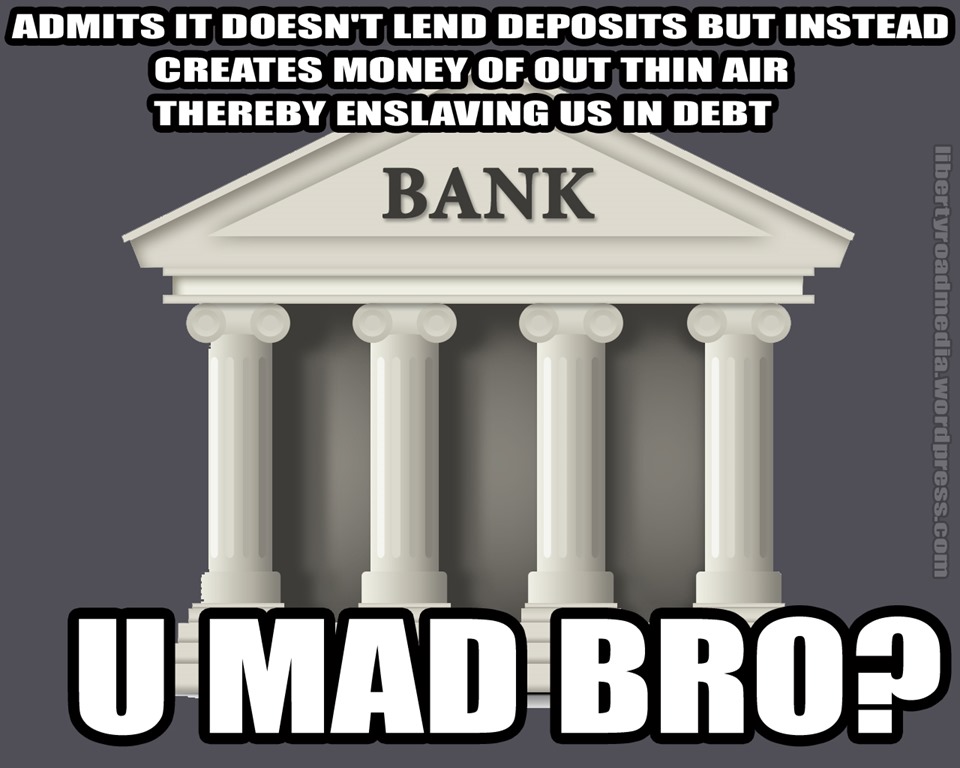
BANK-u mad bro

The simplest and best change is legal recognition of the fact that all currency is issued by people and not by banks, meaning that banks do not loan to people and that banks should therefore have no legal right to control people by limiting their access to funds or by stealing their physical assets because of supposed “default” on “repayment” of money that was created by the person, not “loaned” by a bank.  The shorthand term I have used for this principle is “self-issued currency” and/or “the Air Standard”:

The solution to these problems, then, is self-issued currency.  That is, every citizen in a fiat system ought to have the ability to issue his or her own money, up to any amount needed.  This will solve both of the problems above, because when self-issued currency becomes the norm, paying money will be as easy and as painless and as much as an afterthought as saying “Thank you” is now.  Problem one solved.  And obviously problem two is solved because there would be no monopoly on the issuance of currency, hence no unnecessary control over anyone or anything, either by the state or by the issuer of the state’s currency.

For those that might recoil in horror at such an idea, keep in mind that all money is fictional.  In fact, all money is already self-issued, as will be shown below.  Money must be created by someone, somewhere, because money does not exist in nature–except to the extent that a natural item like gold or salt might be assigned the properties of money.  Despite what the typical Western economics professor might say, money does not just naturally come into being as a consequence of people needing to exchange things.  Indeed, as Bartolome de las Casas observed of the native Cubans in the 16th century:

“…[the natives] put no value on gold and other precious things. They lack all manner of commerce, neither buying nor selling, and rely exclusively on their natural environment for maintenance. They are extremely generous with their possessions and by the same token covet the possessions of their friends and expect the same degree of liberality.”

That is to say, money is a creation of man, and as such, it should serve man, not enslave him.  Can it be that the “uneducated,” “pagan,” and “savage” natives of Cuba from centuries ago were more civilized and wiser about economics than we are today?  It certainly would seem so.

And don’t think that the forex market is the only one being rigged:

Big Banks Busted Massively Manipulating Foreign Exchange, Precious Metals … And Every Other Market

The sheer volume of boot-pissing detailed in the article is depressing and exhausting.  Sample just the headings of the sections, all with numerous links to drive the points home:

“Currency Markets Are Rigged

Gold and Silver Are Manipulated

Derivatives Are Manipulated

Interest Rates Are Manipulated

Energy Prices Manipulated

Oil Prices Are Manipulated

Commodities Are Manipulated

Everything Can Be Manipulated Through High-Frequency Trading”

The beautiful thing is that in a self-issued currency system, there would be no point in rigging prices because everyone would have the exact same access to the currency.  So whether the price of something is $1 or $1 billion it doesn’t matter, because anyone–from a kindergartner to an oil tycoon–could pay it.

Posted in Chase, Conspiracy, Crap-italism, Domestic Spying, Everything Is Rigged, fiat currency, Financial Terrorism, Price-fixing, Uncategorized | Tagged , , , , , , , , , , , , , , | Leave a comment

Crossfade: Global Financial System Fading Out, So Global Police State Being Turned Up

Crossfade: a radio/DJ term for keeping music and/or the beat going between one song that is ending and another one that is beginning.  Or as Wikipedia puts it regarding how crossfaders are used:

“A crossfader on a DJ mixer essentially functions like two faders connected side-by-side, but in opposite directions. It allows a DJ to fade one source out while fading another source in at the same time.[17] This is extremely useful when beatmatching two sources of audio (or more, where channels can be mapped to one of the two sides of the crossfader individually) such as phonograph records, compact discs or digital sources.”

The powers that be are acting like a DJ—as the global financial system fades out, they’re fading in the global police state.  First, as David Stockman points out, the global financial system is headed for certain collapse:

What I think we are facing now is a terminal phase of a monetary system that isn’t viable, stable or sustainable.  Therefore gold has but one characteristic — massive upside in the years ahead.

(We here at LRM disagree somewhat with that last bit—gold is nice and all but is still a fiat currency.  The real solution, as we see it, is self-issued currency.)

Second, there’s that ominous quote from newly re-elected British Prime Minister David Cameron, which tells us that the police state is only going to get worse (the police state is being faded in, getting louder):

“For too long, we have been a passively tolerant society, saying to our citizens: as long as you obey the law, we will leave you alone.”

However, as Max Keiser points out below, it is actually we the people who are the ones that have been passively tolerant of all this for too long.  The social contract is broken, and we need to do something about it post-haste:

As Keiser says (referring to Cameron’s quote) in the video above at approximately the 1:59 minute mark:

“This is a fundamental break of the social contract.  As John Locke warned: ‘When the social contract is broken, the people must revolt.”

Keiser is of course obviously paraphrasing this famous passage from Locke’s Two Treatises of Government:

“…whenever the legislators endeavor to take away and destroy the property of the people, or to reduce them to slavery under arbitrary power, they put themselves into a state of war with the people, who are thereupon absolved from any farther obedience, and are left to the common refuge which God hath provided for all men against force and violence.

Whensoever, therefore, the legislative shall transgress this fundamental rule of society, and either by ambition, fear, folly, or corruption, endeavor to grasp themselves, or put into the hands of any other, an absolute power over the lives, liberties, and estates of the people, by this breach of trust they forfeit the power the people had put into their hands for quite contrary ends, and it devolves to the people, who have a right to resume their original liberty, and by the establishment of a new legislative (such as they shall think fit), provide for their own safety and security, which is the end for which they are in society.”

It may sound radical now, but that was the founding principle of this country—that revolution is the people’s right when officials (i.e., “legislators” as Locke refers to them) want to wield “arbitrary power” that becomes “absolute power over the lives, liberties, and estates” of we the people.  There is nothing more American than that.  There is nothing more American than rejecting tyranny.

Posted in Crap-italism, Everything Is Rigged, Keiser Report, Police State, self-issued currency, Too big to fail, Tyranny | Tagged , , , , , , , , , , , | Leave a comment

Police State Defenders Wrong About Everything Related to Freddie Gray Case: 6 Baltimore Cops Charged

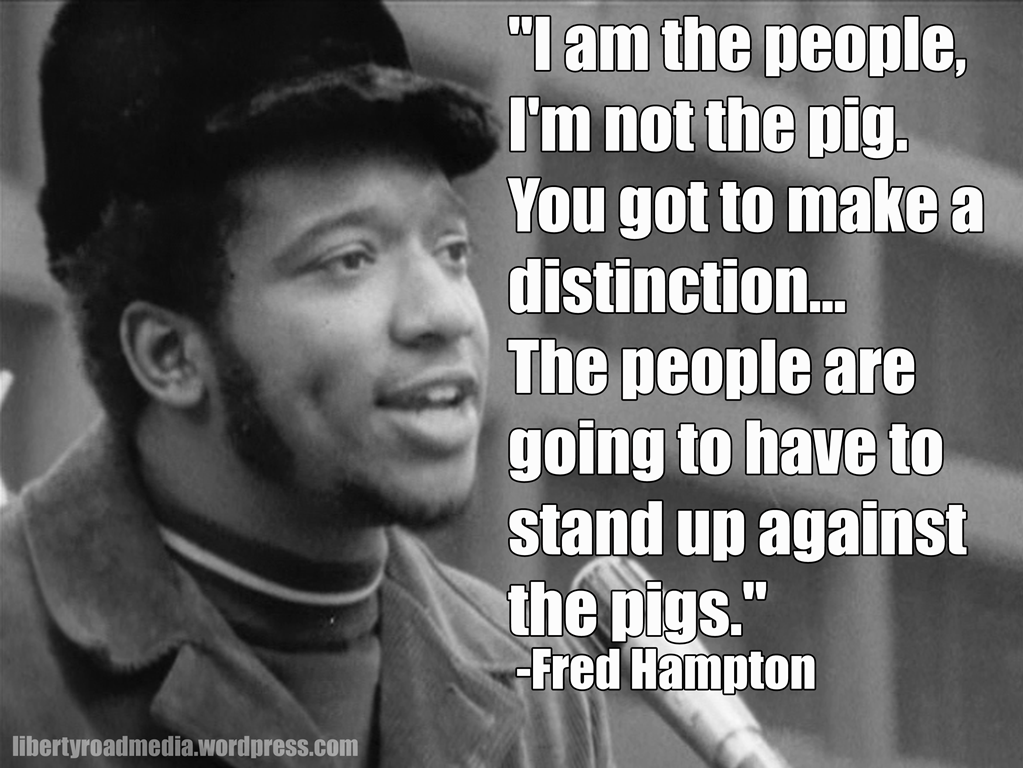
Fred Hampton I Am The People copy

No one should be surprised that these Baltimore cops are being charged with murder, according to the New York Times:

“Baltimore’s chief prosecutor charged six police officers on Friday with crimes including murder and manslaughter in the arrest and fatal injury of Freddie Gray, a striking and surprisingly swift turn in a case that has drawn national attention to police conduct.”

Not only that, but it turns out—predictably, to those who have informed themselves enough to know to not worship the police state and actively seek to overturn it–every major detail of the Freddie Gray story propounded by the defenders of the police state–switchblade, pre-existing spinal injury, arrested for probable cause—was completely wrong.  Untrue.  Speculation.  Wishful thinking on the part of the statists.  Again from the NYT story:

“Ms. Mosby said that Mr. Gray suffered a fatal spinal injury on April 12 while being transported in a police van — and not earlier, while being arrested — and pointed to the failure of the police to put a seatbelt on him as a crucial factor. ‘Mr. Gray suffered a critical neck injury as a result of being handcuffed, shackled by his feet and unrestrained inside the BPD wagon,’ she said, referring to the police van.

[SNIP]

The prosecutor also said that the officers who initially arrested Mr. Gray had done so illegally, without probable cause. Officers charged him with possession of a switchblade, but Ms. Mosby said,  ‘The knife was not a switchblade and is lawful under Maryland law.’

In short, the police killed Freddie Gray, just like the protestors always said.  And now we see what happens when you rise up against the police state—justice, or hopefully the beginning of it in at least this one isolated case, being done.  As Fred Hampton said, referenced in the meme at the top of the story: “The people are going to have to stand up against the pigs.”  Because look what can happen when you do.  If not for the video of Gray’s arrest and the massive protests, it’s doubtful that anybody—certainly not any cops—would be charged with anything.  Let that be a lesson to us all.  The police state is certainly going to factor that in to their strategy in the future, you can count on that.

Will we hear apologies from the Sean Hannitys and Bill O’Reillys and their ilk?  Don’t make me laugh.  That’s why no one should listen to such people—they are bought and paid for by the police state of the banksters.  Hopefully incidents like these will continue to nail shut the coffins of their dying careers.

Posted in civil rights, Police State, racism | Tagged , , , , , , , , | 1 Comment

May Day 2015: 5 Reasons Working People Are Pissed…

A repost from last year…ain’t a damn thing changed, so I just changed the year, changed the title a little, but other than that—it’s exactly the same.  Nothing changes on New Year’s Day.  How long must we sing this song?  Hopefully by next May Day one of these points will have altered significantly enough to demand a new article…

So it’s International Worker’s Day…to paraphrase D. Boon from the video above, I’ll put it in simple words why working men (and women) are (or should be) pissed…

1. Banks got bailed out by workers while banks continue to prey upon workers.  This predation takes a number of forms, with one of the most egregious being the rampant foreclosure fraud.

2. Banks get free money while workers have to actually perform labor for theirs.  This works in a number of ways, with two of the most galling being: a) the fact that banks can create money out of thin air–without having to perform any labor or take any risk at all and b) quantitative easing (QE), which is a gift of money (i.e., bailout) from the central bank to commercial banks.  Of course this money is also created out of thin air with no labor involved and no risk being taken, and that lays the groundwork for the ultimate form of moral hazard.  Don’t believe that this is money created from nothing?  If you won’t believe me, you might believe The Economist magazine, which explains QE thusly:

“To carry out QE central banks create money by buying securities, such as government bonds, from banks, with electronic cash that did not exist before. The new money swells the size of bank reserves in the economy by the quantity of assets purchased—hence “quantitative” easing.”

3. Wages are stagnating while inflation continues to explode.  Here’s how the Washington Post put it:

Wages for millions of American workers, particularly those without college degrees, have flat-lined. Census figures show the median household income in 2012 was no higher than it was 25 years ago. Men’s median wages were lower than in the early 1970s.

Meanwhile, many of the expenses associated with a middle-class life have increased beyond inflation. This includes college tuition, whose skyrocketing cost has laid siege to a bedrock principle of the American Dream: that your children will do better than you did.”

4. Workers pay taxes while giant corporations and banks do not.  From a story entitled “26 top American corporations paid no federal income tax from ’08-’12-report:

Twenty-six of the most powerful American corporations – such as Boeing, General Electric, and Verizon – paid no federal income tax from 2008 to 2012, according to a new report detailing how Fortune 500 companies exploit tax breaks and loopholes.”

5. Having a job does not mean you can afford to live.  This is referred to as being “working poor.”  Salon sums up the situation pretty well here:

“So we’re not sure how to handle the fact that a quarter of people who have jobs today make so little money that they also receive some form of public assistance, or welfare – a proportion that’s much higher in some of the fastest-growing sectors of the workforce. Or that 60 percent of able-bodied adult food-stamp recipients are employed.

Finally, Keiser and Herbert sum it up very well here in a Keiser Report episode entitled “Wealth and Wage Extinction”:

These are just a few of the reasons working people are pissed.  Feel free to list more in the comments below.

Posted in class war, Crap-italism, Debt Slavery, Everything Is Rigged, Feudalism, fiat currency, Financial Terrorism, Foreclosure, Foreclosure fraud, Keiser Report, Paper terrorism, Police State, QE unlimited, Redistribution, Wage slavery | Tagged , , , , , , , , , , , , , , , , | 1 Comment

“Welcome to Freddie and Fannie’s Mortgage Shell Game”: Still As True As The Day It Was First Published

fannie-mae-logo PARODY copy

Due to some recent concerns from well-respected foreclosure fighters concerning this fantastic article from the great Shawn Newman possibly being disappeared from the Internet, we present “Welcome to Freddie and Fannie’s Mortgage Shell Game,” still as true today as it was when it was first published almost four years ago.

Welcome to Freddie and Fannie’s Mortgage Shell Game

By Shawn Timothy Newman, J.D.

Adjunct Professor

Saint Martin’s University

In common parlance, a mortgage (or Deed of Trust) includes the underlying loan (promissory note) and the security on that loan (mortgage or Deed of Trust). This ignores the fact that the note and mortgage (or DOT) are two separate contracts governed by some different laws and legal principals.

As noted in Powell on Real Property, sec. 37.27 [2] (Michael Allan Wolf ed., LexisNexis Matthew Bender 2010)

It must be remembered that the mortgagee has two interests: (1) the debt or obligation which is owned to him, and (2) the security interest in land represented by the mortgage…. In fact, the primary interest is the personalty debt obligation. The interest in land which is available in case security is necessary because of the debtor’s default is considered as collateral interest. Much trouble has been caused by mortgagees attempting to transfer only one of these two interests. Where the mortgagee has “transferred” only the mortgage, the transaction is a nullity and his “assignee,” having received no interest in the underlying debt or obligation, has a worthless piece of paper.

This maxim was adopted by the US Supreme Court in Carpenter v. Longan, 83 U.S. 271, 274, 21 L.Ed. 313 (1873) [“The note and mortgage are inseparable; the former as essential, the latter as an incident. An assignment of the note carries the mortgage with it, while an assignment of the latter alone is a nullity.”]

Regarding #1, the debt is the loan contract (i.e. the promissory note). Promissory notes are governed by the Uniform Commercial Code (UCC) Art. 3 (Negotiable Instruments). The UCC is a uniform law adopted by every state. In addition to promissory notes, negotiable instruments include checks. Like a check, you must negotiate (deliver with proper endorsements) the promissory note to another for that person to claim ownership of the promissory note. Absent proper negotiation of the note, another party cannot claim ownership. So, for example, you find a check made payable to someone else and it is not endorsed to you; you cannot cash it because you are not the owner.

Regarding #2, the security on the debt (i.e. mortgage or deed of trust), is a contractual interest in land with the home buyer designated as the mortgagor and the lender/creditor as the mortgagee. Because a mortgage/DOT is an interest in land, the Statute of Frauds requires such contracts to be in writing and signed to be enforceable. Any assignment of a mortgage or deed of trust must be in writing and signed to be enforceable. Agreements that violate the Statute of Frauds are void and unenforceable as contracts. There are some exceptions to the Statue of Fraud’s writing requirement including an admission in court and under oath “by the party to be charged” that there is a contract (this can be done via discovery). So, as is the case with most mortgages, they are sold by the originating bank (or mortgage company) to either Freddie Mac or Fannie Mae. This is known as the “secondary mortgage market” (secondary, since Freddy and Fannie don’t originate the loans but buy them up from the banks and mortgage companies that do). According to Freddie Mac’s website:

Every day, Freddie Mac provides a continuous flow of funds to mortgage lenders. We do so not by making individual mortgage loans to consumers; instead, we support the U.S. home mortgage market by providing money directly to lenders, ensuring that the system is liquid, stable and affordable. To fulfill this vital mission, Freddie Mac buys residential mortgages and mortgage-related securities and guarantees mortgages made by lenders. We issue debt securities to the global capital markets to fund the purchase of mortgages and mortgage-related securities we hold as an investor. We also create and sell mortgage-related securities to the capital markets, providing a guarantee to investors on those securities.

.…

Freddie Mac pools the mortgages it purchases from lenders across the country and packages them into securities that can be sold to investors. These investors include the lenders themselves, pension funds, insurance companies, securities dealers, commercial and central banks, and others. Freddie Mac also is one of the largest investors in mortgage-related securities, purchasing and holding in portfolio a portion of our own securities and those issued by others.

http://www.freddiemac.com/corporate/company_profile/our_business/securities.html

This brings me to an issue raised by Professor Dale Whitman in his article, “How Negotiability Has Fouled Up the Secondary Mortgage Market, and What To Do About It,” 37 Pepp. L. Rev 738, 757-758 (2010):

While delivery of the note might seem a simple matter of compliance, experience during the past several years has shown that, probably in countless thousands of cases, promissory notes were never delivered to secondary market investors or securitizers, and, in many cases, cannot presently be located at all. The issue is extremely widespread, and, in many cases, appears to have been the result of a conscious policy on the part of mortgage sellers to retain, rather than transfer, the notes representing the loans they were selling.

This “policy” creates fundamental problems with any foreclosure. This “policy” is embedded in Fannie and Freddie’s servicing guidelines. Under their “servicing guidelines,” the servicing bank “may never be identified as the owner of the loan.” See: https://www.efanniemae.com/sf/guides/ssg/svcgpdf.jsp

[Go to last page and click on 2010 Version … Servicing Guide Parts VII and VIII at 801-3 and 801-26 to 28]

First, as noted above, it is important to understand that a mortgage contract is an interest in land and, as such, must be in writing to be enforceable per the Statute of Frauds (or fall within one of the exceptions such as an admission in court). Any “sale” or assignment to Freddy or Fannie must also be in writing per the Statute of Frauds. Some states (like Ohio) require such transfers to be recorded. If you are challenging a foreclosure action, the mortgagor (borrower) should ascertain if a servicer (loan originator or its successor) has sold the mortgage to Freddy or Fannie. This can be done on line at either: https://ww3.freddiemac.com/corporate/ http://www.fanniemae.com/loanlookup/

Chances are Fannie or Freddie “own your mortgage.” If you are in litigation, you should follow up with targeted discovery requests to the servicer confirming the servicer does not “own” your mortgage. Moreover, you should inquire and demand any records showing Freddie or Fannie assigned the mortgage to the servicer. You’ll find that servicers will point to Freddie or Fannie servicing guidelines which basically provide that the servicer forecloses in its (the servicer’s) own name. However, given a mortgage is an interest in land and the requirement under the statute of frauds that such contracts be in writing, the servicer’s standing to foreclose can be challenged absent some proof that the mortgage was specifically assigned by Freddie or Fannie to the servicer. Unless there is a written assignment from the mortgage owner (Freddy or Fannie) to the servicer, the servicer cannot foreclose for the simple reason they are not part of the mortgage contract. Simply put, only the mortgage owner can foreclose on the mortgage contract.

Second, according to Powell on Real Property section 37.27 (quoted above),

It must be remembered that the mortgagee has two interests: (1) the debt or obligation which is owed to him, and (2) the security interest in land represented by the mortgage …. In fact, the primary interest is the personalty debt obligation. The interest in land which is available in case security is necessary because of the debtor’s default is considered a collateral interest. Much trouble has been caused by mortgagees attempting to transfer only one of these two interests. Where the mortgagee has “transferred” only the mortgage, the transaction is a nullity and his “assignee,” having received no interest in the underlying debt or obligation, has a worthless piece of paper.

Given what Professor Whitman describes as a “conscious policy on the part of mortgage sellers to retain, rather than transfer, the notes representing the loans they were selling,” it would appear that any alleged “sale” of the note or mortgage to Freddy and Fannie is a fraud. By analogy, you cannot cash a check that is not in your possession or that is not made payable to or endorsed to you. Not only is the sale of the note a sham where there is no delivery and/or endorsement of the underlying loan/note to Freddie or Fannie, if their records (per the website) “show that Freddie Mac is the owner of your mortgage”, then the unity of interest (i.e. loan/note and mortgage/security must be transferred together) is destroyed leaving Freddie and Fannie with nothing.1

This begs the question: why would Fannie and Freddie have such a policy given the laws governing mortgage contracts and promissory notes? Consider the fact that Freddie and Fannie are Government Sponsored Entities [GSEs] albeit private corporations owned by the major banks. It seems to me that Freddie and Fannie are either the puppet masters or have been willingly hijacked by the major banks and are being used to buy up bad mortgages and then seek a bailout from the taxpayers.

1 http://stopforeclosurefraud.com/2011/08/17/complaint-knights-of-columbus-v-bank-of-new-york-mellon-did-not-acquire-residential-mortgage-backed-securities-but-instead-acquired-securities-backed-by-nothing-at-all/?utm_source=feedburner&utm_medium=feed&utm_campaign=Feed%3A+ForeclosureFraudByDinsfla+%28FORECLOSURE+FRAUD+%7C+by+DinSFLA%29

Posted in Conspiracy, Crap-italism, Everything Is Rigged, Fannie Mae, Foreclosure, Foreclosure fraud, Paper terrorism | Tagged , , , , , , , , , , , , , | 4 Comments